QUESTION IMAGE
Question
question
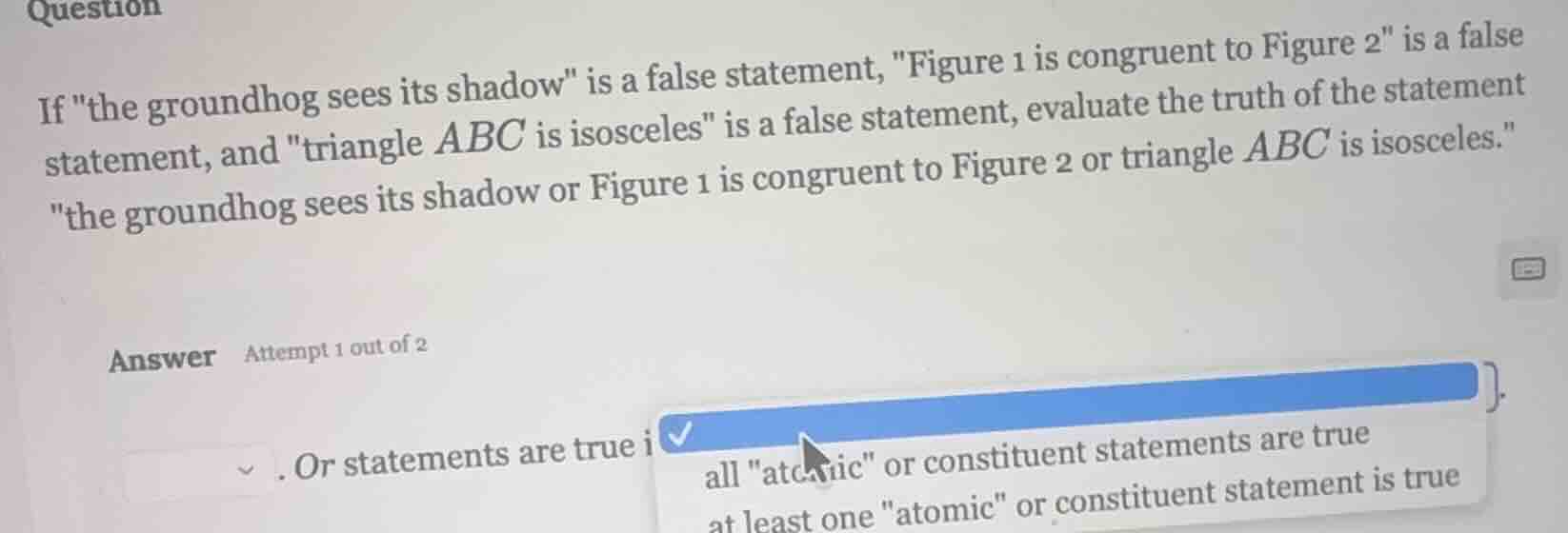
if \the groundhog sees its shadow\ is a false statement, \figure 1 is congruent to figure 2\ is a false statement, and \triangle (abc) is isosceles\ is a false statement, evaluate the truth of the statement \the groundhog sees its shadow or figure 1 is congruent to figure 2 or triangle (abc) is isosceles.\
answer attempt 1 out of 2
. or statements are true i (\boldsymbol{checkmark}) all \atomic\ or constituent statements are true
at least one \atomic\ or constituent statement is true
Step1: Recall "or" logic rule
A disjunction (OR statement) is true if at least one of its constituent statements is true; it is only false if all constituent statements are false.
Step2: Evaluate given statements
Let $P$ = "the groundhog sees its shadow" (False), $Q$ = "Figure 1 is congruent to Figure 2" (False), $R$ = "triangle $ABC$ is isosceles" (False). The statement to evaluate is $P \lor Q \lor R$.
Step3: Compute disjunction truth value
Since $P, Q, R$ are all false, $P \lor Q \lor R = \text{False} \lor \text{False} \lor \text{False} = \text{False}$.

Snap & solve any problem in the app
Get step-by-step solutions on Sovi AI
Photo-based solutions with guided steps
Explore more problems and detailed explanations
The statement "the groundhog sees its shadow or Figure 1 is congruent to Figure 2 or triangle $ABC$ is isosceles" is false.
Additionally, the correct rule for OR statements is: at least one "atomic" or constituent statement is true