QUESTION IMAGE
Question
question id : 617520
9 of 10
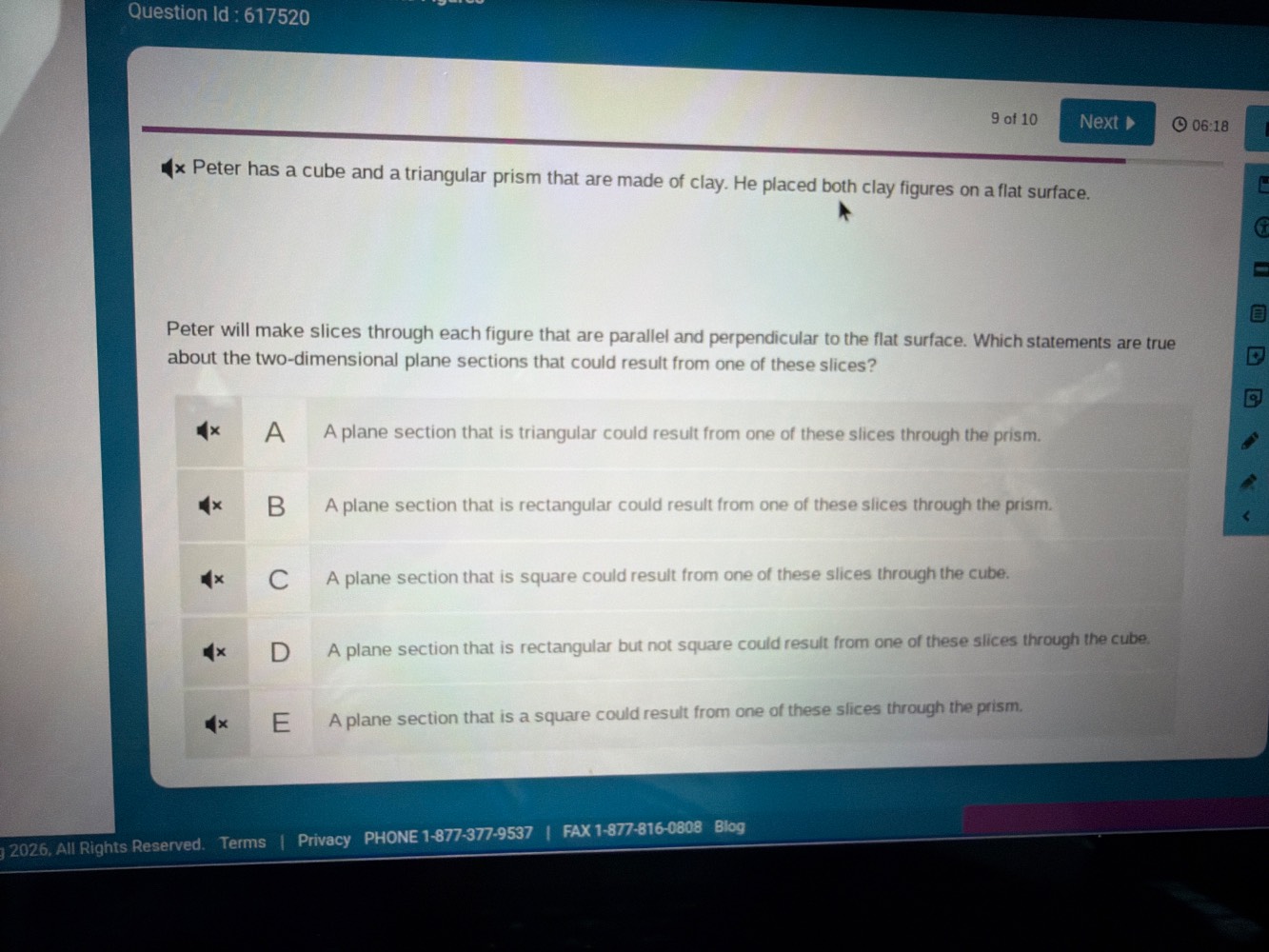
peter has a cube and a triangular prism that are made of clay. he placed both clay figures on a flat surface.
peter will make slices through each figure that are parallel and perpendicular to the flat surface. which statements are true about the two-dimensional plane sections that could result from one of these slices?
a a plane section that is triangular could result from one of these slices through the prism.
b a plane section that is rectangular could result from one of these slices through the prism.
c a plane section that is square could result from one of these slices through the cube.
d a plane section that is rectangular but not square could result from one of these slices through the cube.
e a plane section that is a square could result from one of these slices through the prism.
- Option A: A slice parallel to the triangular base of the prism will create a triangular plane section, so this is true.
- Option B: A slice perpendicular to the triangular base (parallel to the length/height of the prism) will create a rectangular plane section, so this is true.
- Option C: A slice parallel to the square faces of the cube will create a square plane section, so this is true.
- Option D: Slices parallel/perpendicular to the flat surface of a cube only produce squares (all edges of a cube are equal; such slices align with the cube's faces, which are squares), so this is false.
- Option E: A triangular prism (with triangular bases and rectangular lateral faces) cannot produce a square section from slices parallel/perpendicular to the flat surface, as its faces are triangles and rectangles (not squares, unless specified, which is not stated here), so this is false.

Snap & solve any problem in the app
Get step-by-step solutions on Sovi AI
Photo-based solutions with guided steps
Explore more problems and detailed explanations
A. A plane section that is triangular could result from one of these slices through the prism.
B. A plane section that is rectangular could result from one of these slices through the prism.
C. A plane section that is square could result from one of these slices through the cube.