QUESTION IMAGE
Question
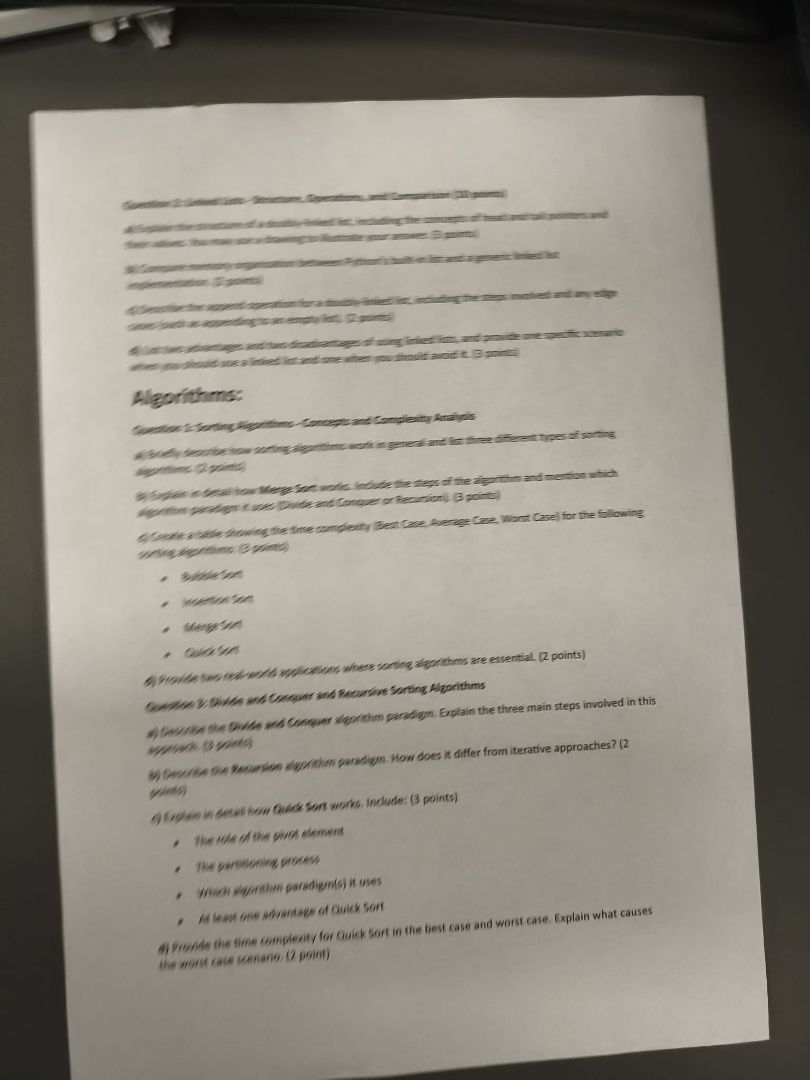
question 2: linked lists - structure, operations, and comparison (10 points)
a) explain the structure of a doubly linked list, including the concepts of head and tail pointers and their values. you may use a drawing to illustrate your answer. (3 points)
b) compare memory organization between python’s built - in list and a generic linked list implementation. (2 points)
c) describe the append operation for a doubly linked list, including the steps involved and any edge cases (such as appending to an empty list). (2 points)
d) list two advantages and two disadvantages of using linked lists, and provide one specific scenario when you should use a linked list and one when you should avoid it. (3 points)
algorithms:
question 2: sorting algorithms - concepts and complexity analysis
a) briefly describe how sorting algorithms work in general and list three different types of sorting algorithms. (2 points)
b) explain in detail how merge sort works. include the steps of the algorithm and mention which algorithm paradigm it uses (divide and conquer or recursion). (3 points)
c) create a table showing the time complexity (best case, average case, worst case) for the following sorting algorithms: (3 points)
- bubble sort
- insertion sort
- merge sort
- quick sort
d) provide two real - world applications where sorting algorithms are essential. (2 points)
question 3: divide and conquer and recursive sorting algorithms
a) describe the divide and conquer algorithm paradigm. explain the three main steps involved in this approach. (3 points)
b) describe the recursion algorithm paradigm. how does it differ from iterative approaches? (2 points)
c) explain in detail how quick sort works. include: (3 points)
- the role of the pivot element
- the partitioning process
- which algorithm paradigm(s) it uses
- at least one advantage of quick sort
d) provide the time complexity for quick sort in the best case and worst case. explain what causes the worst - case scenario. (2 points)
Since the problem contains multiple sub - questions related to data structures (like linked lists) and algorithms (sorting algorithms, divide - and - conquer, recursion), we will use the Answer - Explanation Format for each sub - question.
Question 2 (Linked Lists - Structure, Operations, and Comparison)
a) Explain the structure of a doubly linked list...
A doubly linked list is a linear data structure. Each node has three parts: data, a pointer to the previous node, and a pointer to the next node. The head pointer points to the first node, and the tail pointer points to the last node. For an empty list, both head and tail are null. A drawing can show nodes connected with forward (next) and backward (prev) pointers, with head at the start and tail at the end.
Python's built - in list is a dynamic array. It stores elements in a contiguous block of memory (with some over - allocation for growth). A generic linked list (e.g., doubly linked list) stores nodes non - contiguously, with each node having pointers to adjacent nodes. Python list has O(1) access by index (due to contiguous memory), while linked list has O(n) access (need to traverse from head/tail).
For a doubly linked list append: 1. Create a new node with data. 2. If list is empty: set head and tail to new node (new_node.prev = new_node.next = null). 3. Else: new_node.prev = tail; tail.next = new_node; update tail to new_node. Edge case: empty list, handled by setting head and tail.

Snap & solve any problem in the app
Get step-by-step solutions on Sovi AI
Photo-based solutions with guided steps
Explore more problems and detailed explanations
A doubly linked list has nodes with data, a 'prev' (points to previous node) and a 'next' (points to next node) pointer. Head points to the first node, tail to the last node; empty list has head = tail = null.