QUESTION IMAGE
Question
question 6 (1 point)
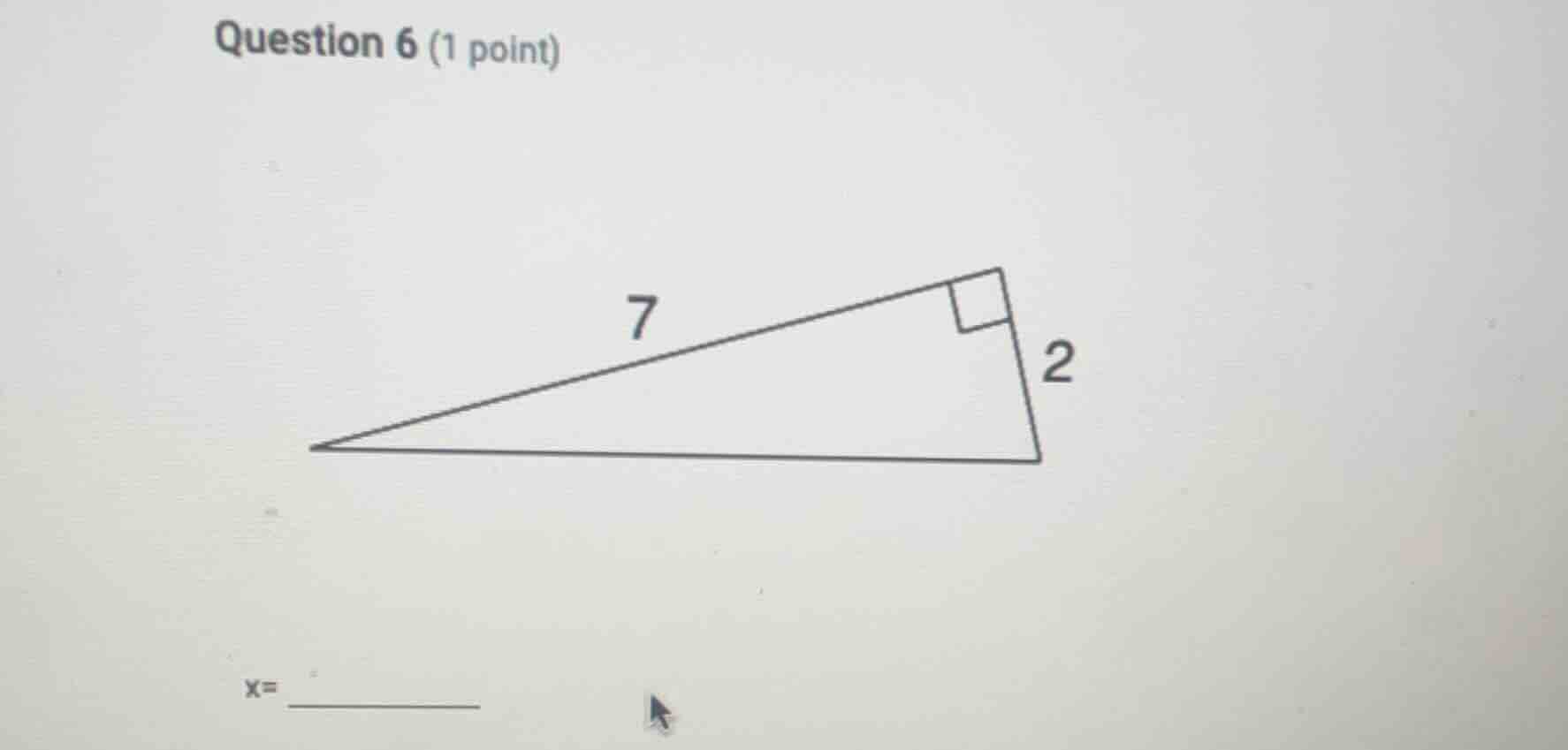
right triangle with one leg 2, another leg 7, hypotenuse x
x= ________
Step1: Identify the triangle type
This is a right - triangle, so we can use the Pythagorean theorem. The Pythagorean theorem states that for a right - triangle with legs \(a\), \(b\) and hypotenuse \(c\), \(c^{2}=a^{2}+b^{2}\). Here, one leg \(a = 2\), the other leg (the vertical side) is \(7\)? Wait, no, wait. Wait, in the right - triangle, the two legs are the sides forming the right angle, and the hypotenuse is the side opposite the right angle. Wait, looking at the diagram, the right angle is between the side of length \(7\) and the side of length \(2\)? No, that can't be. Wait, no, maybe I got the legs and hypotenuse wrong. Wait, the right angle is at the corner where the side of length \(7\) and the side of length \(2\) meet? No, the hypotenuse is the longest side. Wait, let's re - examine. Let's assume that the two legs are \(7\) and \(2\), and \(x\) is the hypotenuse? No, that can't be, because \(7\) is longer than \(2\), but if \(x\) is the hypotenuse, then \(x=\sqrt{7^{2}+2^{2}}\). Wait, maybe the legs are \(2\) and the other leg, and \(7\) is the hypotenuse? Wait, no, the hypotenuse must be longer than either leg. So if \(7\) is the hypotenuse, and one leg is \(2\), then the other leg \(x\) (the base) can be found by \(x=\sqrt{7^{2}-2^{2}}\).
Step2: Apply the Pythagorean theorem
The Pythagorean theorem for a right - triangle is \(c^{2}=a^{2}+b^{2}\), where \(c\) is the hypotenuse, and \(a\) and \(b\) are the legs. If we assume that \(c = 7\) (the hypotenuse) and \(a = 2\) (one leg), and \(b=x\) (the other leg), then we can re - arrange the formula to \(b=\sqrt{c^{2}-a^{2}}\).
Substitute \(c = 7\) and \(a = 2\) into the formula:
\(x=\sqrt{7^{2}-2^{2}}=\sqrt{49 - 4}=\sqrt{45}=\sqrt{9\times5}=3\sqrt{5}\approx6.71\) (if we want a decimal approximation) or in exact form \(3\sqrt{5}\).
Wait, maybe I mixed up the legs and hypotenuse. Let's check the diagram again. The right angle is at the top, with one leg of length \(7\) (vertical) and one leg of length \(2\) (horizontal), and \(x\) is the hypotenuse? No, that can't be, because \(7\) is longer than \(2\), but the hypotenuse should be longer than both legs. Wait, no, maybe the side of length \(7\) is one leg, the side of length \(2\) is another leg, and \(x\) is the hypotenuse. Then \(x=\sqrt{7^{2}+2^{2}}=\sqrt{49 + 4}=\sqrt{53}\approx7.28\). But that contradicts the hypotenuse being the longest side. Wait, maybe the side of length \(7\) is the hypotenuse, and the side of length \(2\) is one leg, so the other leg \(x\) is \(\sqrt{7^{2}-2^{2}}=\sqrt{49 - 4}=\sqrt{45}=3\sqrt{5}\approx6.71\).

Snap & solve any problem in the app
Get step-by-step solutions on Sovi AI
Photo-based solutions with guided steps
Explore more problems and detailed explanations
If we consider \(7\) as the hypotenuse and \(2\) as one leg, then \(x = \sqrt{7^{2}-2^{2}}=\sqrt{45}=3\sqrt{5}\approx6.71\) (or in exact form \(3\sqrt{5}\)). If we consider \(7\) and \(2\) as legs and \(x\) as hypotenuse, then \(x=\sqrt{7^{2}+2^{2}}=\sqrt{53}\approx7.28\). But since \(7\) is longer than \(2\), it's more likely that \(7\) is the hypotenuse. So the exact value of \(x\) is \(3\sqrt{5}\) (or approximately \(6.71\)).