QUESTION IMAGE
Question
question 9 (1 point)
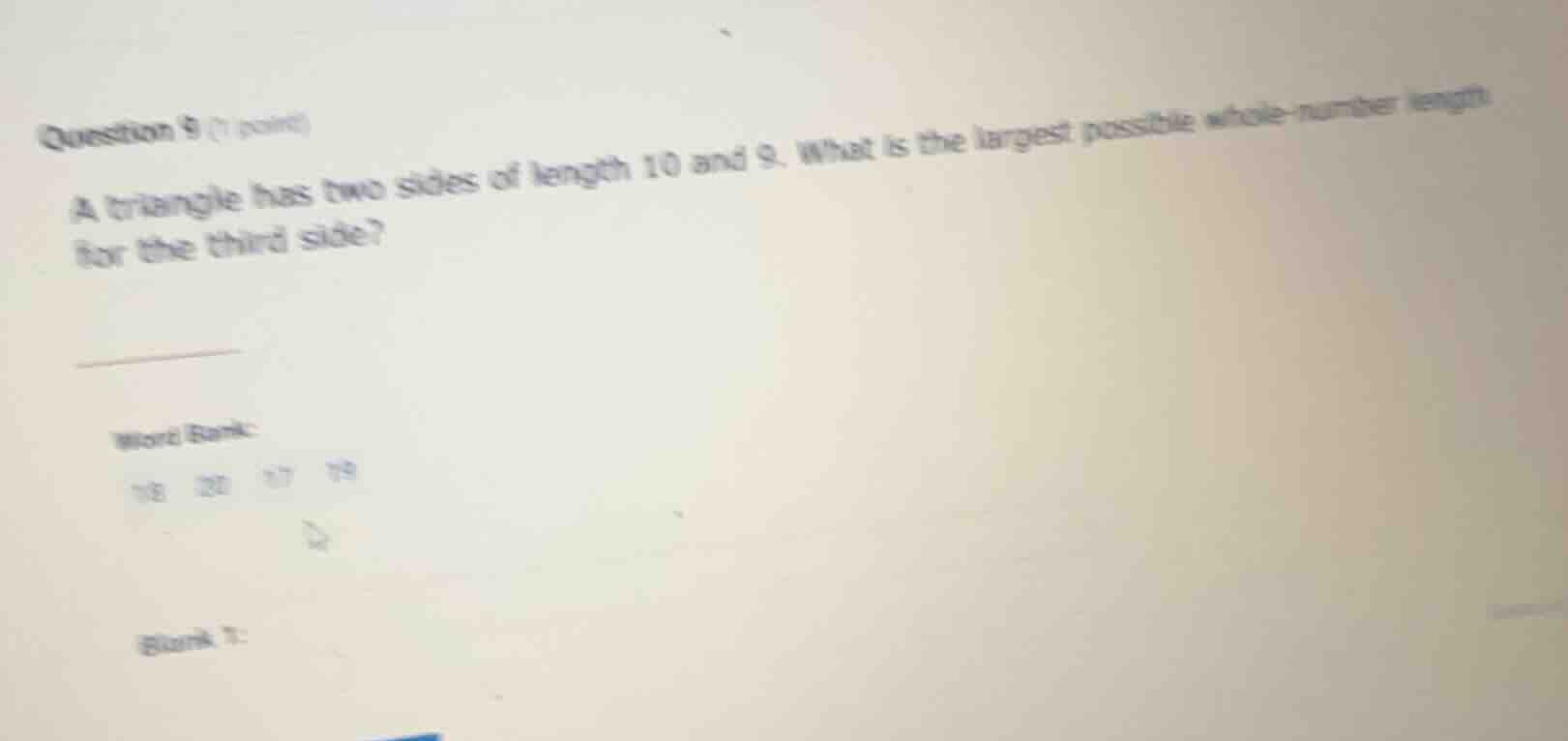
a triangle has two sides of length 10 and 9. what is the largest possible whole - number length for the third side?
word bank:
18 20 17 19
blank 1:
Step1: Recall triangle inequality theorem
The triangle inequality theorem states that the sum of the lengths of any two sides of a triangle must be greater than the length of the remaining side. For a triangle with sides \(a\), \(b\), and \(c\), we have \(a + b>c\), \(a + c>b\), and \(b + c>a\). In this case, let the two given sides be \(a = 10\) and \(b = 9\), and the third side be \(c\). We need to find the largest whole - number value of \(c\) such that the triangle inequalities hold. The relevant inequality here for finding the upper bound of \(c\) is \(a + b>c\) (since we want the largest \(c\), we focus on this inequality as the other inequalities will be satisfied for positive lengths). So, \(10+9>c\), which simplifies to \(c < 19\).
Step2: Determine the largest whole - number
Since \(c\) must be a whole number and \(c < 19\), the largest whole - number value that \(c\) can take is \(18\) (we also need to check the other inequalities: \(10 + c>9\) (which is true for positive \(c\)) and \(9 + c>10\) (which is true when \(c > 1\), and \(18>1\))).

Snap & solve any problem in the app
Get step-by-step solutions on Sovi AI
Photo-based solutions with guided steps
Explore more problems and detailed explanations
18