QUESTION IMAGE
Question
question 3 0.5 pts
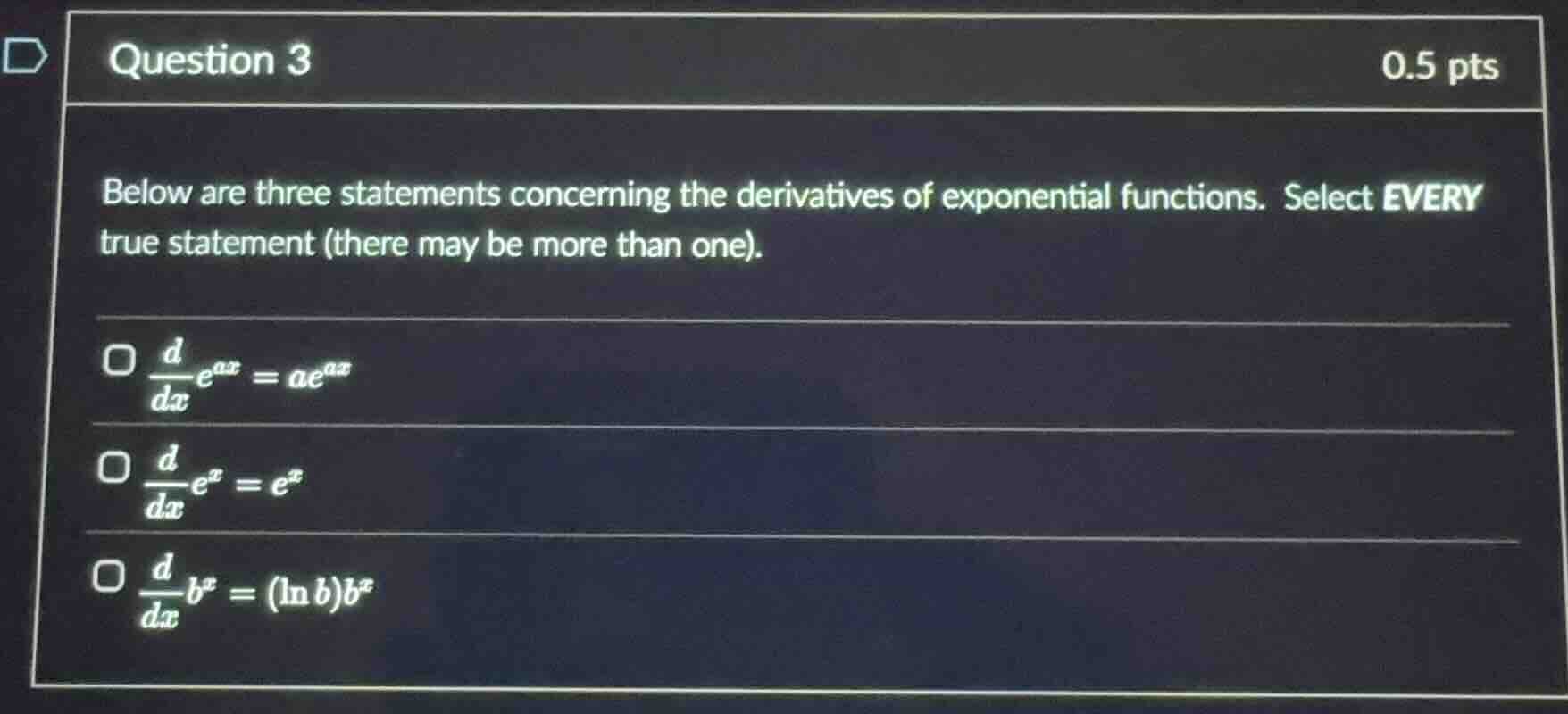
below are three statements concerning the derivatives of exponential functions. select every true statement (there may be more than one).
\\(\frac{d}{dx}e^{ax} = ae^{ax}\\)
\\(\frac{d}{dx}e^{x} = e^{x}\\)
\\(\frac{d}{dx}b^{x} = (\ln b)b^{x}\\)
Brief Explanations
- For \(\frac{d}{dx}e^{ax}\): Using the chain rule, if \(u = ax\), then \(\frac{d}{dx}e^u=e^u\cdot\frac{du}{dx}=e^{ax}\cdot a = ae^{ax}\), so this statement is true.
- For \(\frac{d}{dx}e^{x}\): The derivative of \(e^x\) with respect to \(x\) is a fundamental result in calculus, and \(\frac{d}{dx}e^{x}=e^{x}\), so this statement is true.
- For \(\frac{d}{dx}b^{x}\): We can rewrite \(b^{x}=e^{x\ln b}\), then using the chain rule, \(\frac{d}{dx}e^{x\ln b}=e^{x\ln b}\cdot\ln b = b^{x}\ln b\), so this statement is true.

Snap & solve any problem in the app
Get step-by-step solutions on Sovi AI
Photo-based solutions with guided steps
Explore more problems and detailed explanations
A. \(\boldsymbol{\frac{d}{dx}e^{ax} = ae^{ax}}\)
B. \(\boldsymbol{\frac{d}{dx}e^{x} = e^{x}}\)
C. \(\boldsymbol{\frac{d}{dx}b^{x} = (\ln b)b^{x}}\)