QUESTION IMAGE
Question
question 9
1 pts
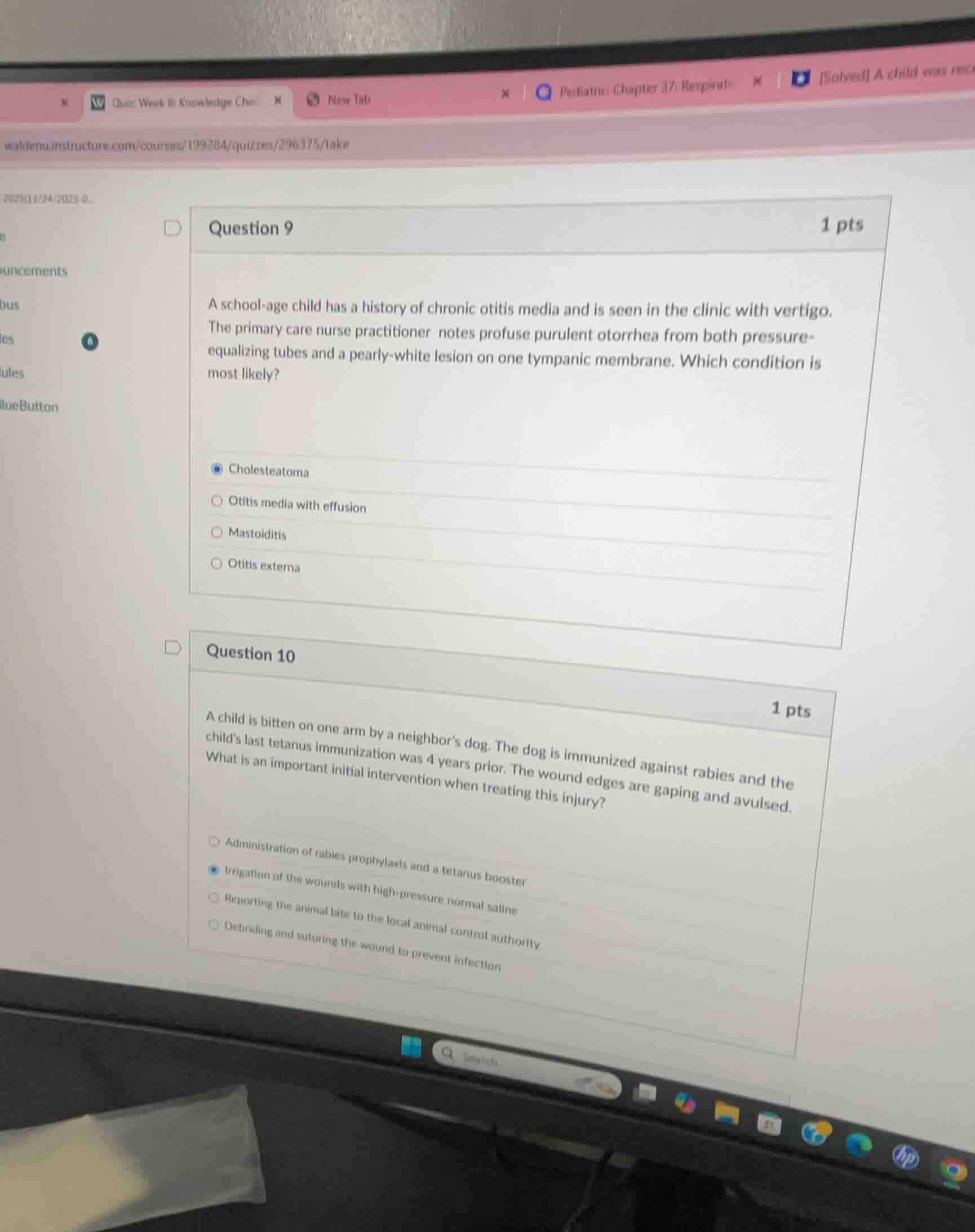
a school - age child has a history of chronic otitis media and is seen in the clinic with vertigo. the primary care nurse practitioner notes profuse purulent otorrhea from both pressure - equalizing tubes and a pearly - white lesion on one tympanic membrane. which condition is most likely?
- cholesteatoma
- otitis media with effusion
- mastoiditis
- otitis externa
question 10
1 pts
a child is bitten on one arm by a neighbor’s dog. the dog is immunized against rabies and the child’s last tetanus immunization was 4 years prior. the wound edges are gaping and avulsed. what is an important initial intervention when treating this injury?
- administration of rabies prophylaxis and a tetanus booster
- irrigation of the wounds with high - pressure normal saline
- reporting the animal bite to the local animal control authority
- debriding and suturing the wound to prevent infection
Question 9
- Cholesteatoma: Associated with chronic otitis media, presents with purulent otorrhea, vertigo, and a pearly - white lesion on the tympanic membrane.
- Otitis media with effusion: Mainly has fluid in the middle ear without the purulent otorrhea and pearly - white lesion.
- Mastoiditis: Involves the mastoid bone, symptoms are more related to mastoid pain and swelling, not the tympanic membrane lesion described.
- Otitis externa: Affects the outer ear canal, not related to pressure - equalizing tubes or tympanic membrane lesions.
- For a dog - bite wound with gaping and avulsed edges, initial irrigation with high - pressure normal saline is crucial to clean the wound and reduce infection risk.
- Rabies prophylaxis is not needed as the dog is immunized.
- Tetanus booster is not the initial intervention (wound cleaning first).
- Reporting the animal is not the initial treatment for the wound.

Snap & solve any problem in the app
Get step-by-step solutions on Sovi AI
Photo-based solutions with guided steps
Explore more problems and detailed explanations
A. Cholesteatoma