QUESTION IMAGE
Question
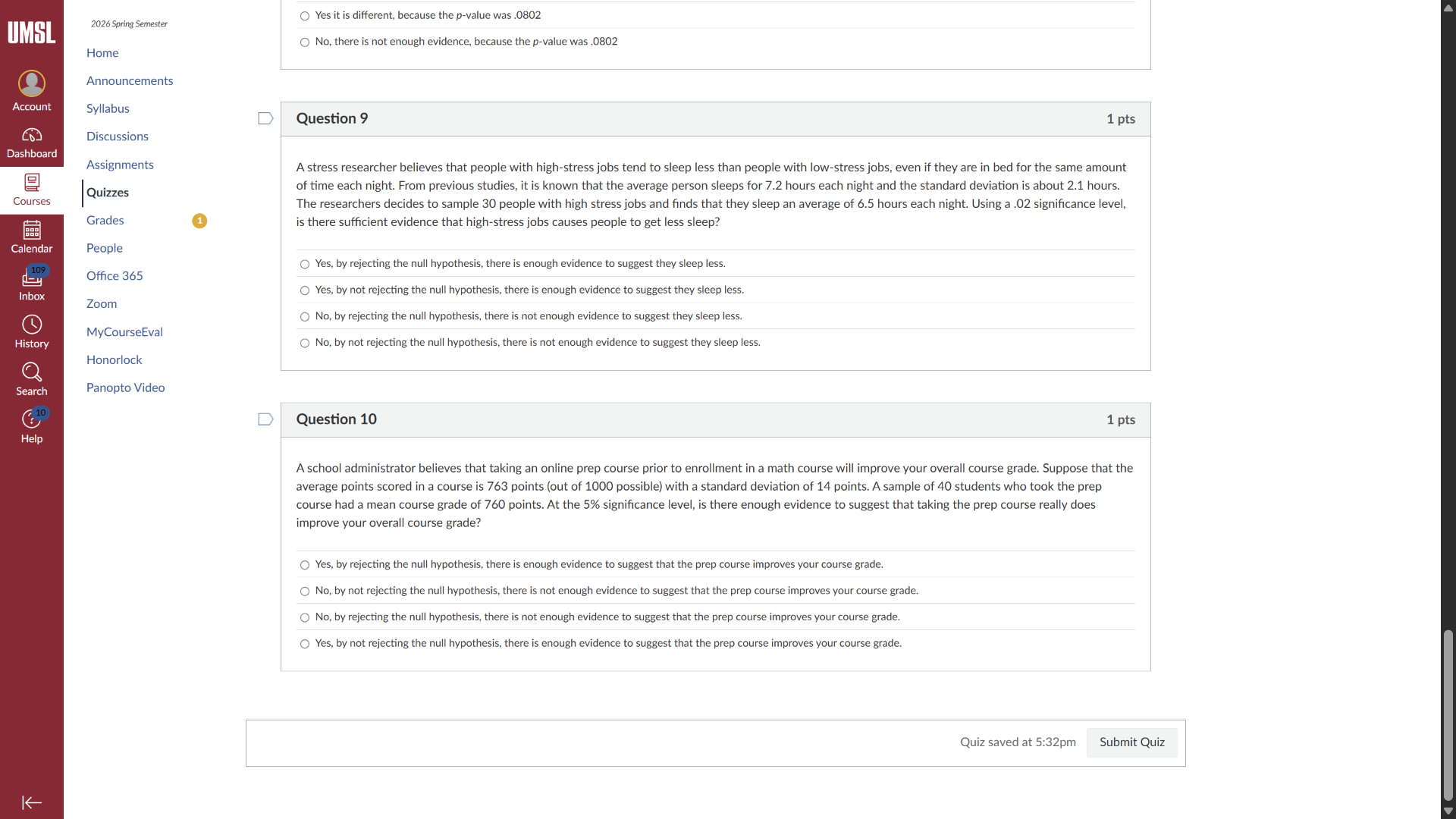
question 9 1 pts a stress researcher believes that people with high - stress jobs tend to sleep less than people with low - stress jobs, even if they are in bed for the same amount of time each night. from previous studies, it is known that the average person sleeps for 7.2 hours each night and the standard deviation is about 2.1 hours. the researchers decides to sample 30 people with high stress jobs and finds that they sleep an average of 6.5 hours each night. using a.02 significance level, is there sufficient evidence that high - stress jobs causes people to get less sleep? yes, by rejecting the null hypothesis, there is enough evidence to suggest they sleep less. yes, by not rejecting the null hypothesis, there is enough evidence to suggest they sleep less. no, by rejecting the null hypothesis, there is not enough evidence to suggest they sleep less. no, by not rejecting the null hypothesis, there is not enough evidence to suggest they sleep less. question 10 1 pts a school administrator believes that taking an online prep course prior to enrollment in a math course will improve your overall course grade. suppose that the average points scored in a course is 763 points (out of 1000 possible) with a standard deviation of 14 points. a sample of 40 students who took the prep course had a mean course grade of 760 points. at the 5% significance level, is there enough evidence to suggest that taking the prep course really does improve your overall course grade? yes, by rejecting the null hypothesis, there is enough evidence to suggest that the prep course improves your course grade. no, by not rejecting the null hypothesis, there is not enough evidence to suggest that the prep course improves your course grade. no, by rejecting the null hypothesis, there is not enough evidence to suggest that the prep course improves your course grade. yes, by not rejecting the null hypothesis, there is enough evidence to suggest that the prep course improves your course grade.
Question 9
Step1: Define Hypotheses
Null hypothesis ($H_0$): $\mu = 7.2$ (high - stress job sleep = average sleep). Alternative hypothesis ($H_1$): $\mu<7.2$ (high - stress job sleep < average sleep).
Step2: Identify Parameters
Population mean ($\mu$) = 7.2, population standard deviation ($\sigma$) = 2.1, sample size ($n$) = 30, sample mean ($\bar{x}$) = 6.5, significance level ($\alpha$) = 0.02.
Step3: Calculate Test Statistic
Since population standard deviation is known, we use z - test. The formula for z - statistic is $z=\frac{\bar{x}-\mu}{\frac{\sigma}{\sqrt{n}}}$.
Substitute the values: $\frac{6.5 - 7.2}{\frac{2.1}{\sqrt{30}}}=\frac{- 0.7}{\frac{2.1}{\sqrt{30}}}\approx\frac{-0.7}{0.383}\approx - 1.83$.
Step4: Find Critical Value
For a left - tailed test with $\alpha = 0.02$, the critical z - value is $z_{\alpha}=-2.05$ (from z - table).
Step5: Make Decision
The test statistic $z=-1.83$ is greater than the critical value $z_{\alpha}=-2.05$. So we do not reject the null hypothesis. But wait, let's re - check. Wait, the sample mean is less than the population mean. Wait, maybe I made a mistake in critical value. Wait, for $\alpha = 0.02$ (left - tailed), the critical value is $z=-2.05$ (using standard normal table: $P(Z < z)=0.02$, so $z\approx - 2.05$). Our test statistic is $z=-1.83$, which is greater than - 2.05, so we fail to reject $H_0$. But the question is about high - stress jobs causing less sleep. Wait, maybe I messed up the direction. Wait, the null hypothesis is that high - stress job sleep is equal to average, alternative is less. So if we fail to reject $H_0$, there is not enough evidence. But let's check the options. The options are about rejecting or not. Wait, maybe my calculation of z - statistic is wrong. Let's recalculate: $\bar{x}=6.5$, $\mu = 7.2$, $\sigma = 2.1$, $n = 30$. $\frac{\bar{x}-\mu}{\sigma/\sqrt{n}}=\frac{6.5 - 7.2}{2.1/\sqrt{30}}=\frac{-0.7}{2.1/5.477}\approx\frac{-0.7}{0.383}\approx - 1.83$. The critical value for $\alpha = 0.02$ (left - tailed) is $z=-2.05$. Since $-1.83>-2.05$, we do not reject $H_0$. So the correct option should be: No, by not rejecting the null hypothesis, there is not enough evidence to suggest they sleep less. Wait, but let's check the options again. The options are:
- Yes, by rejecting the null hypothesis, there is enough evidence to suggest they sleep less.
- Yes, by not rejecting the null hypothesis, there is enough evidence to suggest they sleep less.
- No, by rejecting the null hypothesis, there is not enough evidence to suggest they sleep less.
- No, by not rejecting the null hypothesis, there is not enough evidence to suggest they sleep less.
Since we do not reject $H_0$, the correct option is the fourth one: No, by not rejecting the null hypothesis, there is not enough evidence to suggest they sleep less. Wait, but maybe I made a mistake in the critical value. Let's use the p - value method. The p - value for $z=-1.83$ (left - tailed) is $P(Z < - 1.83)\approx0.0336$. Since $\alpha = 0.02$, and $p - value=0.0336>0.02$, we fail to reject $H_0$. So the conclusion is that there is not enough evidence, and we do not reject $H_0$. So the correct option is "No, by not rejecting the null hypothesis, there is not enough evidence to suggest they sleep less."
Step1: Define Hypotheses
Null hypothesis ($H_0$): $\mu = 763$ (prep course has no effect). Alternative hypothesis ($H_1$): $\mu>763$ (prep course improves grade).
Step2: Identify Parameters
Population mean ($\mu$) = 763, population standard deviation ($\sigma$) = 14, sample size ($n$) = 40, sample mean ($\bar{x}$) = 760, significance level ($\alpha$) = 0.05.
Step3: Calculate Test Statistic
Using z - test (since $\sigma$ is known). The formula for z - statistic is $z=\frac{\bar{x}-\mu}{\frac{\sigma}{\sqrt{n}}}$.
Substitute the values: $\frac{760 - 763}{\frac{14}{\sqrt{40}}}=\frac{-3}{\frac{14}{6.3246}}\approx\frac{-3}{2.214}\approx - 1.355$.
Step4: Find Critical Value
For a right - tailed test with $\alpha = 0.05$, the critical z - value is $z_{\alpha}=1.645$ (from z - table).
Step5: Make Decision
The test statistic $z=-1.355$ is less than the critical value $z_{\alpha}=1.645$. So we do not reject the null hypothesis. Let's use p - value method. The p - value for $z=-1.355$ (right - tailed, so $P(Z > - 1.355)=1 - P(Z < - 1.355)\approx1 - 0.0874 = 0.9126$. Since $p - value = 0.9126>0.05$, we fail to reject $H_0$. So the conclusion is that there is not enough evidence, and we do not reject $H_0$. The options are:
- Yes, by rejecting the null hypothesis, there is enough evidence to suggest that the prep course improves your course grade.
- No, by not rejecting the null hypothesis, there is not enough evidence to suggest that the prep course improves your course grade.
- No, by rejecting the null hypothesis, there is not enough evidence to suggest that the prep course improves your course grade.
- Yes, by not rejecting the null hypothesis, there is enough evidence to suggest that the prep course improves your course grade.
Since we do not reject $H_0$, the correct option is the second one: No, by not rejecting the null hypothesis, there is not enough evidence to suggest that the prep course improves your course grade.

Snap & solve any problem in the app
Get step-by-step solutions on Sovi AI
Photo-based solutions with guided steps
Explore more problems and detailed explanations
D. No, by not rejecting the null hypothesis, there is not enough evidence to suggest they sleep less. (assuming the options are labeled A, B, C, D in order)