QUESTION IMAGE
Question
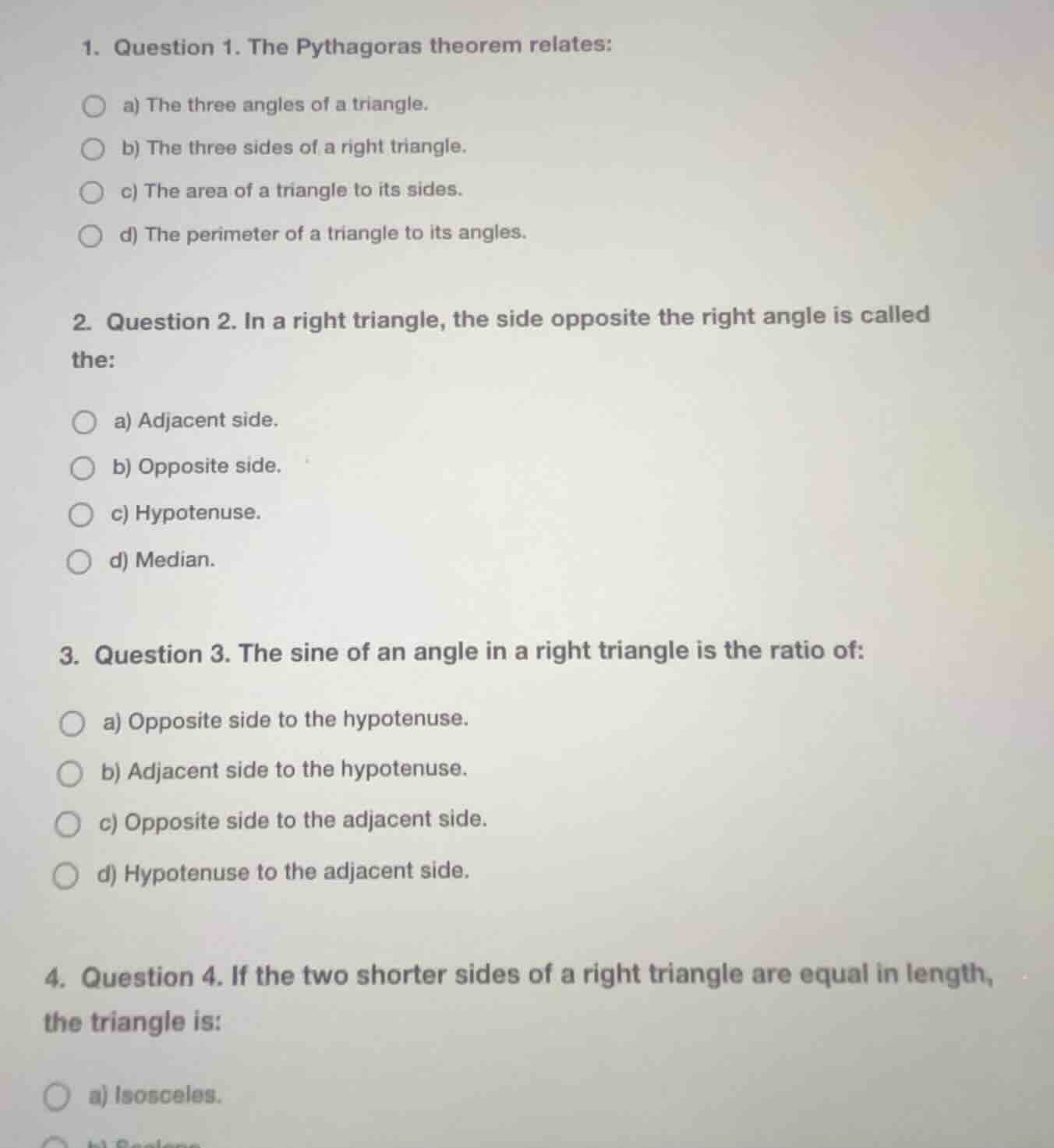
- question 1. the pythagoras theorem relates:
a) the three angles of a triangle.
b) the three sides of a right triangle.
c) the area of a triangle to its sides.
d) the perimeter of a triangle to its angles.
- question 2. in a right triangle, the side opposite the right angle is called the:
a) adjacent side.
b) opposite side.
c) hypotenuse.
d) median.
- question 3. the sine of an angle in a right triangle is the ratio of:
a) opposite side to the hypotenuse.
b) adjacent side to the hypotenuse.
c) opposite side to the adjacent side.
d) hypotenuse to the adjacent side.
- question 4. if the two shorter sides of a right triangle are equal in length, the triangle is:
a) isosceles.
Brief Explanations
- Pythagoras theorem defines the relationship between the three sides of a right triangle, stated as $a^2 + b^2 = c^2$ where $c$ is the longest side.
- The side opposite the right angle in a right triangle is the longest side, specifically named the hypotenuse.
- By definition, the sine of an acute angle in a right triangle is the ratio of the side opposite the angle to the hypotenuse.
- A triangle with two sides of equal length is classified as an isosceles triangle; this applies to the two shorter equal sides of the right triangle.

Snap & solve any problem in the app
Get step-by-step solutions on Sovi AI
Photo-based solutions with guided steps
Explore more problems and detailed explanations
- b) The three sides of a right triangle.
- c) Hypotenuse.
- a) Opposite side to the hypotenuse.
- a) Isosceles.