QUESTION IMAGE
Question
question 2
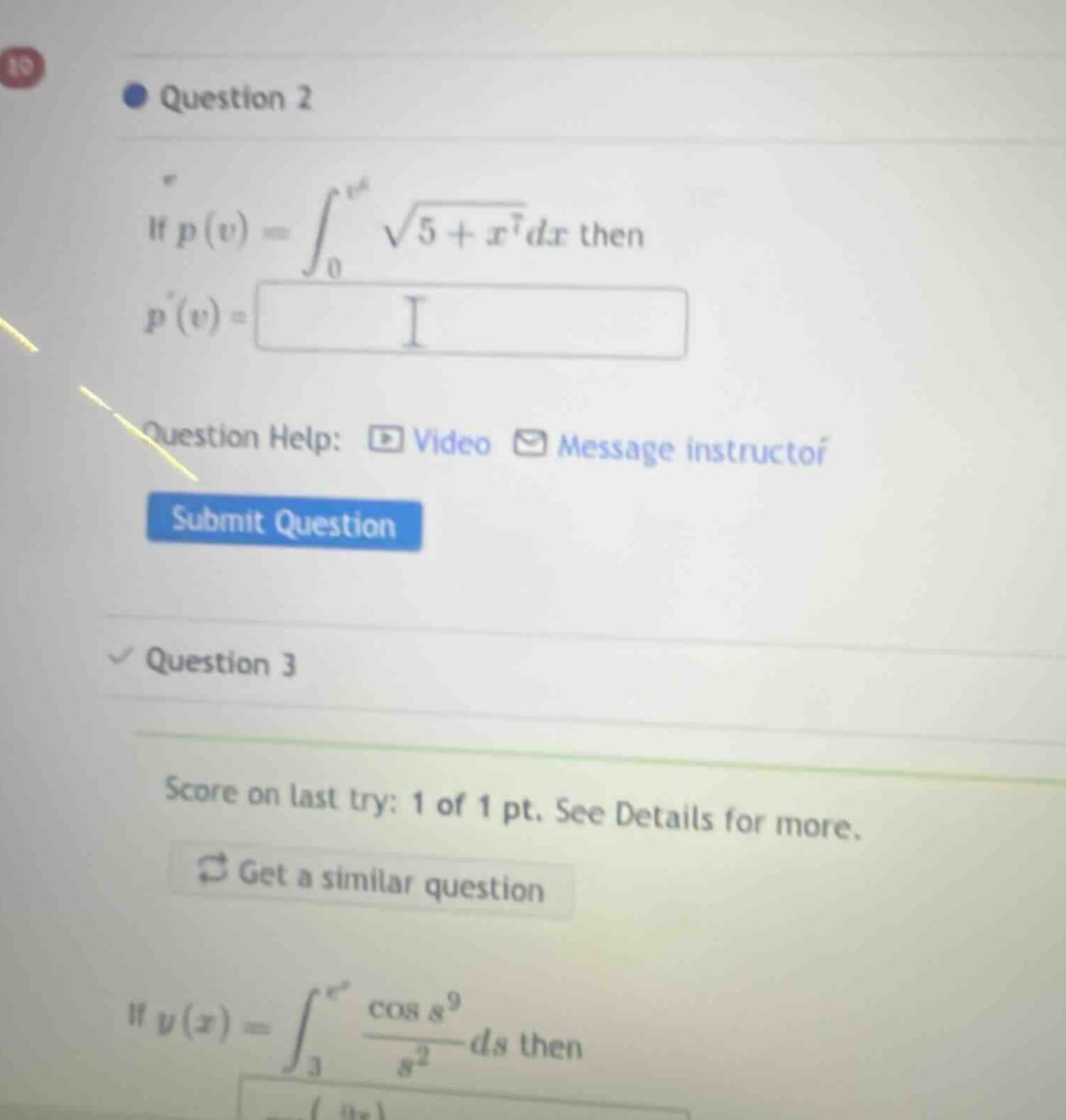
if $p(v) = \int_{0}^{v^6} \sqrt{5 + x^7} dx$ then
$p(v) = $
question help: video message instructor
submit question
question 3
score on last try: 1 of 1 pt. see details for more.
get a similar question
if $y(x) = \int_{3}^{e^x} \frac{\cos s^9}{s^2} ds$ then
Step1: Apply Fundamental Theorem of Calculus
Let $F(x)$ be the antiderivative of $\sqrt{5+x^7}$, so $F'(x)=\sqrt{5+x^7}$. By the Fundamental Theorem of Calculus, $p(v)=F(v^6)-F(0)$.
Step2: Differentiate using Chain Rule
Differentiate $p(v)$ with respect to $v$. The derivative of $F(0)$ (a constant) is 0. For $F(v^6)$, use the chain rule: $\frac{d}{dv}F(v^6)=F'(v^6)\cdot \frac{d}{dv}(v^6)$.
<Expression>
$p'(v)=\sqrt{5+(v^6)^7} \cdot 6v^5$
</Expression>
Step3: Simplify the expression
Simplify the exponent inside the square root: $(v^6)^7=v^{42}$.
<Expression>
$p'(v)=6v^5\sqrt{5+v^{42}}$
</Expression>
Step1: Apply Fundamental Theorem of Calculus
Let $G(s)$ be the antiderivative of $\frac{\cos s^9}{s^2}$, so $G'(s)=\frac{\cos s^9}{s^2}$. By the Fundamental Theorem of Calculus, $y(x)=G(e^x)-G(3)$.
Step2: Differentiate using Chain Rule
Differentiate $y(x)$ with respect to $x$. The derivative of $G(3)$ (a constant) is 0. For $G(e^x)$, use the chain rule: $\frac{d}{dx}G(e^x)=G'(e^x)\cdot \frac{d}{dx}(e^x)$.
<Expression>
$y'(x)=\frac{\cos (e^x)^9}{(e^x)^2} \cdot e^x$
</Expression>
Step3: Simplify the expression
Simplify the exponent and the rational term: $(e^x)^9=e^{9x}$, and $\frac{e^x}{(e^x)^2}=\frac{1}{e^x}=e^{-x}$.
<Expression>
$y'(x)=\frac{\cos e^{9x}}{e^x}$
</Expression>

Snap & solve any problem in the app
Get step-by-step solutions on Sovi AI
Photo-based solutions with guided steps
Explore more problems and detailed explanations
$6v^5\sqrt{5+v^{42}}$
---