QUESTION IMAGE
Question
question #1
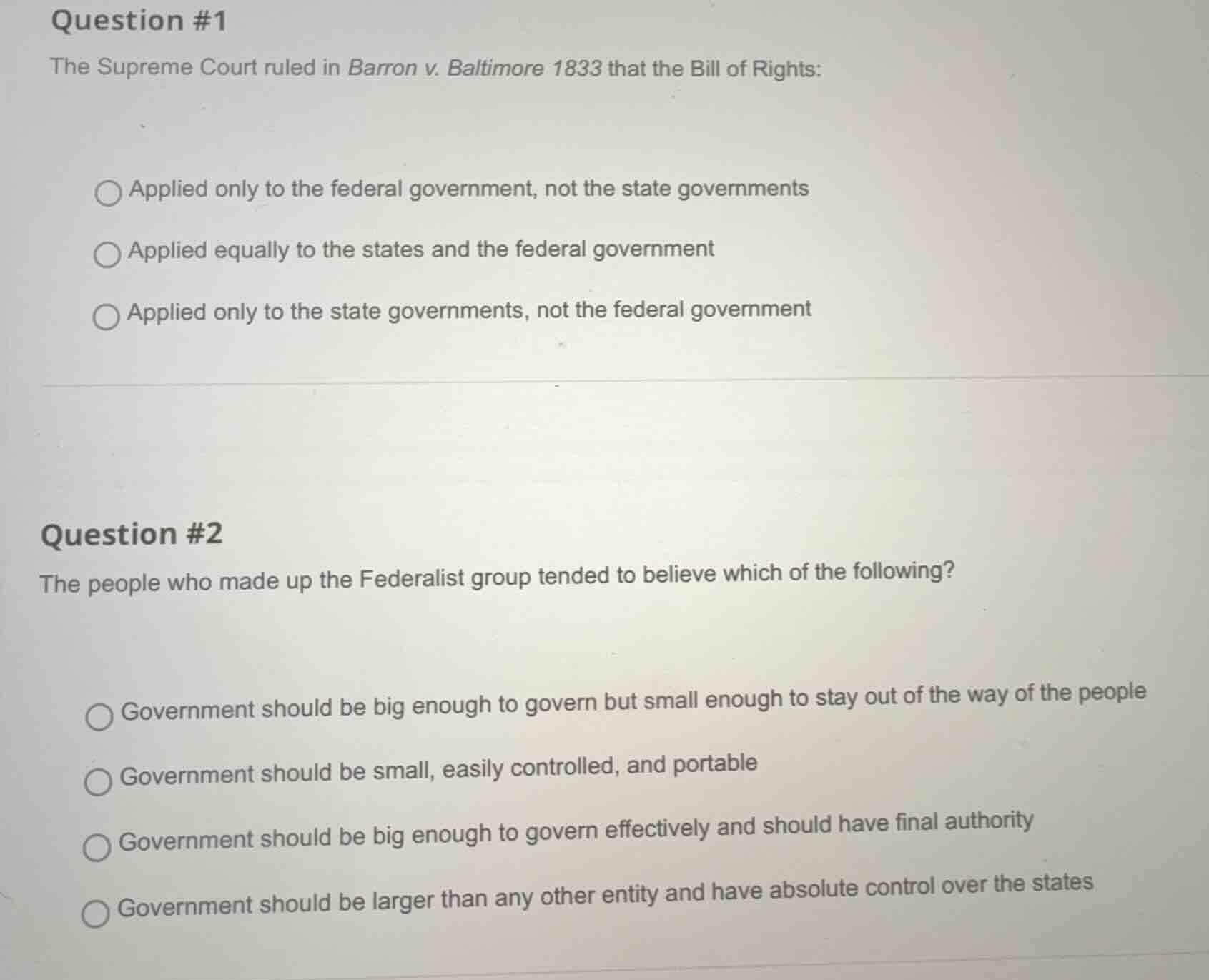
the supreme court ruled in barron v. baltimore 1833 that the bill of rights:
○ applied only to the federal government, not the state governments
○ applied equally to the states and the federal government
○ applied only to the state governments, not the federal government
question #2
the people who made up the federalist group tended to believe which of the following?
○ government should be big enough to govern but small enough to stay out of the way of the people
○ government should be small, easily controlled, and portable
○ government should be big enough to govern effectively and should have final authority
○ government should be larger than any other entity and have absolute control over the states
Question #1
In the case of Barron v. Baltimore (1833), the Supreme Court held that the Bill of Rights (the first ten amendments to the U.S. Constitution) was intended to restrict only the federal government, not the state governments. The Court reasoned that the Bill of Rights was a set of limitations on federal power, and the original Constitution (before the amendments) did not impose these restrictions on the states, and the Bill of Rights did not change that with respect to state governments at that time (the incorporation of Bill of Rights protections against the states came later through the Fourteenth Amendment's due process clause in subsequent cases). So the correct option is the one stating the Bill of Rights applied only to the federal government, not state governments.
Federalists believed in a strong central (federal) government. They thought the government should be strong enough to govern effectively (to handle national issues like defense, trade, etc.) and have final authority in matters where it had jurisdiction. The first option's "small enough to stay out of the way" and the second option's "small, easily controlled" are more in line with Anti - Federalist or later Republican - like views. The last option's "absolute control over the states" is too extreme; Federalists still recognized state governments' roles, just wanted a strong federal government. So the correct option is the one about the government being big enough to govern effectively and having final authority.

Snap & solve any problem in the app
Get step-by-step solutions on Sovi AI
Photo-based solutions with guided steps
Explore more problems and detailed explanations
A. Applied only to the federal government, not the state governments