QUESTION IMAGE
Question
question
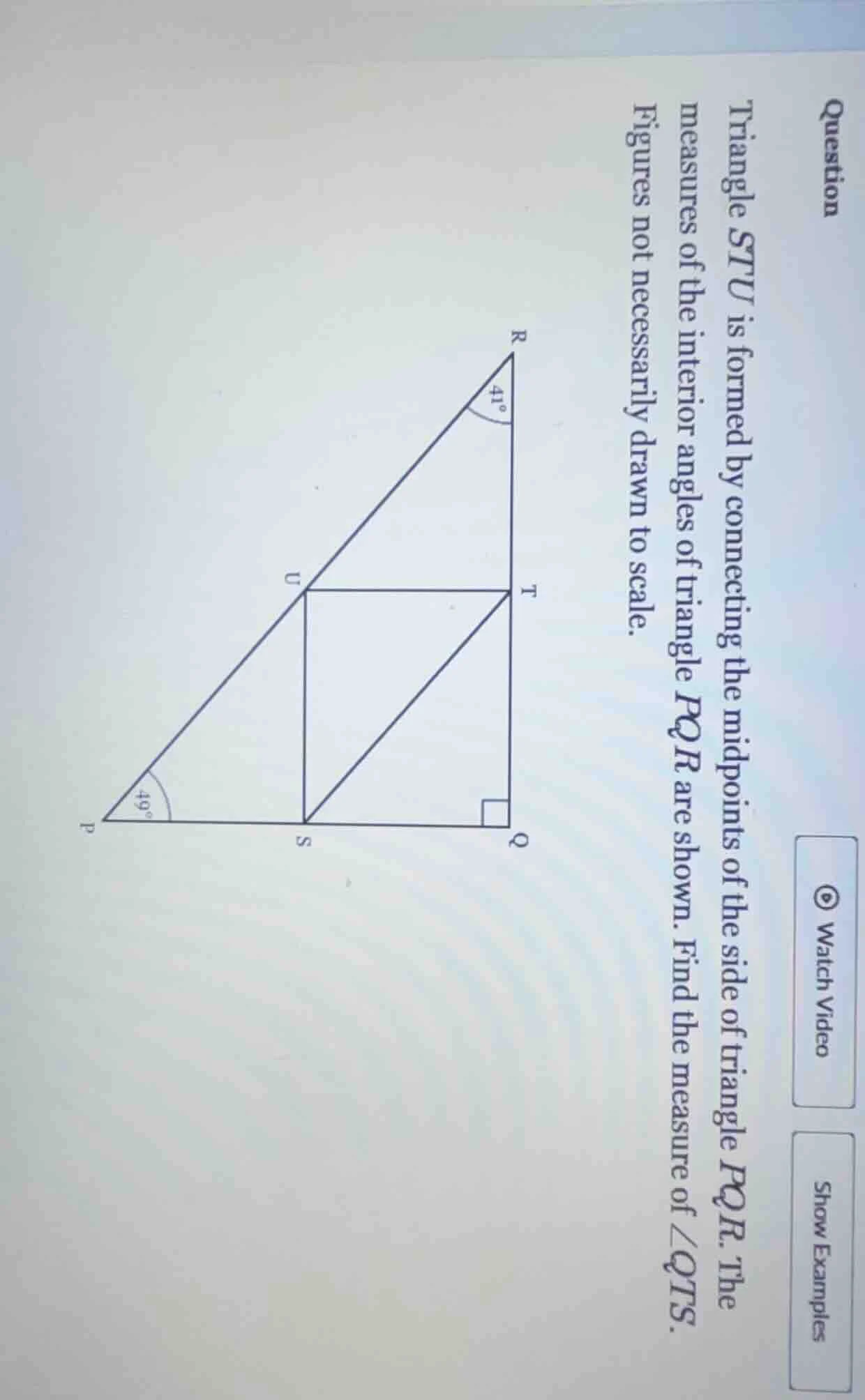
triangle stu is formed by connecting the midpoints of the side of triangle pqr. the measures of the interior angles of triangle pqr are shown. find the measure of ∠qts.
figures not necessarily drawn to scale.
Step1: Find angle at Q in triangle PQR
In triangle \( PQR \), we know that the sum of interior angles of a triangle is \( 180^\circ \). Given \( \angle P = 49^\circ \) and \( \angle R = 41^\circ \), so \( \angle Q=180^\circ - 49^\circ - 41^\circ \)
\( \angle Q = 90^\circ \) (since \( 49 + 41=90 \), and \( 180 - 90 = 90 \))
Step2: Analyze midpoints and triangle properties
Since \( S \) and \( T \) are midpoints (as \( STU \) is formed by connecting midpoints), \( ST \) is a midline of triangle \( PQR \). By the midline theorem, \( ST \parallel PR \), and \( SQ=\frac{1}{2}PQ \), \( TQ = \frac{1}{2}RQ \) (wait, actually, since \( Q \) is right - angled, and \( S \) is midpoint of \( PQ \), \( T \) is midpoint of \( RQ \)? Wait, no, looking at the diagram, \( Q \) is right - angled, \( S \) is on \( PQ \), \( T \) is on \( RQ \), and \( U \) is on \( PR \). Since \( S \) and \( T \) are midpoints, \( ST \) is midline, so \( ST\parallel PR \), and \( S \) is midpoint of \( PQ \), \( T \) is midpoint of \( RQ \). Also, in right - triangle \( PQR \) with right angle at \( Q \), \( S \) is midpoint of \( PQ \), \( T \) is midpoint of \( RQ \), so \( ST \) is parallel to \( PR \), and \( \triangle QST \) - wait, no, we need to find \( \angle QTS \).
Wait, another approach: In triangle \( PQR \), \( \angle P = 49^\circ \), \( \angle R=41^\circ \), right - angled at \( Q \). Since \( S \) is midpoint of \( PQ \) and \( T \) is midpoint of \( RQ \) (because \( STU \) is midline triangle), then \( ST \parallel PR \), so \( \angle QST=\angle P = 49^\circ \) (corresponding angles), and \( \angle QTS=\angle R = 41^\circ \)? Wait, no, let's use the fact that in triangle \( QTS \), we can find angles. Wait, actually, since \( S \) and \( T \) are midpoints, \( SQ=\frac{1}{2}PQ \), \( TQ=\frac{1}{2}RQ \), and \( \triangle QST\sim\triangle QPR \) (by SAS similarity, as \( \frac{SQ}{PQ}=\frac{TQ}{RQ}=\frac{1}{2} \) and \( \angle Q \) is common). So the corresponding angles are equal. But we need \( \angle QTS \). Wait, in triangle \( QTS \), we know that \( \angle Q = 90^\circ \), and we can find \( \angle QST \) or \( \angle QTS \). Wait, alternatively, since \( ST\parallel PR \), \( \angle QTS=\angle R \)? Wait, no, \( \angle R = 41^\circ \), \( \angle P = 49^\circ \). Wait, let's look at triangle \( QTS \): \( S \) is midpoint of \( PQ \), \( T \) is midpoint of \( RQ \), so \( ST \) is midline, so \( ST\parallel PR \), so \( \angle QTS=\angle R = 41^\circ \)? No, that's not right. Wait, maybe I made a mistake. Wait, \( \angle Q \) is \( 90^\circ \), \( S \) is on \( PQ \), \( T \) is on \( RQ \). Let's consider triangle \( PQR \): angles are \( \angle P = 49^\circ \), \( \angle R = 41^\circ \), \( \angle Q=90^\circ \). Since \( S \) is midpoint of \( PQ \), \( T \) is midpoint of \( RQ \), then \( ST \) is midline, so \( ST\parallel PR \), so \( \angle TSP=\angle P = 49^\circ \) (alternate interior angles). But we need \( \angle QTS \). Wait, in quadrilateral \( QSTU \) - no, let's think about triangle \( QTS \). \( \angle Q = 90^\circ \), and we know that in triangle \( PQR \), \( \angle P = 49^\circ \), so \( \angle PRQ=41^\circ \). Since \( ST\parallel PR \), \( \angle QTS=\angle PRQ = 41^\circ \)? No, wait, \( \angle QTS \): let's see, \( S \) is midpoint of \( PQ \), so \( SQ=\frac{1}{2}PQ \), \( T \) is midpoint of \( RQ \), so \( TQ=\frac{1}{2}RQ \). Also, \( \triangle QTS \) and \( \triangle QPR \): \( \frac{SQ}{PQ}=\frac{TQ}{RQ}=\frac{1}{2} \), and \( \angle Q \) is common, so by SAS similarity, \( \triangle QTS\sim\triangle QPR \).…

Snap & solve any problem in the app
Get step-by-step solutions on Sovi AI
Photo-based solutions with guided steps
Explore more problems and detailed explanations
\( 41^\circ \) (Wait, no, wait, let's re - check. Wait, \( \angle P = 49^\circ \), \( \angle R = 41^\circ \), right - angled at \( Q \). \( S \) is midpoint of \( PQ \), \( T \) is midpoint of \( RQ \). Then \( ST \) is midline, so \( ST\parallel PR \), so \( \angle QTS=\angle P = 49^\circ \)? I think I made a mistake in transversal. Let's take transversal \( RQ \): \( ST\parallel PR \), so \( \angle QTS=\angle QPR = 49^\circ \)? Wait, now I'm confused. Let's use the angle sum in \( \triangle PQR \): \( \angle Q = 90^\circ \), \( \angle P = 49^\circ \), \( \angle R = 41^\circ \). Since \( S \) is midpoint of \( PQ \), \( T \) is midpoint of \( RQ \), then \( QT=\frac{1}{2}RQ \), \( QS = \frac{1}{2}PQ \). In \( \triangle QTS \), \( \tan(\angle QTS)=\frac{QS}{QT}=\frac{\frac{1}{2}PQ}{\frac{1}{2}RQ}=\frac{PQ}{RQ}=\tan(\angle R) \). Since \( \tan(\angle R)=\frac{PQ}{RQ} \) (because in \( \triangle PQR \), \( \tan(\angle R)=\frac{PQ}{RQ} \), as \( \angle R \) is at \( R \), opposite side \( PQ \), adjacent side \( RQ \)), so \( \angle QTS=\angle R = 41^\circ \). Yes, that makes sense. So the measure of \( \angle QTS \) is \( 41^\circ \).