QUESTION IMAGE
Question
this question has two parts. first, answer part a. then, answer part b.
part a
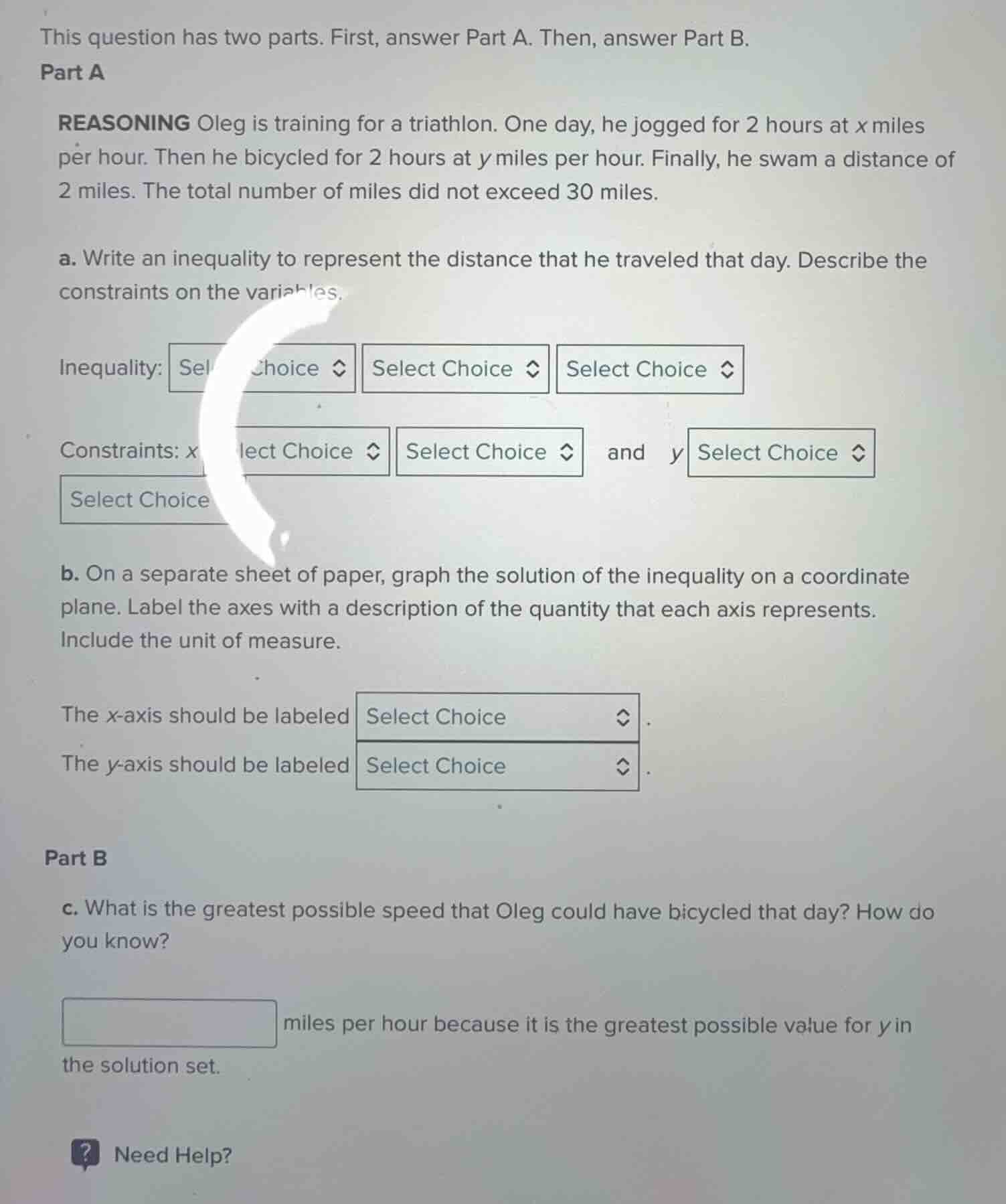
reasoning oleg is training for a triathlon. one day, he jogged for 2 hours at x miles per hour. then he bicycled for 2 hours at y miles per hour. finally, he swam a distance of 2 miles. the total number of miles did not exceed 30 miles.
a. write an inequality to represent the distance that he traveled that day. describe the constraints on the variables.
inequality: select choice select choice select choice
constraints: x select choice select choice and y select choice select choice
b. on a separate sheet of paper, graph the solution of the inequality on a coordinate plane. label the axes with a description of the quantity that each axis represents. include the unit of measure.
the x-axis should be labeled select choice
the y-axis should be labeled select choice
part b
c. what is the greatest possible speed that oleg could have bicycled that day? how do you know?
____ miles per hour because it is the greatest possible value for y in the solution set.
need help?
Step1: Calculate jogging distance
Distance = speed × time, so jogging distance is $2x$ miles.
Step2: Calculate bicycling distance
Bicycling distance is $2y$ miles.
Step3: Set up total distance inequality
Total distance (jog + bike + swim) ≤ 30:
$$2x + 2y + 2 \leq 30$$
Simplify: $2x + 2y \leq 28$, then $x + y \leq 14$
Step4: Define variable constraints
Speeds are positive values: $x > 0$, $y > 0$
Step5: Label coordinate axes
x-axis: Jogging speed (miles per hour)
y-axis: Bicycling speed (miles per hour)
Step6: Find max bicycling speed
Set $x=0$ (minimum jog speed): $0 + y \leq 14$, so $y=14$

Snap & solve any problem in the app
Get step-by-step solutions on Sovi AI
Photo-based solutions with guided steps
Explore more problems and detailed explanations
Part A a.
Inequality: $2x + 2y + 2 \leq 30$ (or simplified $x + y \leq 14$)
Constraints: $x > 0$ and $y > 0$
Part A b.
The x-axis should be labeled: Jogging speed (miles per hour)
The y-axis should be labeled: Bicycling speed (miles per hour)
Part B c.
14 miles per hour because it is the greatest possible value for y in the solution set.