QUESTION IMAGE
Question
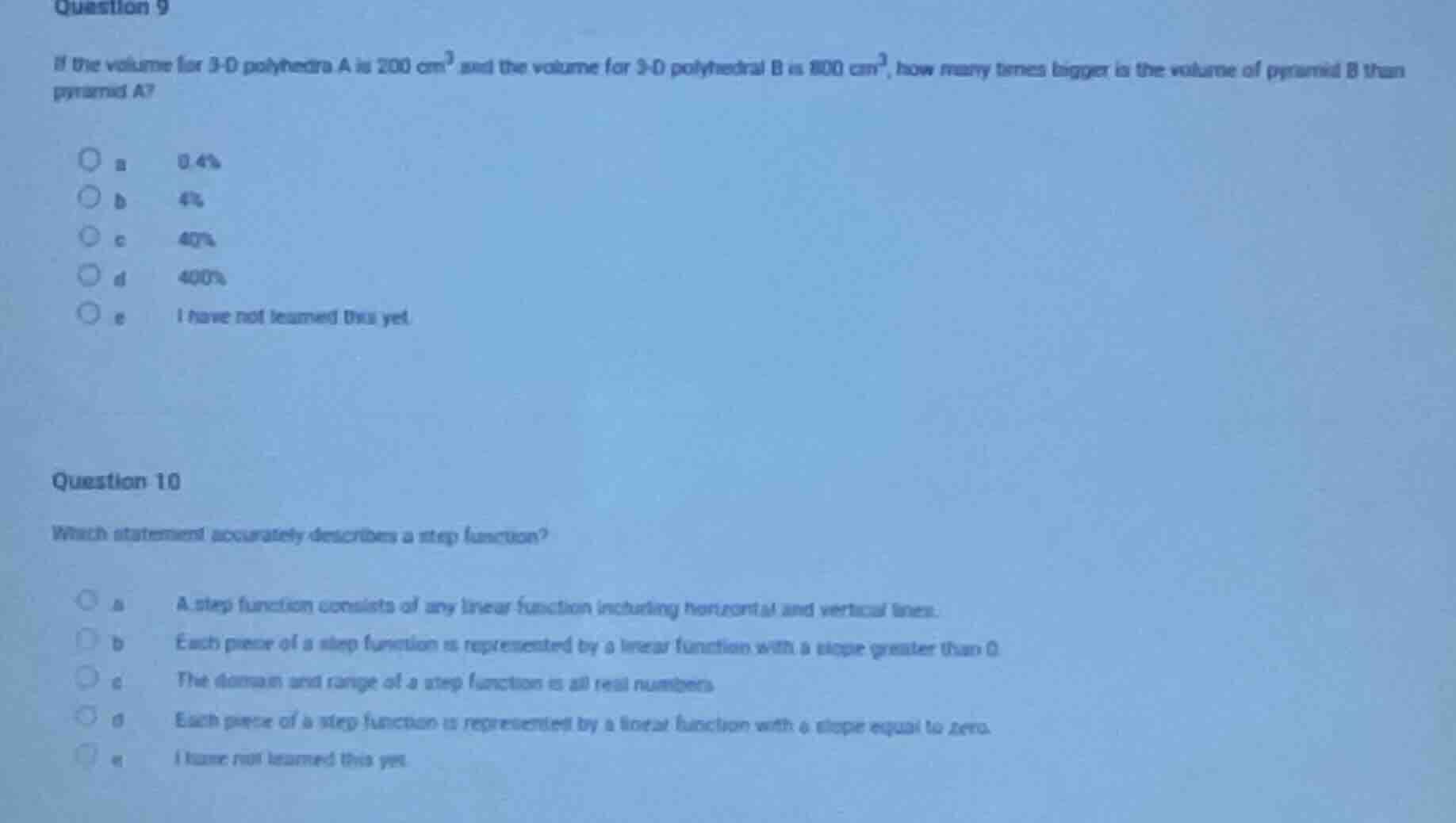
question 9
if the volume for 3 - d polyhedra a is 200 cm³ and the volume for 3 - d polyhedral b is 800 cm³, how many times bigger is the volume of pyramid b than pyramid a?
a 0.4%
b 4%
c 40%
d 400%
e i have not learned this yet.
question 10
which statement accurately describes a step function?
a a step function consists of any linear function including horizontal and vertical lines.
b each piece of a step function is represented by a linear function with a slope greater than 0.
c the domain and range of a step function is all real numbers
d each piece of a step function is represented by a linear function with a slope equal to zero.
e i have not learned this yet.
Question 9
Step1: Find the ratio of volumes
To find how many times bigger the volume of B is than A, we calculate the ratio of the volume of B to the volume of A. The volume of A is \(200\space cm^3\) and the volume of B is \(800\space cm^3\). So the ratio is \(\frac{800}{200}\).
\(\frac{800}{200}=4\)
Step2: Convert the ratio to a percentage
To convert the ratio to a percentage, we multiply by \(100\%\). So \(4\times100\% = 400\%\).
- Option a: A step function is not just any linear function; vertical lines are not functions, and step functions have horizontal segments (constant) and jumps, not general linear functions. Eliminate a.
- Option b: Step function pieces are constant (slope 0), not with slope greater than 0. Eliminate b.
- Option c: The range of a step function is a set of discrete values (not all real numbers), and the domain can be all real numbers but the range is not. Eliminate c.
- Option d: Each piece of a step function is a horizontal line segment, which is a linear function with slope \(0\) (since \(y = c\) has slope \(0\)). This is correct.
- Option e: Not applicable as we can determine the answer.

Snap & solve any problem in the app
Get step-by-step solutions on Sovi AI
Photo-based solutions with guided steps
Explore more problems and detailed explanations
d. 400%