QUESTION IMAGE
Question
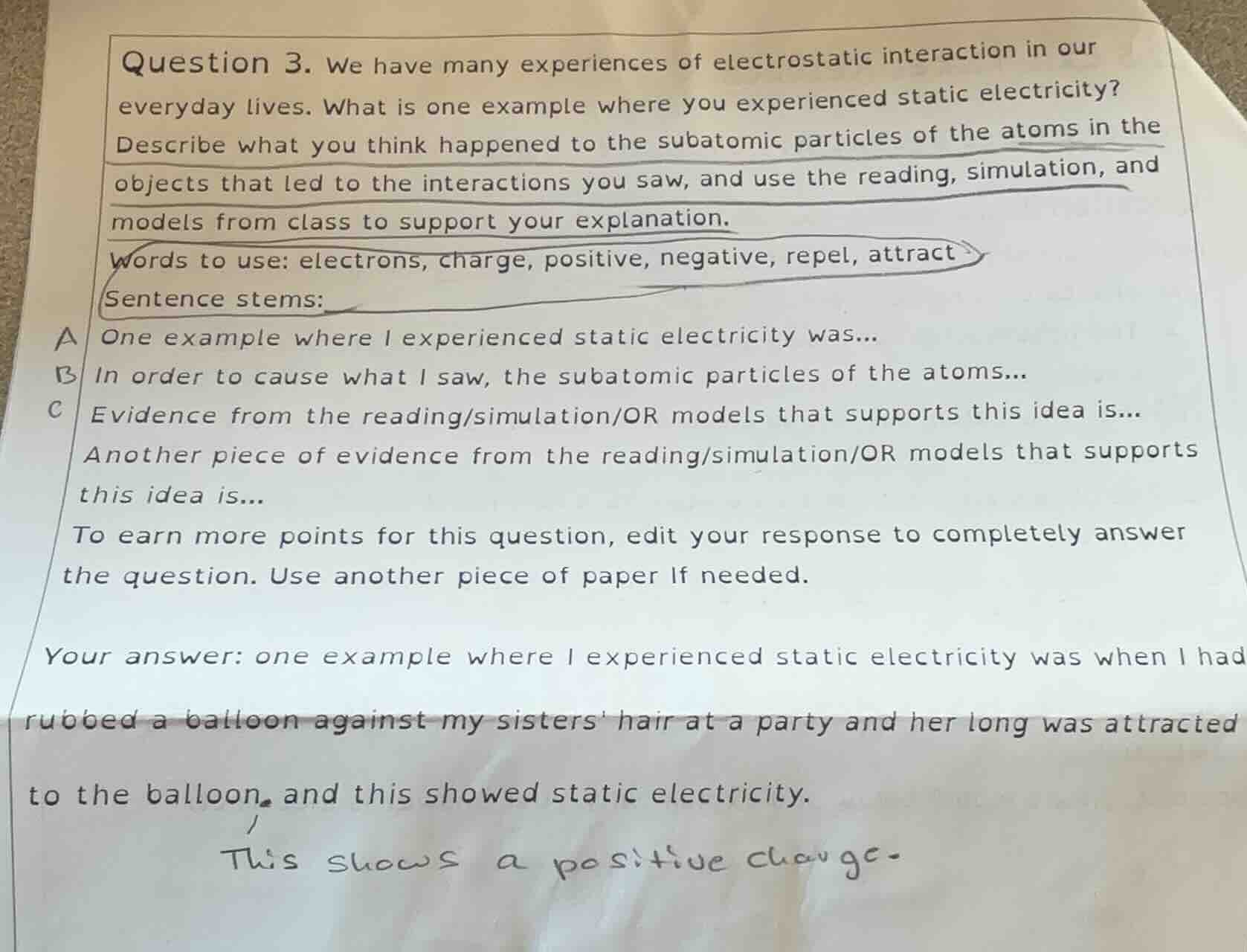
question 3. we have many experiences of electrostatic interaction in our everyday lives. what is one example where you experienced static electricity? describe what you think happened to the subatomic particles of the atoms in the objects that led to the interactions you saw, and use the reading, simulation, and models from class to support your explanation. words to use: electrons, charge, positive, negative, repel, attract sentence stems: a one example where i experienced static electricity was... b in order to cause what i saw, the subatomic particles of the atoms... c evidence from the reading/simulation/or models that supports this idea is... another piece of evidence from the reading/simulation/or models that supports this idea is... to earn more points for this question, edit your response to completely answer the question. use another piece of paper if needed. your answer: one example where i experienced static electricity was when i had rubbed a balloon against my sisters hair at a party and her long was attracted to the balloon, and this showed static electricity. this shows a positive charge-
- Example of static electricity: Rubbing a balloon on hair (like the given example) is a common static electricity experience. When the balloon is rubbed against hair, electrons (negatively charged) transfer from the hair to the balloon. This makes the balloon negatively charged and the hair positively charged (since it lost electrons). Opposite charges attract, so the hair is attracted to the balloon. Also, if you rub a comb on hair and then hold it near small pieces of paper, the comb (which gains or loses electrons, depending on the materials) will attract the paper due to static charge.
- Subatomic particle behavior: Atoms are neutral with equal protons (positive) and electrons (negative). When two objects rub, electrons can move. For the balloon - hair example, the balloon (maybe made of rubber) has a greater affinity for electrons, so electrons move from the hair (made of keratin) to the balloon. So the hair atoms lose electrons, becoming positively charged (since protons > electrons now), and the balloon atoms gain electrons, becoming negatively charged (electrons > protons). Then, the opposite charges (positive hair, negative balloon) cause attraction, which is why the hair sticks to the balloon.
- Supporting evidence: From class models, like the triboelectric series (a model showing which materials gain or lose electrons when rubbed together), rubber (balloon) is higher on the series (gains electrons) and hair (keratin) is lower (loses electrons). Also, in static electricity simulations, when you rub two objects, you can see charge transfer and then attraction/repulsion (like a charged rod attracting neutral paper, which is polarized).

Snap & solve any problem in the app
Get step-by-step solutions on Sovi AI
Photo-based solutions with guided steps
Explore more problems and detailed explanations
One example where I experienced static electricity was when I rubbed a balloon against my hair and then the balloon stuck to a wall. In order to cause what I saw, the subatomic particles of the atoms: when I rubbed the balloon on my hair, electrons (negatively charged) transferred from my hair's atoms to the balloon's atoms. My hair's atoms then had more protons (positive charge) than electrons, so they became positively charged. The balloon's atoms had more electrons than protons, so they became negatively charged. Then, when I brought the negatively charged balloon near the neutral wall, the wall's atoms became polarized (electrons in the wall atoms moved slightly), and the positive part of the wall atoms was attracted to the negative balloon, making it stick. Evidence from the reading/simulation/models that supports this idea is the triboelectric series model, which shows that rubber (balloon material) tends to gain electrons when rubbed with hair (keratin - based), leading to charge separation. Another piece of evidence from the reading/simulation/models that supports this idea is the simulation of static charge where a charged object attracts neutral objects due to polarization, just like the balloon attracted the wall.