QUESTION IMAGE
Question
question
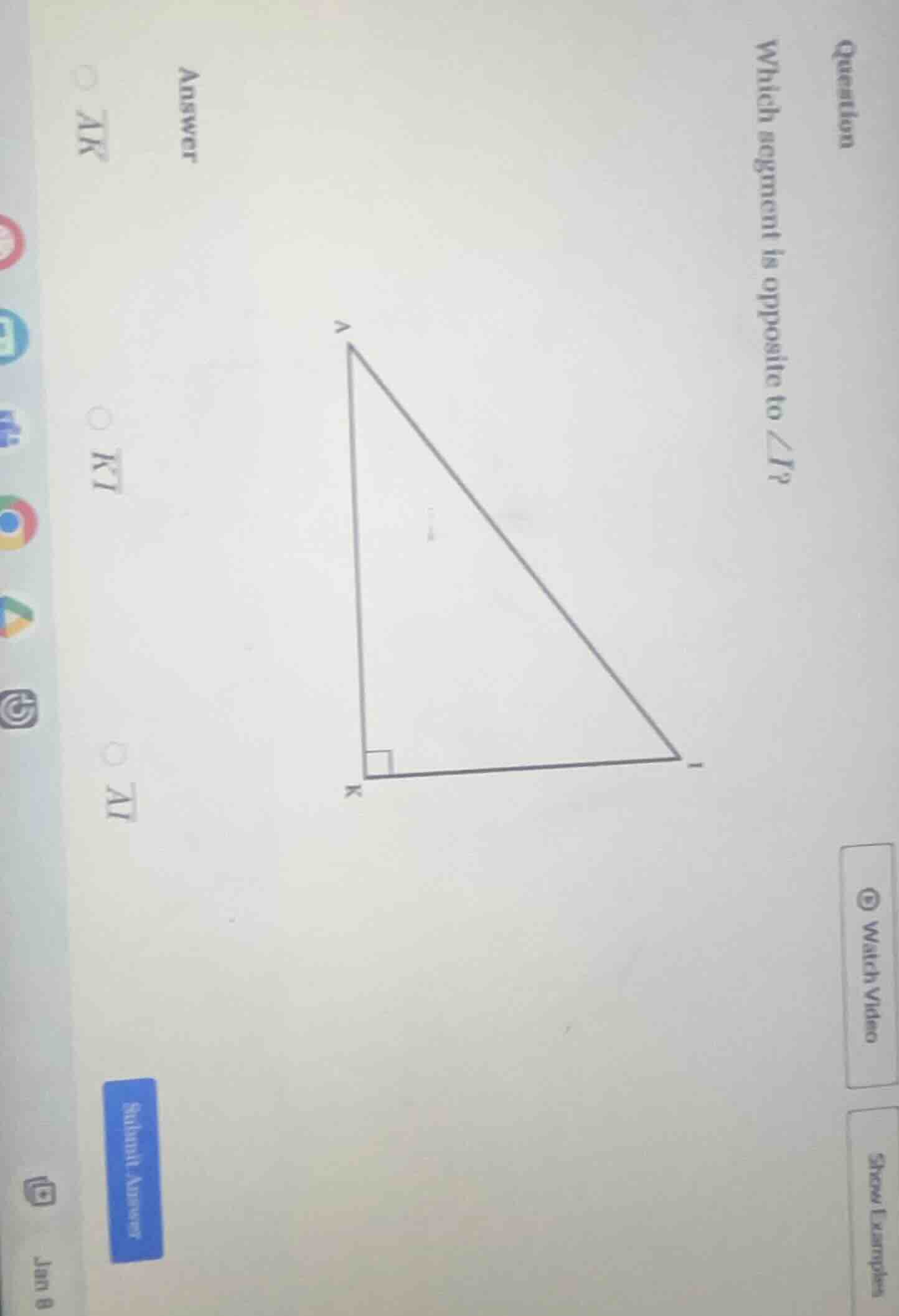
which segment is opposite to ∠i?
answer
options: (overline{ak}), (overline{ki}), (overline{ai}) (triangle with right angle at k, vertices a, k, i)
Step1: Recall triangle side-angle opposite rule
In a triangle, the side opposite an angle is the side that does not form the angle (i.e., the side with endpoints not including the angle's vertex). For \(\angle I\) (vertex at \(I\)) in \(\triangle IKA\) (right - angled at \(K\)), we need to find the side with endpoints not \(I\).
Step2: Identify the sides and angle
The angle \(\angle I\) has vertices \(I\), and the sides forming \(\angle I\) are \( \overline{KI}\) and \( \overline{AI}\). The side opposite \(\angle I\) should be the side that is not connected to \(I\) at both ends. The side \(\overline{AK}\) has endpoints \(A\) and \(K\), and does not include \(I\) as a vertex. The side \(\overline{KI}\) is adjacent to \(\angle I\) (forms the angle), and \(\overline{AI}\) is also adjacent (forms the angle). So the side opposite \(\angle I\) is \(\overline{AK}\). Wait, no, wait. Wait, the triangle is \( \triangle AKI\) (right - angled at \(K\)). So vertices are \(A\), \(K\), \(I\). Angle at \(I\): the sides meeting at \(I\) are \( \overline{KI}\) and \( \overline{AI}\). So the side opposite angle \(I\) is the side that is opposite to vertex \(I\), which is \( \overline{AK}\)? Wait, no, let's label the triangle properly. Let's see, the right angle is at \(K\), so triangle \(AKI\) with right angle at \(K\). So angle at \(I\): the sides are \( KI\) (from \(K\) to \(I\)) and \( AI\) (from \(A\) to \(I\)). So the side opposite angle \(I\) is the side that is not part of angle \(I\), so it's the side between \(A\) and \(K\), which is \( \overline{AK}\)? Wait, no, maybe I made a mistake. Wait, in a triangle, the side opposite angle \(X\) is named by the other two vertices. So for angle at \(I\), the side opposite is \( \overline{AK}\) (since the other two vertices are \(A\) and \(K\)). Wait, but let's check the options. The options are \( \overline{AK}\), \( \overline{KI}\), \( \overline{AI}\)? Wait, no, the options in the image (from the text) are \( \overline{AK}\), \( \overline{KI}\), \( \overline{AI}\)? Wait, the user's options: first option \( \overline{AK}\), second \( \overline{KI}\), third \( \overline{AI}\)? Wait, no, the original problem's options: looking at the image, the options are \( \overline{AK}\), \( \overline{KI}\), \( \overline{AI}\) (maybe typo as \( \overline{AI}\) was written as \( \overline{AI}\) or \( \overline{AI}\)). Wait, no, let's re - examine. The triangle is right - angled at \(K\), so vertices \(A\), \(K\), \(I\). So angle at \(I\): the sides forming angle \(I\) are \( \overline{KI}\) (from \(K\) to \(I\)) and \( \overline{AI}\) (from \(A\) to \(I\)). So the side opposite angle \(I\) is the side that is opposite to vertex \(I\), which is the side connecting the other two vertices, \(A\) and \(K\), so \( \overline{AK}\). Wait, but maybe I got the angle wrong. Wait, the angle is \(\angle I\), so vertex \(I\). So in triangle notation, the side opposite angle \(I\) is denoted as \( AK\) (using the standard notation where side opposite angle \(I\) is \( ak\) if the triangle is \( \triangle ABC\), side opposite \(A\) is \( a\) (BC), opposite \(B\) is \( b\) (AC), opposite \(C\) is \( c\) (AB)). So in \( \triangle AKI\), angle at \(I\), so side opposite is \( AK\) (since side opposite angle \(I\) is between \(A\) and \(K\)). So the correct side opposite \(\angle I\) is \( \overline{AK}\). Wait, but let's check again. If we have triangle \(AKI\), right - angled at \(K\). So:
- Angle at \(A\): opposite side is \( KI\)
- Angle at \(K\): opposite side is \( AI\) (hypotenuse)
- Angle at \(I\): opposite side is \( AK\…

Snap & solve any problem in the app
Get step-by-step solutions on Sovi AI
Photo-based solutions with guided steps
Explore more problems and detailed explanations
\(\overline{AK}\) (assuming the first option is \(\overline{AK}\), so the answer is the option with \(\overline{AK}\), e.g., if the first option is A. \(\overline{AK}\), then A. \(\overline{AK}\))