QUESTION IMAGE
Question
question 2
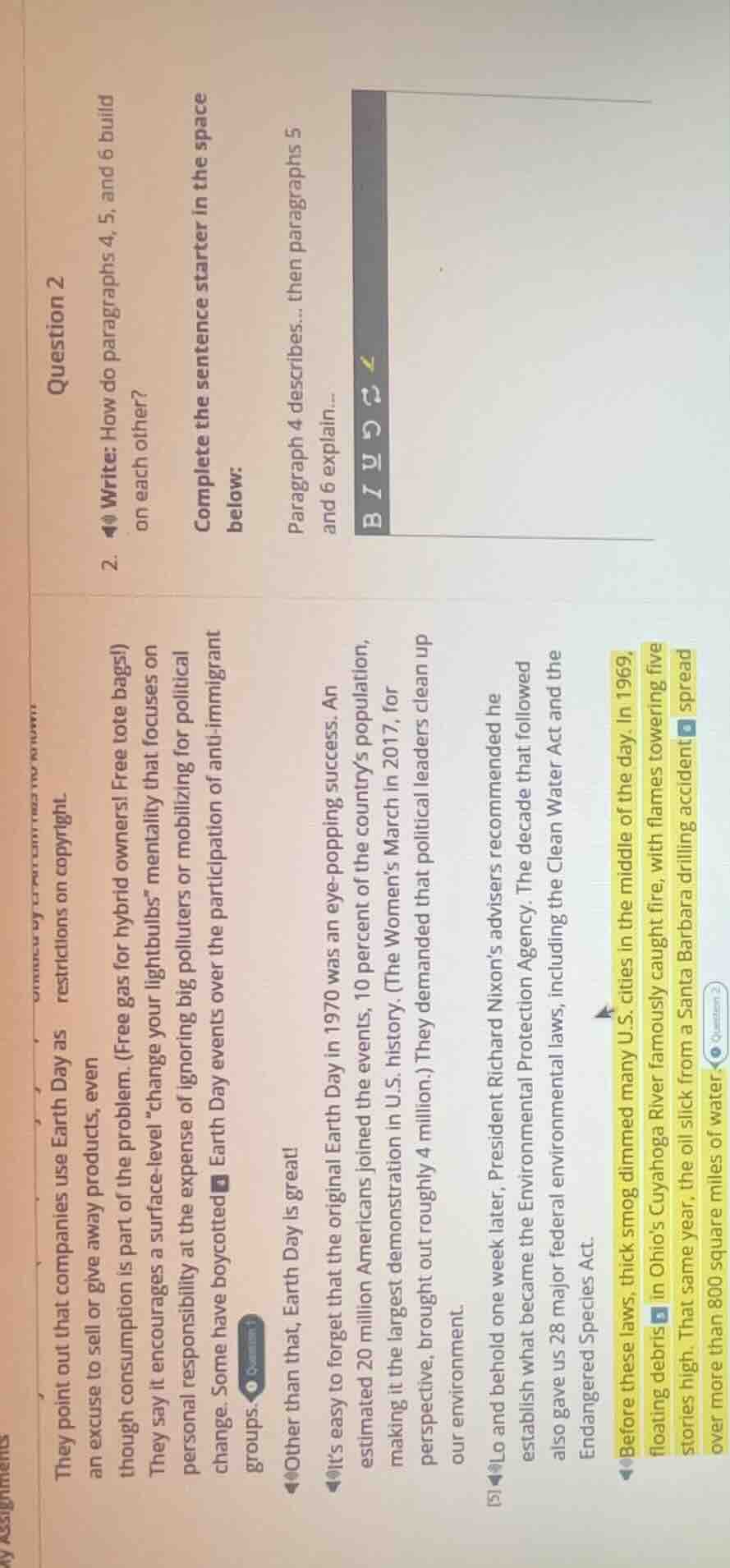
- write: how do paragraphs 4, 5, and 6 build on each other?
complete the sentence starter in the space below:
paragraph 4 describes... then paragraphs 5 and 6 explain...
they point out that companies use earth day as an excuse to sell or give away products, even though consumption is part of the problem. (free gas for hybrid owners! free tote bags!) they say it encourages a surface - level “change your lightbulbs” mentality that focuses on personal responsibility at the expense of ignoring big polluters or mobilizing for political change. some have boycotted earth day events over the participation of anti - immigrant groups.
other than that, earth day is great
it’s easy to forget that the original earth day in 1970 was an eye - popping success. an estimated 20 million americans joined the events, 10 percent of the country’s population, making it the largest demonstration in u.s. history. (the women’s march in 2017, for perspective, brought out roughly 4 million.) they demanded that political leaders clean up our environment.
lo and behold one week later, president richard nixon’s advisers recommended he establish what became the environmental protection agency. the decade that followed also gave us 28 major federal environmental laws, including the clean water act and the endangered species act.
before these laws, thick smog dimmed many u.s. cities in the middle of the day. in 1969, in ohio’s cuyahoga river famously caught fire, with flames towering five stories high. that same year, the oil slick from a santa barbara drilling accident spread over more than 800 square miles of water.
To answer how paragraphs 4, 5, and 6 build on each other, we analyze their content:
Paragraph 4:
It focuses on the success of the original Earth Day in 1970, highlighting the massive participation (20 million Americans, 10% of the population) and its role in mobilizing political leaders to address environmental issues.
Paragraph 5:
It follows up on the political action spurred by Earth Day, describing how President Nixon’s advisers recommended creating the Environmental Protection Agency (EPA) and the passage of major environmental laws (e.g., Clean Water Act, Endangered Species Act) in the decade after Earth Day.
Paragraph 6 (implied by the “Before these laws” context):
It provides context for the need for such laws by describing severe environmental crises (e.g., smog, river fires, oil spills) that existed before the legislation was enacted.
How They Build on Each Other:
- Paragraph 4 establishes the momentum and public support generated by Earth Day.
- Paragraph 5 shows how this momentum translated into policy and legislative action (EPA, environmental laws).
- Paragraph 6 (or the “Before these laws” section) explains the urgency for change by depicting the environmental disasters that existed prior to these laws, justifying the actions described in Paragraph 5.
In short, Paragraph 4 introduces the success of Earth Day, Paragraph 5 details the resulting policy changes, and Paragraph 6 (or its context) provides the pre - law environmental context that made these changes necessary—creating a logical flow from problem (pre - law crises) to solution (Earth Day’s impact and subsequent legislation).

Snap & solve any problem in the app
Get step-by-step solutions on Sovi AI
Photo-based solutions with guided steps
Explore more problems and detailed explanations
Paragraph 4 shows Earth Day’s success in mobilizing people. Paragraph 5 describes the resulting policy actions (EPA, laws). Paragraph 6 (or its context) provides pre - law environmental crises that justified these actions, creating a problem - to - solution flow.