QUESTION IMAGE
Question
question 3
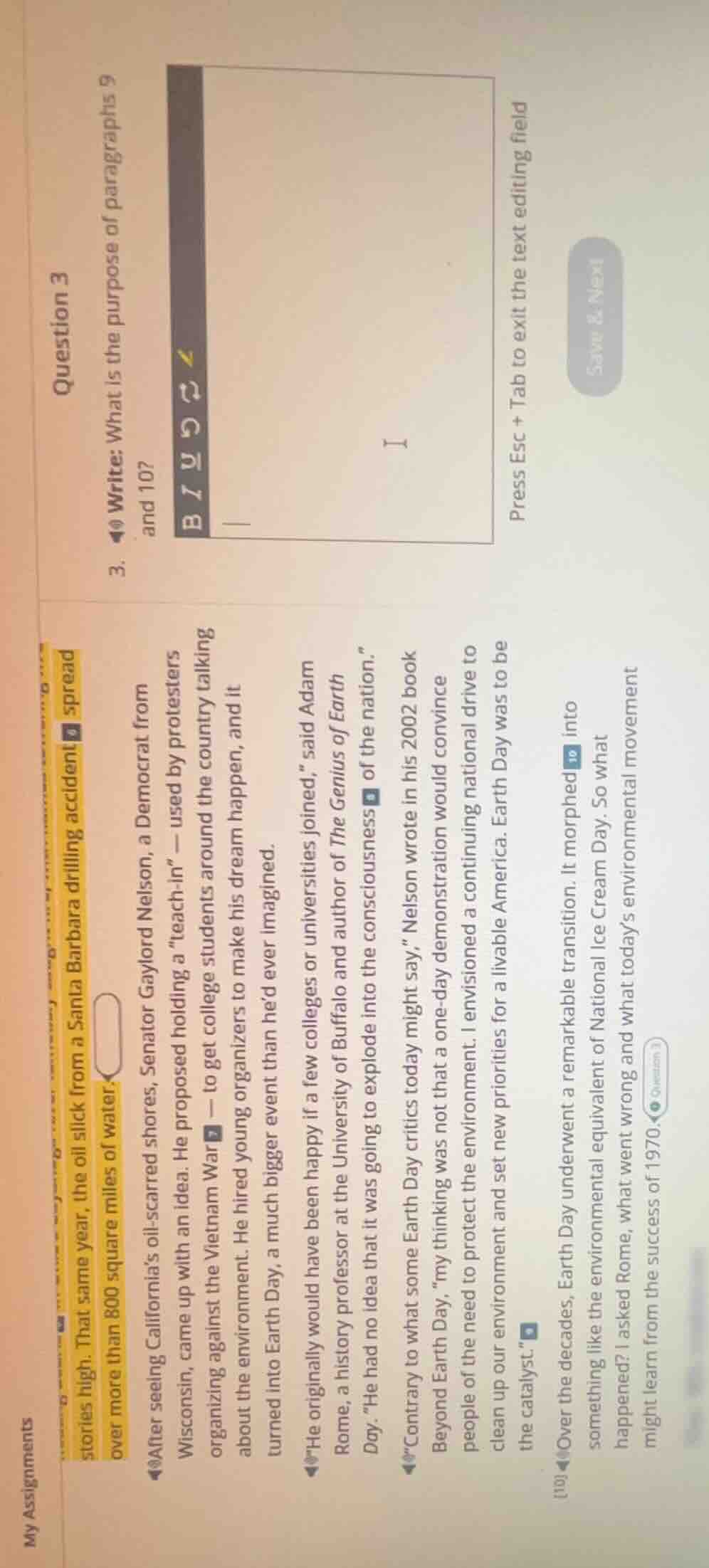
- write: what is the purpose of paragraphs 9 and 10?
that same year, the oil slick from a santa barbara drilling accident — spread over more than 800 square miles of water.
after seeing california’s oil - scarred shores, senator gaylord nelson, a democrat from wisconsin, came up with an idea. he proposed holding a “teach - in” — used by protesters organizing against the vietnam war — to get college students around the country talking about the environment. he hired young organizers to make his dream happen, and it turned into earth day, a much bigger event than he’d ever imagined.
“he originally would have been happy if a few colleges or universities joined,” said adam rome, a history professor at the university of buffalo and author of the genius of earth day. “he had no idea that it was going to explode into the consciousness of the nation.”
“contrary to what some earth day critics might say,” nelson wrote in his 2002 book beyond earth day, “my thinking was not that a one - day demonstration would convince people of the need to protect the environment. i envisioned a continuing national drive to clean up our environment and set new priorities for a livable america. earth day was to be the catalyst.”
over the decades, earth day underwent a remarkable transition. it morphed into something like the environmental equivalent of national ice cream day. so what happened? i asked rome, what went wrong and what today’s environmental movement might learn from the success of 1970.
To determine the purpose of paragraphs 9 and 10, we analyze their content:
Paragraph 9:
It describes the Santa Barbara oil spill (an environmental disaster) and Senator Gaylord Nelson’s response—organizing a “teach - in” against the Vietnam War, which evolved into Earth Day. This sets the context for Earth Day’s origins, showing how environmental concerns and anti - war organizing intersected to create the event.
Paragraph 10:
It details Adam Rome’s perspective on Earth Day’s growth (from a few colleges to a national movement) and Nelson’s vision (a demonstration to inspire environmental action). It also explains Earth Day’s role as a “catalyst” for environmental awareness and action.
Together, these paragraphs explain the origins and significance of Earth Day: how it was conceived (in response to environmental harm and anti - war organizing), how it grew beyond expectations, and its role in sparking the modern environmental movement. They provide historical context and highlight Earth Day’s impact on environmental consciousness and action in America.

Snap & solve any problem in the app
Get step-by-step solutions on Sovi AI
Photo-based solutions with guided steps
Explore more problems and detailed explanations
The purpose of paragraphs 9 and 10 is to explain the origins of Earth Day (including the events that inspired it, like the Santa Barbara oil spill and anti - Vietnam War organizing) and its significance as a catalyst for the modern environmental movement, detailing how it grew and influenced environmental awareness and action in the United States.