QUESTION IMAGE
Question
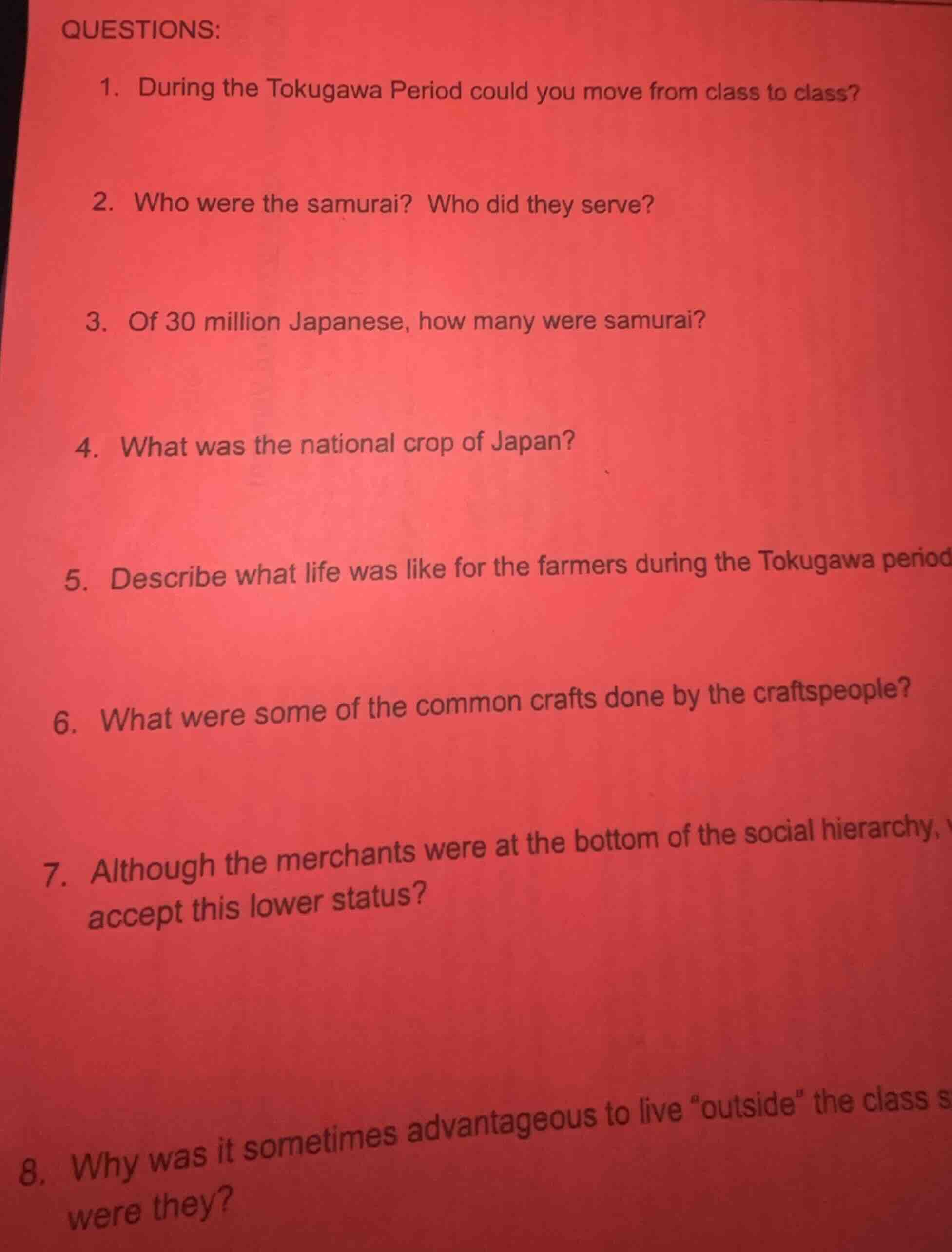
questions:
- during the tokugawa period could you move from class to class?
- who were the samurai? who did they serve?
- of 30 million japanese, how many were samurai?
- what was the national crop of japan?
- describe what life was like for the farmers during the tokugawa period
- what were some of the common crafts done by the craftspeople?
- although the merchants were at the bottom of the social hierarchy, accept this lower status?
- why was it sometimes advantageous to live \outside\ the class s were they?
Question 1
During the Tokugawa Period (Edo Period) in Japan, the social structure was highly rigid with a four - tiered class system (samurai, farmers, artisans, merchants). Movement between classes was generally not permitted by law. The Tokugawa shogunate enforced this rigid class structure to maintain social order and the power of the samurai class.
Samurai were the warrior class in feudal Japan during the Tokugawa Period. They followed a code of conduct called Bushido, which emphasized loyalty, honor, and martial skills. They served the daimyo (feudal lords). The daimyo were powerful landowners, and the samurai were responsible for protecting the daimyo's lands, enforcing their laws, and fighting in wars on their behalf.
During the Tokugawa Period, out of a population of around 30 million Japanese, the samurai class made up about 1.5 million. This proportion was relatively small, as the samurai were a privileged warrior class, and the majority of the population was composed of farmers, artisans, and merchants.

Snap & solve any problem in the app
Get step-by-step solutions on Sovi AI
Photo-based solutions with guided steps
Explore more problems and detailed explanations
During the Tokugawa Period, you generally could not move from class to class. The social structure was rigid with a four - tiered system (samurai, farmers, artisans, merchants) and legal restrictions prevented class mobility.