QUESTION IMAGE
Question
1.1.3 quiz: understanding causation and argumentation in u.s. history
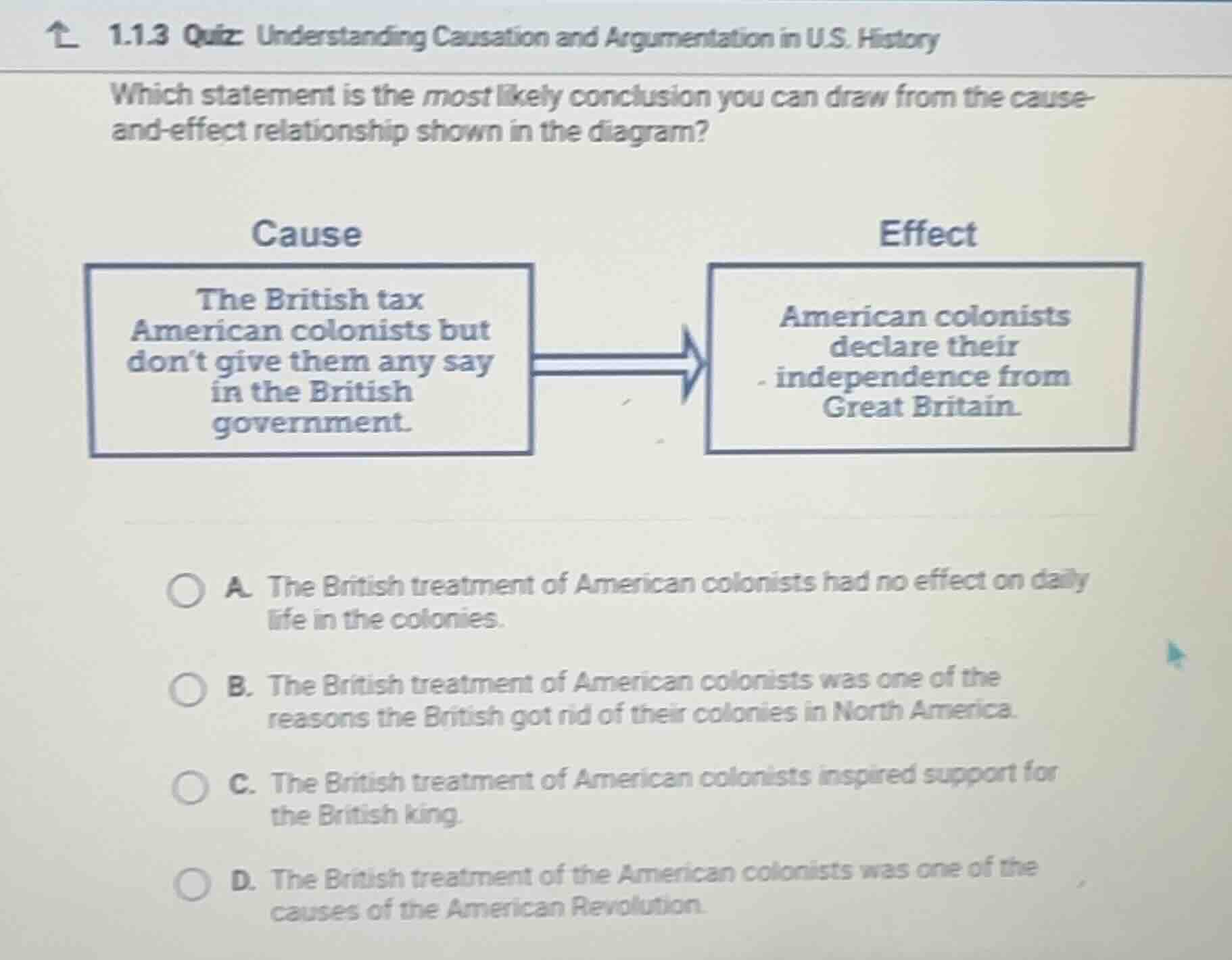
which statement is the most likely conclusion you can draw from the cause-and-effect relationship shown in the diagram?
cause
the british tax american colonists but don’t give them any say in the british government.
effect
american colonists declare their independence from great britain.
a. the british treatment of american colonists had no effect on daily life in the colonies.
b. the british treatment of american colonists was one of the reasons the british got rid of their colonies in north america.
c. the british treatment of american colonists inspired support for the british king.
d. the british treatment of the american colonists was one of the causes of the american revolution.
- Option A: The diagram shows a cause - effect relationship, so the British treatment did have an effect (the colonists declared independence), so A is wrong.
- Option B: The British did not "get rid of" their colonies; the colonists declared independence, so B is incorrect.
- Option C: The colonists declared independence, which means they did not support the British king, so C is wrong.
- Option D: The cause (British taxing colonists without representation) led to the effect (colonists declaring independence), and the American Revolution involved the colonists' fight for independence from Britain. So the British treatment was a cause of the American Revolution.

Snap & solve any problem in the app
Get step-by-step solutions on Sovi AI
Photo-based solutions with guided steps
Explore more problems and detailed explanations
D. The British treatment of the American colonists was one of the causes of the American Revolution.