QUESTION IMAGE
Question
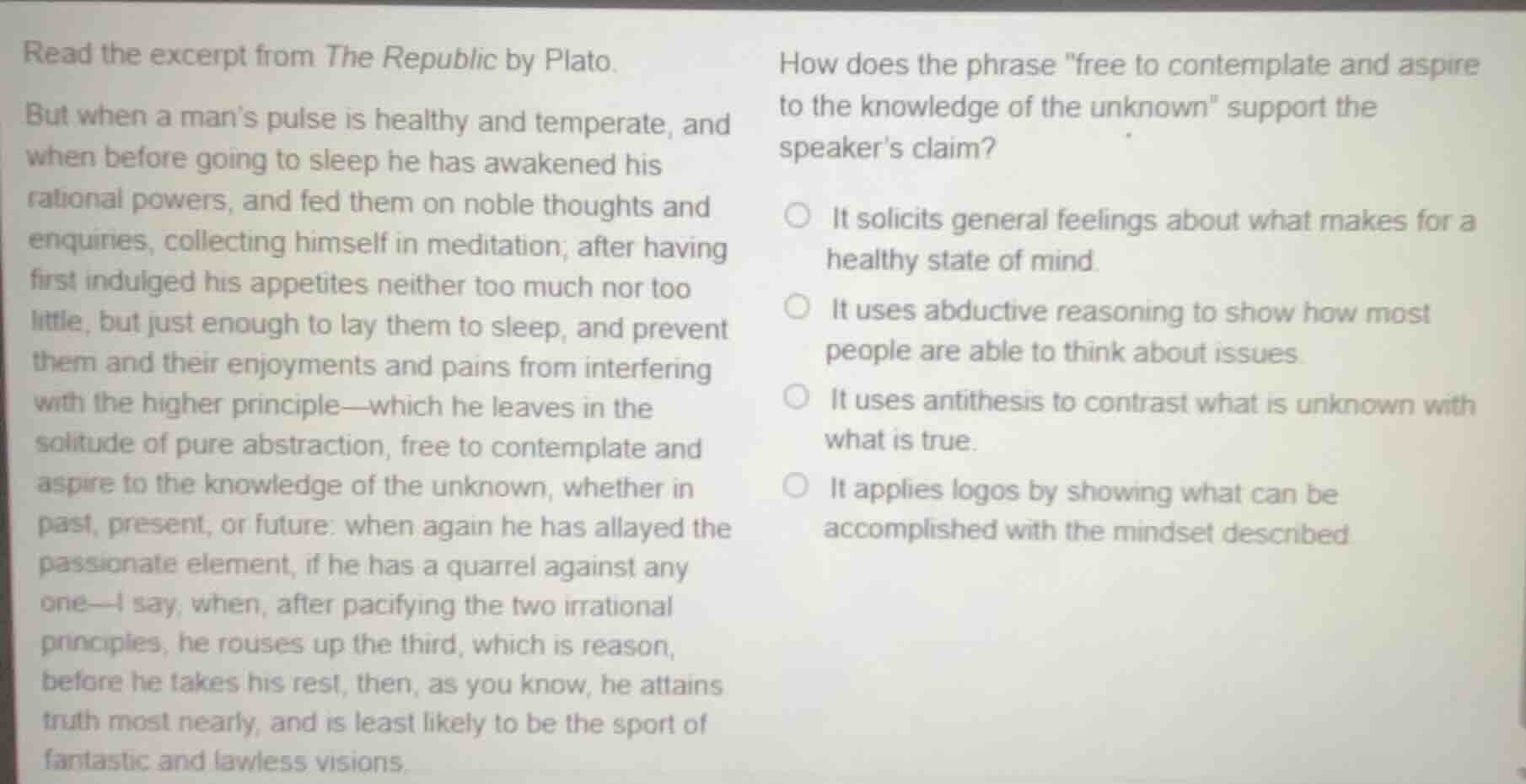
read the excerpt from the republic by plato. but when a man’s pulse is healthy and temperate, and when before going to sleep he has awakened his rational powers, and fed them on noble thoughts and enquires, collecting himself in meditation; after having first indulged his appetites neither too much nor too little, but just enough to lay them to sleep, and prevent them and their enjoyments and pains from interfering with the higher principle—which he leaves in the solitude of pure abstraction, free to contemplate and aspire to the knowledge of the unknown, whether in past, present, or future: when again he has allayed the passionate element, if he has a quarrel against any one—i say, when, after pacifying the two irrational principles, he rouses up the third, which is reason, before he takes his rest, then, as you know, he attains truth most nearly, and is least likely to be the sport of fantastic and lawless visions. how does the phrase \free to contemplate and aspire to the knowledge of the unknown\ support the speaker’s claim? it solicits general feelings about what makes for a healthy state of mind. it uses abductive reasoning to show how most people are able to think about issues. it uses antithesis to contrast what is unknown with what is true. it applies logos by showing what can be accomplished with the mindset described.
- Analyze Option A: The phrase is not about soliciting general feelings but about a rational, disciplined mindset for knowledge, so A is incorrect.
- Analyze Option B: Abductive reasoning involves inferring the best explanation, and the phrase doesn't use abductive reasoning or focus on "most people," so B is incorrect.
- Analyze Option C: Antithesis involves contrasting opposing ideas, and the phrase doesn't contrast "unknown" with "true" in that way, so C is incorrect.
- Analyze Option D: Logos is logical appeal. The excerpt describes a mindset (temperate, rational, meditative) that allows one to "contemplate and aspire to the knowledge of the unknown," showing what can be achieved with that mindset, which is logos. So D is correct.

Snap & solve any problem in the app
Get step-by-step solutions on Sovi AI
Photo-based solutions with guided steps
Explore more problems and detailed explanations
D. It applies logos by showing what can be accomplished with the mindset described.