QUESTION IMAGE
Question
read the passage about star and planet formation.
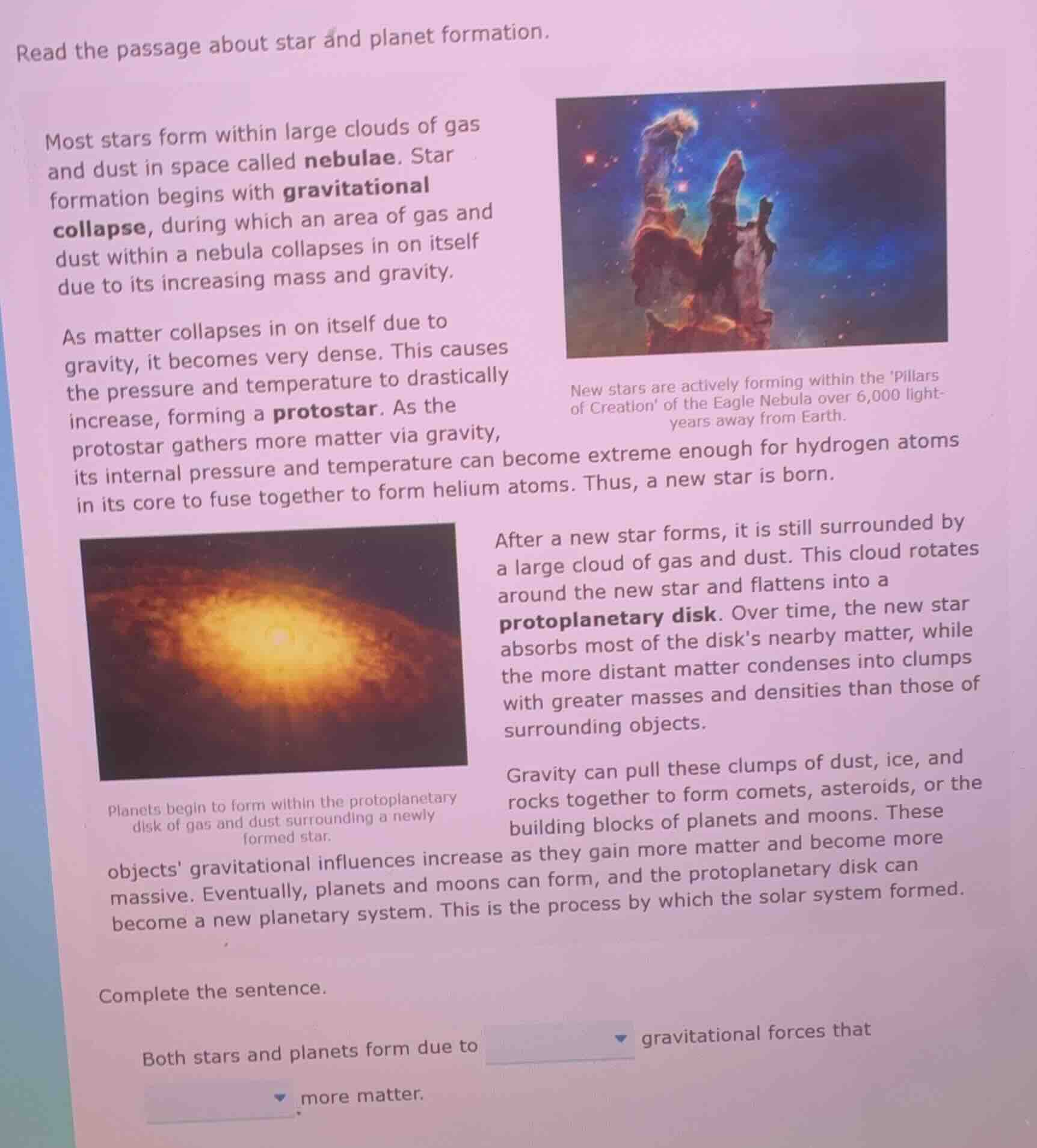
most stars form within large clouds of gas and dust in space called nebulae. star formation begins with gravitational collapse, during which an area of gas and dust within a nebula collapses in on itself due to its increasing mass and gravity.
as matter collapses in on itself due to gravity, it becomes very dense. this causes the pressure and temperature to drastically increase, forming a protostar. as the protostar gathers more matter via gravity, its internal pressure and temperature can become extreme enough for hydrogen atoms in its core to fuse together to form helium atoms. thus, a new star is born.
after a new star forms, it is still surrounded by a large cloud of gas and dust. this cloud rotates around the new star and flattens into a protoplanetary disk. over time, the new star absorbs most of the disks nearby matter, while the more distant matter condenses into clumps with greater masses and densities than those of surrounding objects.
gravity can pull these clumps of dust, ice, and rocks together to form comets, asteroids, or the building blocks of planets and moons. these objects gravitational influences increase as they gain more matter and become more massive. eventually, planets and moons can form, and the protoplanetary disk can become a new planetary system. this is the process by which the solar system formed.
complete the sentence.
both stars and planets form due to ▼ gravitational forces that
▼ more matter.
The passage states stars form when gravitational collapse pulls nebula matter inward, and planets form as gravity pulls clumps of matter together to accumulate more mass. Both processes rely on gravitational forces that draw in and gather additional matter.

Snap & solve any problem in the app
Get step-by-step solutions on Sovi AI
Photo-based solutions with guided steps
Explore more problems and detailed explanations
Both stars and planets form due to inward-pulling gravitational forces that gather/attract more matter.