QUESTION IMAGE
Question
read the passage. then answer the question below.
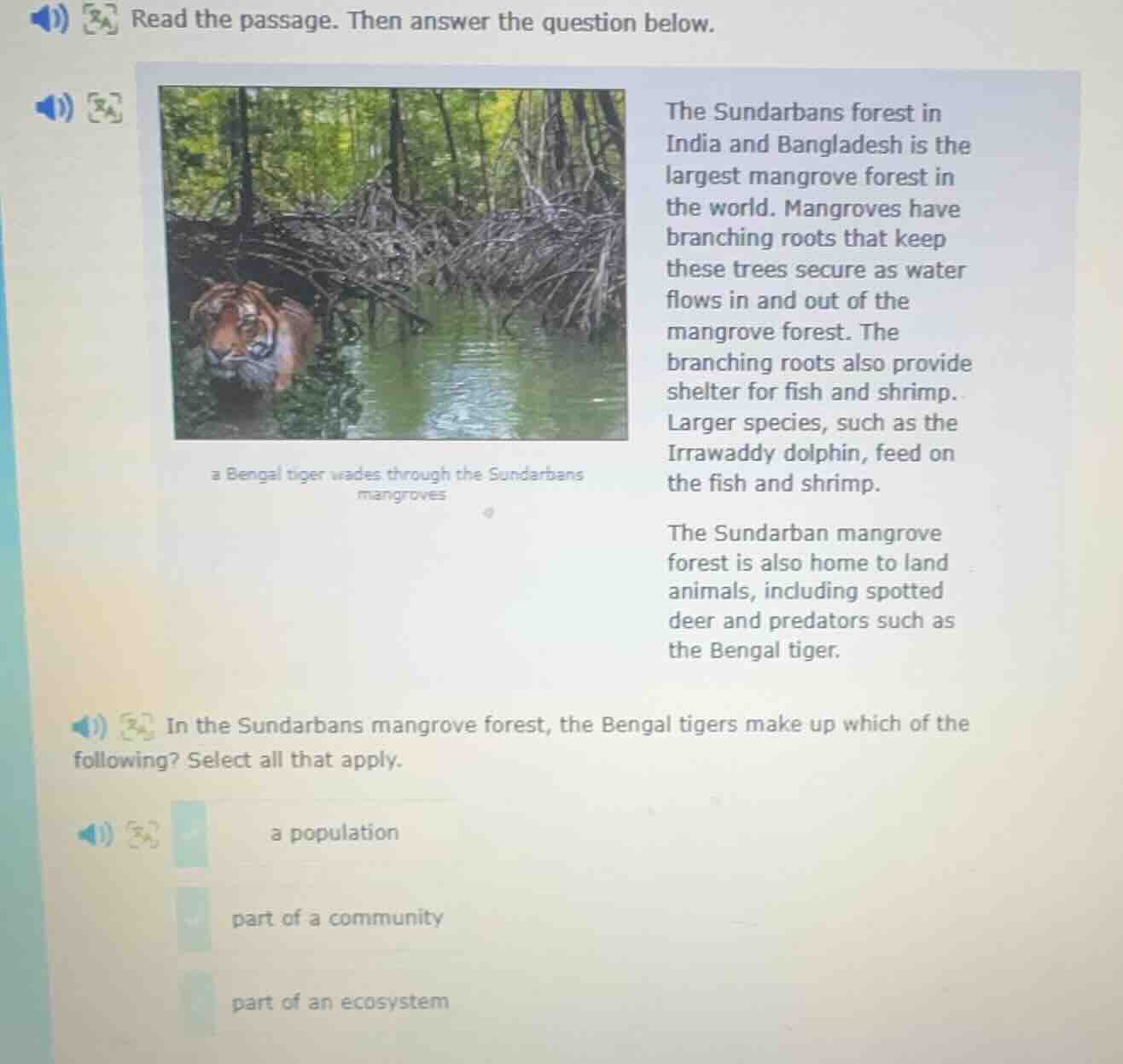
image: a bengal tiger wades through the sundarbans mangroves
the sundarbans forest in india and bangladesh is the largest mangrove forest in the world. mangroves have branching roots that keep these trees secure as water flows in and out of the mangrove forest. the branching roots also provide shelter for fish and shrimp. larger species, such as the irrawaddy dolphin, feed on the fish and shrimp.
the sundarban mangrove forest is also home to land animals, including spotted deer and predators such as the bengal tiger.
in the sundarbans mangrove forest, the bengal tigers make up which of the following? select all that apply.
- a population
- part of a community
- part of an ecosystem
- For "a population": A population is a group of individuals of the same species in a given area. In the Sundarbans, Bengal tigers are a single species, so all Bengal tigers there form a population.
- For "part of a community": A community consists of all populations (different species) in an area. Bengal tigers coexist with other species (like spotted deer, fish, shrimp, dolphins) in the Sundarbans, so they are part of the community.
- For "part of an ecosystem": An ecosystem includes all living (community) and non - living components (water, soil, roots, etc.) in an area. Since Bengal tigers are part of the community and the Sundarbans has non - living elements too, tigers are part of the ecosystem.

Snap & solve any problem in the app
Get step-by-step solutions on Sovi AI
Photo-based solutions with guided steps
Explore more problems and detailed explanations
a. a population
b. part of a community
c. part of an ecosystem