QUESTION IMAGE
Question
read the passage. then answer the question below.
the rocks and sand in the monument valley desert are rust colored, because they are rich in iron. the desert is located in the navajo nation, on the border between arizona and utah.
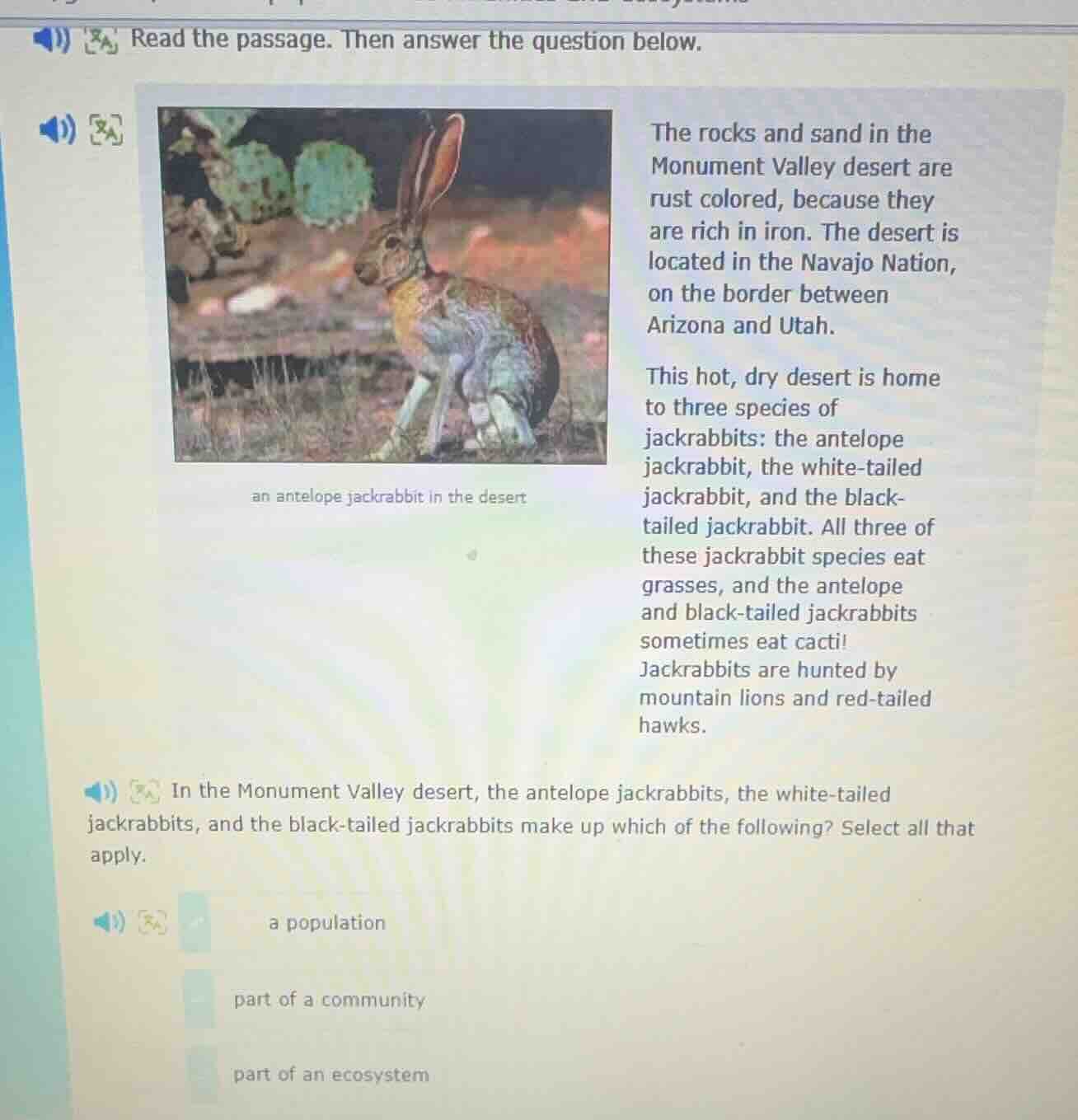
this hot, dry desert is home to three species of jackrabbits: the antelope jackrabbit, the white - tailed jackrabbit, and the black - tailed jackrabbit. all three of these jackrabbit species eat grasses, and the antelope and black - tailed jackrabbits sometimes eat cacti! jackrabbits are hunted by mountain lions and red - tailed hawks.
in the monument valley desert, the antelope jackrabbits, the white - tailed jackrabbits, and the black - tailed jackrabbits make up which of the following? select all that apply.
a population
part of a community
part of an ecosystem
- For "a population": A population is a group of individuals of the same species in a given area. Here, the three jackrabbit species are different species, so they don't form a single population. Wait, correction: Wait, the question is about the three species together. Wait, no—actually, a population is one species. But maybe the question considers them as part of the jackrabbit population (even though different species? No, species are distinct. Wait, maybe the problem has a different take. Wait, no, let's re - check: The three are different species (antelope, white - tailed, black - tailed jackrabbits). So a population is one species. But maybe the question is using a broader definition? Or maybe I made a mistake. Wait, no, let's look at the other options.
- For "part of a community": A community is all the different populations (species) in an area. The jackrabbits (three species) are part of the community of the Monument Valley desert (which includes mountain lions, red - tailed hawks, plants like cacti and grasses, etc.).
- For "part of an ecosystem": An ecosystem includes all the biotic (living) and abiotic (non - living, like rocks, sand, climate) components. The jackrabbits are biotic components, and the desert has abiotic components (rocks, sand, hot dry climate), so the jackrabbits are part of the ecosystem.
Wait, maybe the first option: If we consider that the three jackrabbit species are all jackrabbits (maybe the problem considers them as a population of jackrabbits, ignoring species differences for the question). But strictly, a population is one species. However, in some basic biology contexts, maybe they are considered a population of jackrabbits. But also, they are part of the community (with other species) and part of the ecosystem (with biotic and abiotic factors).
So:
- a population: If we consider the three species as a group of jackrabbits (even though different species, maybe the question's context), but strictly, a population is one species. But maybe the question intends this.
- part of a community: Yes, because a community is all species in an area, and the jackrabbits are among the species (along with mountain lions, hawks, plants).
- part of an ecosystem: Yes, because an ecosystem has biotic (jackrabbits) and abiotic (rocks, sand, climate) components.
So the correct options are "part of a community" and "part of an ecosystem", and maybe "a population" depending on the question's definition (if it considers the three species as a jackrabbit population).

Snap & solve any problem in the app
Get step-by-step solutions on Sovi AI
Photo-based solutions with guided steps
Explore more problems and detailed explanations
a. a population (depending on the question's context, but strictly, a population is one species. However, in the context of the question, it might be considered correct)
b. part of a community (correct, as they are part of the group of species in the desert)
c. part of an ecosystem (correct, as they interact with biotic and abiotic factors of the desert)
So the correct options are:
- part of a community
- part of an ecosystem
- (possibly a population, but with the strict definition, it's less accurate. But based on the question's likely intent, all three might be considered, but more accurately, part of a community and part of an ecosystem, and maybe a population in the question's context)