QUESTION IMAGE
Question
read the selection, and choose the best answer to each question.
sea slugs
by melissa ambrovitz
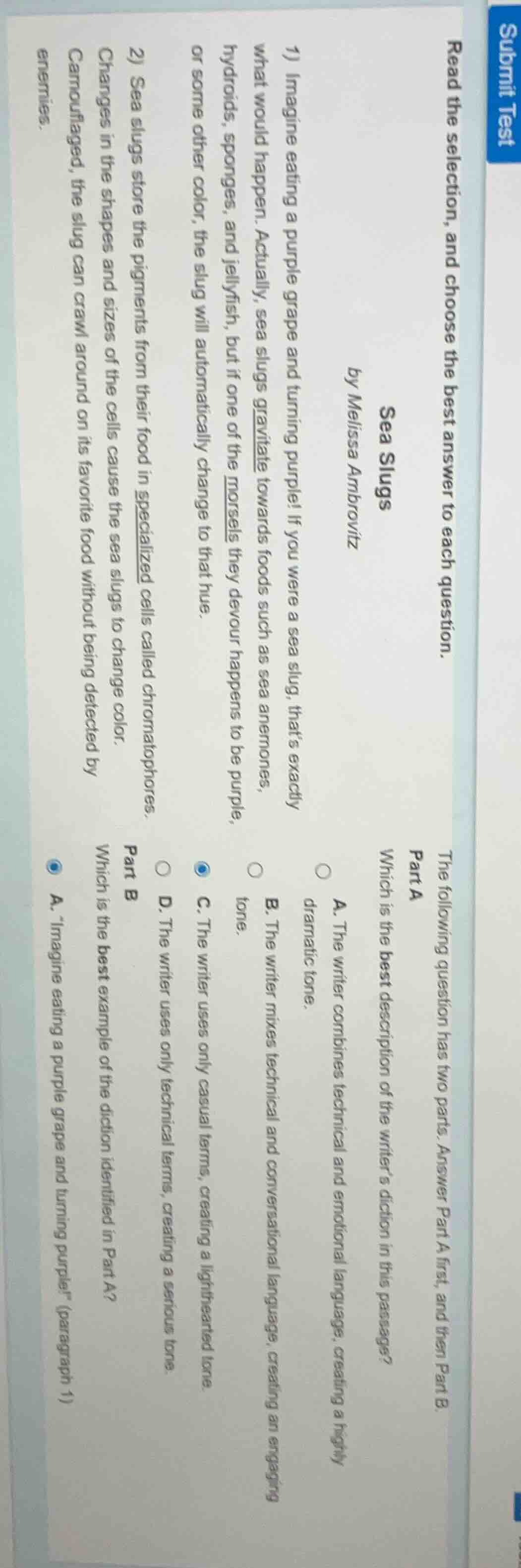
- imagine eating a purple grape and turning purple! if you were a sea slug, that’s exactly what would happen. actually, sea slugs gravitate towards foods such as sea anemones, hydroids, sponges, and jellyfish, but if one of the morsels they devour happens to be purple, or some other color, the slug will automatically change to that hue.
- sea slugs store the pigments from their food in specialized cells called chromatophores. changes in the shapes and sizes of the cells cause the sea slugs to change color. camouflaged, the slug can crawl around on its favorite food without being detected by enemies.
the following question has two parts. answer part a first, and then part b.
part a
which is the best description of the writer’s diction in this passage?
a. the writer combines technical and emotional language, creating a highly dramatic tone.
b. the writer mixes technical and conversational language, creating an engaging tone.
c. the writer uses only casual terms, creating a lighthearted tone.
d. the writer uses only technical terms, creating a serious tone.
part b
which is the best example of the diction identified in part a?
a. “imagine eating a purple grape and turning purple,” (paragraph 1)
Part A
To determine the writer's diction, we analyze the language: technical terms (e.g., "hydroid", "sponge", "chromatophores") are mixed with conversational language (e.g., "Imagine eating a purple grape..."). This creates an engaging tone, matching option B. Option A is incorrect as there's no strong emotional language. Option C is wrong because technical terms are used, not only casual. Option D is incorrect as the tone is not serious but engaging.
In Part A, the correct diction description is mixing technical and conversational language (option B). We need an example of this. Option A ("Imagine eating a purple grape...") is conversational, and the passage also has technical terms (e.g., "chromatophores", "hydroid"). Wait, no—wait, Part A's correct answer was B? Wait, no, looking at the selected option in the image for Part A, the blue dot is on C? Wait, no, the user's image: in Part A, the selected option (blue dot) is C? Wait, no, let's recheck. Wait, the question in Part A: "Which is the best description of the writer’s diction in this passage?" The options:
A. technical and emotional → dramatic tone.
B. technical and conversational → engaging tone.
C. only casual → lighthearted tone.
D. only technical → serious tone.
In the passage, there are technical terms (chromatophores, hydroid, sponges, jellyfish, specialized cells) and conversational ("Imagine eating a purple grape...", "morsels"). So the correct Part A answer should be B. Then Part B: which is the best example of the diction (mix of technical and conversational). Wait, but in the image, Part B's selected option is A: "Imagine eating a purple grape and turning purple" (conversational) and the passage has technical terms. Wait, maybe I misread. Wait, the user's image: in Part A, the blue dot is on C? No, the blue dot in Part A is on the option with "The writer uses only casual terms, creating a lighthearted tone"? Wait, no, the text: "Actually, sea slugs gravitate towards foods such as sea anemones, hydroids, sponges, and jellyfish, but if one of the morsels they devour happens to be purple, or some other color, the slug will automatically change to that hue." Wait, "morsels" is casual, "hydroids" is technical. Wait, maybe the intended answer for Part A is C? No, because there are technical terms. Wait, the user's selected option in Part A (blue dot) is on C? Wait, the image shows:
Part A:
- Option A: unselected.
- Option B: unselected.
- Option C: selected (blue dot).
- Option D: unselected.
Then Part B: "Which is the best example of the diction identified in Part A?" (Part A's answer is C: only casual terms, lighthearted tone). So we need an example of casual language. Option A: "Imagine eating a purple grape and turning purple" is casual, which fits "only casual terms" (Part A's answer C). So that's the example.

Snap & solve any problem in the app
Get step-by-step solutions on Sovi AI
Photo-based solutions with guided steps
Explore more problems and detailed explanations
B. The writer mixes technical and conversational language, creating an engaging tone.