QUESTION IMAGE
Question
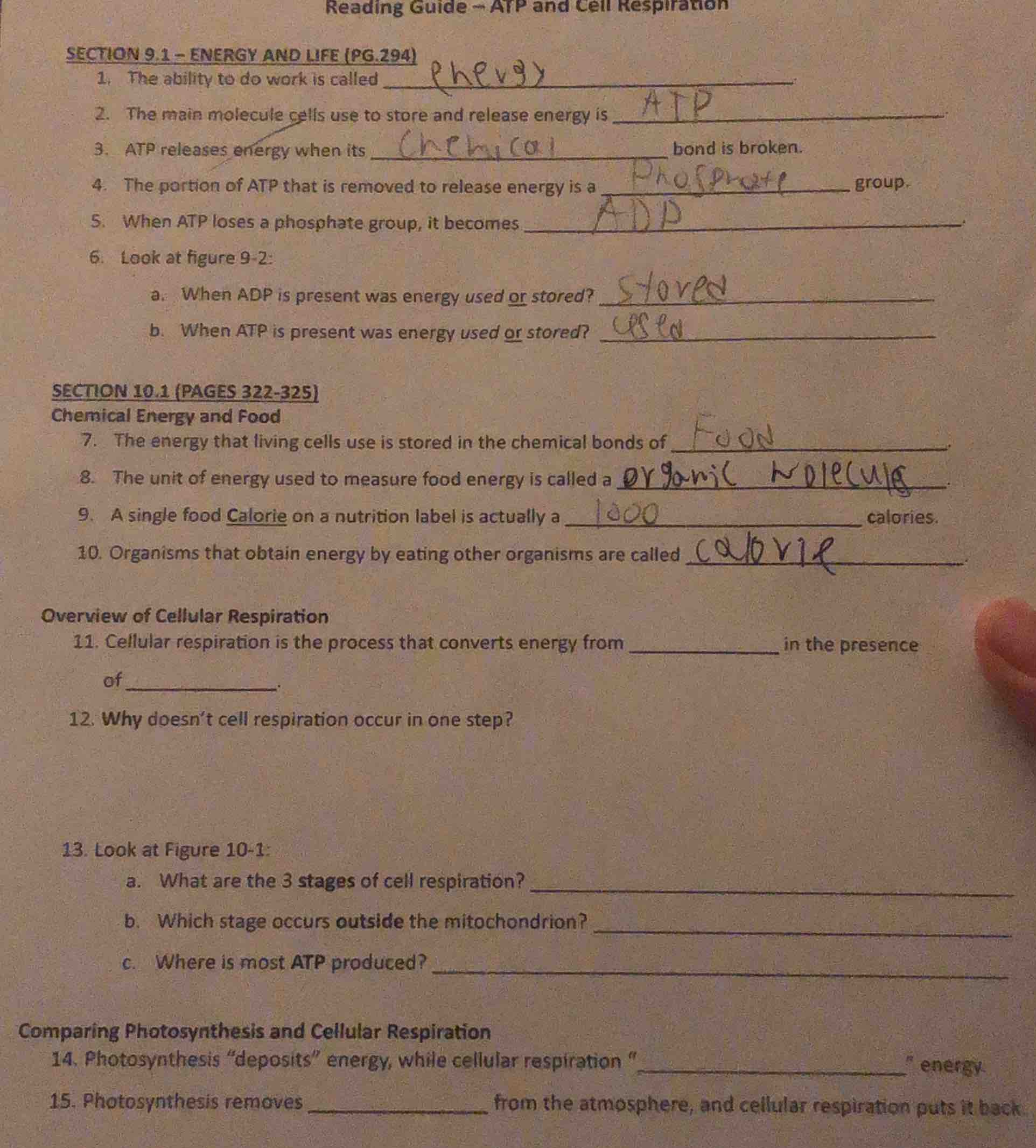
reading guide - atp and cell respiration
section 9.1 - energy and life (pg.294)
- the ability to do work is called
- the main molecule cells use to store and release energy is
- atp releases energy when its bond is broken.
- the portion of atp that is removed to release energy is a group.
- when atp loses a phosphate group, it becomes
- look at figure 9-2:
a. when adp is present was energy used or stored?
b. when atp is present was energy used or stored?
section 10.1 (pages 322-325)
chemical energy and food
- the energy that living cells use is stored in the chemical bonds of
- the unit of energy used to measure food energy is called a
- a single food calorie on a nutrition label is actually a calories.
- organisms that obtain energy by eating other organisms are called
overview of cellular respiration
- cellular respiration is the process that converts energy from in the presence
of
- why doesn’t cell respiration occur in one step?
- look at figure 10-1:
a. what are the 3 stages of cell respiration?
b. which stage occurs outside the mitochondrion?
c. where is most atp produced?
comparing photosynthesis and cellular respiration
- photosynthesis “deposits” energy, while cellular respiration “ ” energy.
- photosynthesis removes from the atmosphere, and cellular respiration puts it back.
To solve these questions, we'll refer to the concepts of ATP, cellular respiration, and related biological principles:
Section 9.1 – Energy and Life
- The ability to do work is called \(\boldsymbol{\text{energy}}\) (definition of energy).
- The main molecule cells use to store and release energy is \(\boldsymbol{\text{ATP}}\) (adenosine triphosphate is the energy currency of cells).
- ATP releases energy when its \(\boldsymbol{\text{high - energy (or phosphate)}}\) bond is broken (the terminal phosphate bond in ATP is high - energy; breaking it releases energy).
- The portion of ATP that is removed to release energy is a \(\boldsymbol{\text{phosphate}}\) group (ATP has three phosphate groups; removing one releases energy).
- When ATP loses a phosphate group, it becomes \(\boldsymbol{\text{ADP}}\) (ATP \(-\) phosphate \(=\) ADP, where ADP is adenosine diphosphate).
- a. When ADP is present was energy used or stored? \(\boldsymbol{\text{Stored}}\) (ADP is converted to ATP by adding a phosphate, which stores energy).
b. When ATP is present was energy used or stored? \(\boldsymbol{\text{Used}}\) (ATP is broken down to ADP, releasing energy for cellular work).
Section 10.1 – Chemical Energy and Food
- The energy that living cells use is stored in the chemical bonds of \(\boldsymbol{\text{food (or organic molecules)}}\) (food contains organic molecules like carbohydrates, lipids, proteins with stored chemical energy).
- The unit of energy used to measure food energy is called a \(\boldsymbol{\text{Calorie (or kilocalorie)}}\) (food energy is measured in Calories, where 1 Calorie \( = 1000\) small - c calories).
- A single food Calorie on a nutrition label is actually a \(\boldsymbol{\text{1000}}\) calories (by definition, 1 food Calorie \(= 1\) kilocalorie \( = 1000\) calories).
- Organisms that obtain energy by eating other organisms are called \(\boldsymbol{\text{consumers (or heterotrophs)}}\) (consumers/heterotrophs depend on other organisms for food).
Overview of Cellular Respiration
- Cellular respiration is the process that converts energy from \(\boldsymbol{\text{food (glucose)}}\) in the presence of \(\boldsymbol{\text{oxygen}}\) (cellular respiration uses glucose and oxygen to produce ATP).
- Why doesn’t cell respiration occur in one step? If cellular respiration occurred in one step, too much energy would be released at once (as heat), which would be inefficient and potentially harmful to the cell. Instead, it occurs in multiple steps to capture energy gradually (in the form of ATP).
- a. What are the 3 stages of cell respiration? \(\boldsymbol{\text{Glycolysis, Krebs Cycle (Citric Acid Cycle), Electron Transport Chain}}\) (these are the three main stages of aerobic cellular respiration).
b. Which stage occurs outside the mitochondrion? \(\boldsymbol{\text{Glycolysis}}\) (glycolysis takes place in the cytoplasm).
c. Where is most ATP produced? \(\boldsymbol{\text{Electron Transport Chain (in the mitochondria)}}\) (the electron transport chain produces the majority of ATP during cellular respiration).
Comparing Photosynthesis and Cellular Respiration
- Photosynthesis “deposits” energy, while cellular respiration “ \(\boldsymbol{\text{withdraws}}\) ” energy (photosynthesis stores energy in glucose; cellular respiration releases it).
- Photosynthesis removes \(\boldsymbol{\text{carbon dioxide (CO}_2\text{)}}\) from the atmosphere, and cellular respiration puts it back (photosynthesis us…

Snap & solve any problem in the app
Get step-by-step solutions on Sovi AI
Photo-based solutions with guided steps
Explore more problems and detailed explanations
To solve these questions, we'll refer to the concepts of ATP, cellular respiration, and related biological principles:
Section 9.1 – Energy and Life
- The ability to do work is called \(\boldsymbol{\text{energy}}\) (definition of energy).
- The main molecule cells use to store and release energy is \(\boldsymbol{\text{ATP}}\) (adenosine triphosphate is the energy currency of cells).
- ATP releases energy when its \(\boldsymbol{\text{high - energy (or phosphate)}}\) bond is broken (the terminal phosphate bond in ATP is high - energy; breaking it releases energy).
- The portion of ATP that is removed to release energy is a \(\boldsymbol{\text{phosphate}}\) group (ATP has three phosphate groups; removing one releases energy).
- When ATP loses a phosphate group, it becomes \(\boldsymbol{\text{ADP}}\) (ATP \(-\) phosphate \(=\) ADP, where ADP is adenosine diphosphate).
- a. When ADP is present was energy used or stored? \(\boldsymbol{\text{Stored}}\) (ADP is converted to ATP by adding a phosphate, which stores energy).
b. When ATP is present was energy used or stored? \(\boldsymbol{\text{Used}}\) (ATP is broken down to ADP, releasing energy for cellular work).
Section 10.1 – Chemical Energy and Food
- The energy that living cells use is stored in the chemical bonds of \(\boldsymbol{\text{food (or organic molecules)}}\) (food contains organic molecules like carbohydrates, lipids, proteins with stored chemical energy).
- The unit of energy used to measure food energy is called a \(\boldsymbol{\text{Calorie (or kilocalorie)}}\) (food energy is measured in Calories, where 1 Calorie \( = 1000\) small - c calories).
- A single food Calorie on a nutrition label is actually a \(\boldsymbol{\text{1000}}\) calories (by definition, 1 food Calorie \(= 1\) kilocalorie \( = 1000\) calories).
- Organisms that obtain energy by eating other organisms are called \(\boldsymbol{\text{consumers (or heterotrophs)}}\) (consumers/heterotrophs depend on other organisms for food).
Overview of Cellular Respiration
- Cellular respiration is the process that converts energy from \(\boldsymbol{\text{food (glucose)}}\) in the presence of \(\boldsymbol{\text{oxygen}}\) (cellular respiration uses glucose and oxygen to produce ATP).
- Why doesn’t cell respiration occur in one step? If cellular respiration occurred in one step, too much energy would be released at once (as heat), which would be inefficient and potentially harmful to the cell. Instead, it occurs in multiple steps to capture energy gradually (in the form of ATP).
- a. What are the 3 stages of cell respiration? \(\boldsymbol{\text{Glycolysis, Krebs Cycle (Citric Acid Cycle), Electron Transport Chain}}\) (these are the three main stages of aerobic cellular respiration).
b. Which stage occurs outside the mitochondrion? \(\boldsymbol{\text{Glycolysis}}\) (glycolysis takes place in the cytoplasm).
c. Where is most ATP produced? \(\boldsymbol{\text{Electron Transport Chain (in the mitochondria)}}\) (the electron transport chain produces the majority of ATP during cellular respiration).
Comparing Photosynthesis and Cellular Respiration
- Photosynthesis “deposits” energy, while cellular respiration “ \(\boldsymbol{\text{withdraws}}\) ” energy (photosynthesis stores energy in glucose; cellular respiration releases it).
- Photosynthesis removes \(\boldsymbol{\text{carbon dioxide (CO}_2\text{)}}\) from the atmosphere, and cellular respiration puts it back (photosynthesis uses \(CO_2\) to make glucose; cellular respiration produces \(CO_2\) as a waste product).
Final Answers (Key Terms)
- energy
- ATP
- high - energy (or phosphate)
- phosphate
- ADP
6a. Stored
6b. Used
- food (or organic molecules)
- Calorie (or kilocalorie)
- 1000
- consumers (or heterotrophs)
- food (glucose); oxygen
- (Explanation as above)
13a. Glycolysis, Krebs Cycle, Electron Transport Chain
13b. Glycolysis
13c. Electron Transport Chain (in mitochondria)
- withdraws
- carbon dioxide (\(CO_2\))