QUESTION IMAGE
Question
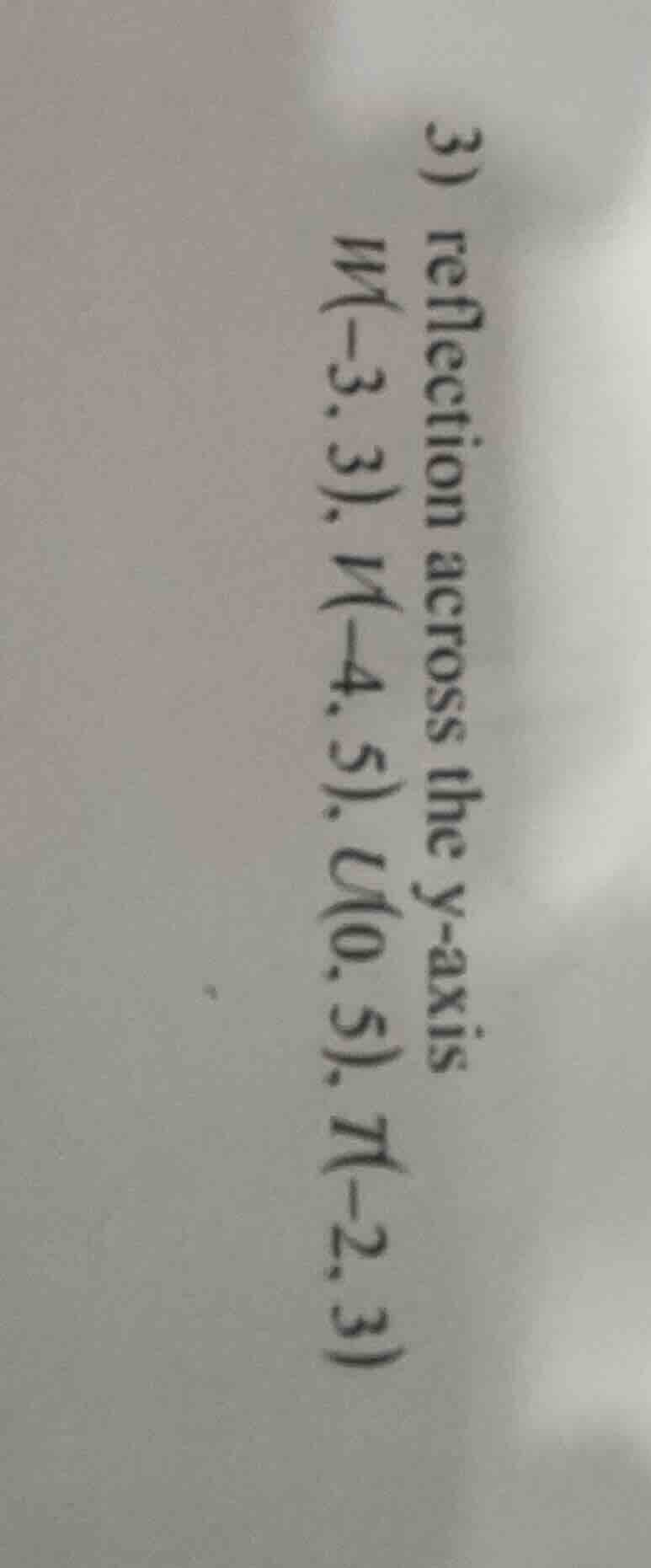
- reflection across the y - axis\\( m(-3, 3) \\), \\( n(-4, 5) \\), \\( u(0, 5) \\), \\( r(-2, 3) \\)
To reflect a point \((x, y)\) across the \(y\)-axis, we use the transformation rule: the \(x\)-coordinate changes sign while the \(y\)-coordinate remains the same. Mathematically, this is given by \((x, y) \to (-x, y)\).
Step 1: Reflect point \(M(-3, 3)\)
Using the reflection rule across the \(y\)-axis, for point \(M(-3, 3)\), we change the sign of the \(x\)-coordinate.
So, the new \(x\)-coordinate is \(-(-3)=3\) and the \(y\)-coordinate remains \(3\).
Thus, the reflected point \(M'\) is \((3, 3)\).
Step 2: Reflect point \(N(-4, 5)\)
For point \(N(-4, 5)\), applying the reflection rule across the \(y\)-axis, we change the sign of the \(x\)-coordinate.
The new \(x\)-coordinate is \(-(-4) = 4\) and the \(y\)-coordinate remains \(5\).
So, the reflected point \(N'\) is \((4, 5)\).
Step 3: Reflect point \(U(0, 5)\)
For point \(U(0, 5)\), when we apply the reflection rule across the \(y\)-axis, the \(x\)-coordinate of \(0\) changes sign to \(0\) (since \(-0=0\)) and the \(y\)-coordinate remains \(5\).
Thus, the reflected point \(U'\) is \((0, 5)\).
Step 4: Reflect point \(T(-2, 3)\)
For point \(T(-2, 3)\), using the reflection rule across the \(y\)-axis, we change the sign of the \(x\)-coordinate.
The new \(x\)-coordinate is \(-(-2)=2\) and the \(y\)-coordinate remains \(3\).
So, the reflected point \(T'\) is \((2, 3)\).

Snap & solve any problem in the app
Get step-by-step solutions on Sovi AI
Photo-based solutions with guided steps
Explore more problems and detailed explanations
The reflected points are \(M'(3, 3)\), \(N'(4, 5)\), \(U'(0, 5)\), and \(T'(2, 3)\).