QUESTION IMAGE
Question
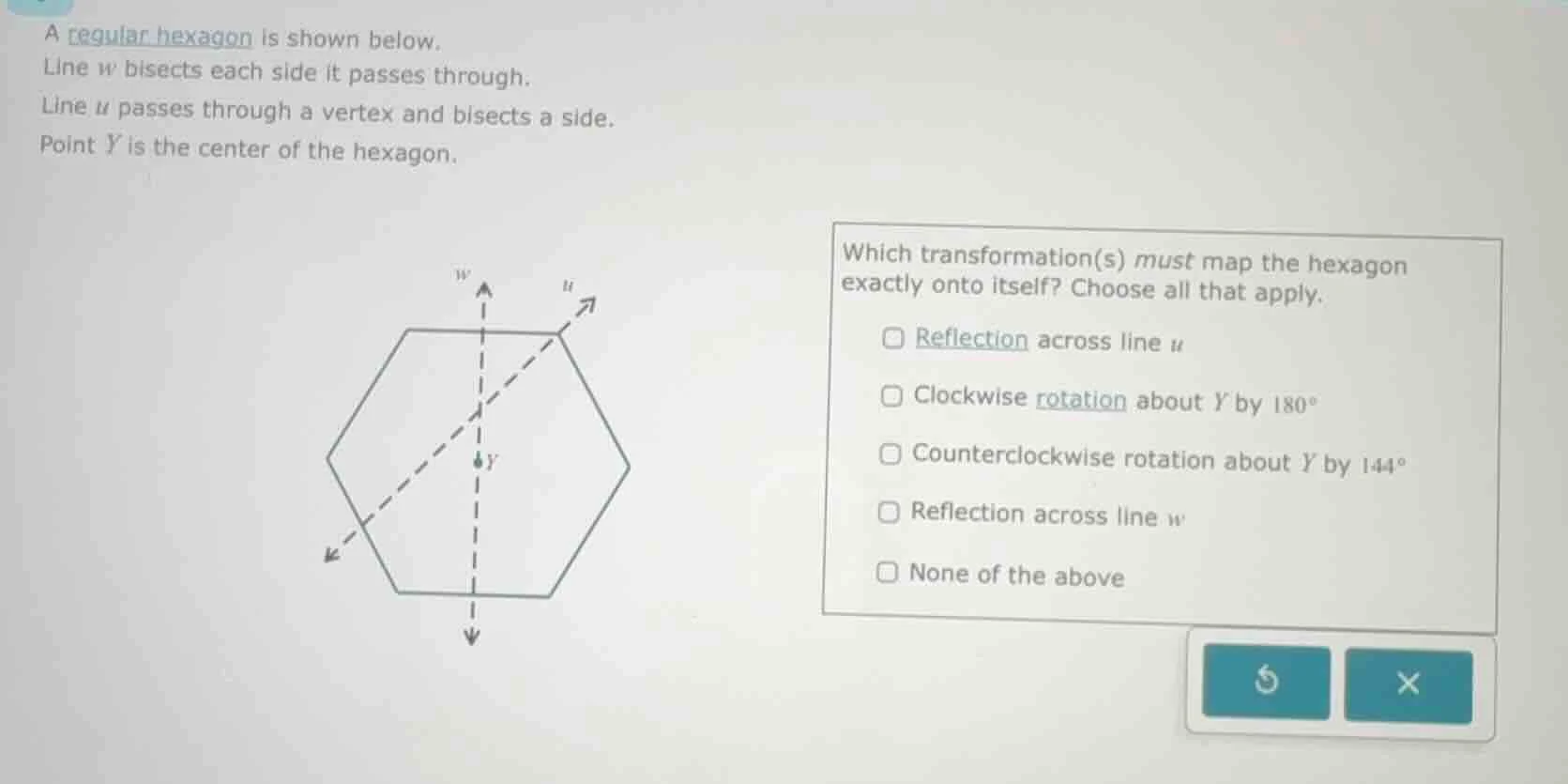
a regular hexagon is shown below.
line w bisects each side it passes through.
line u passes through a vertex and bisects a side.
point y is the center of the hexagon.
image of a regular hexagon with center y, dashed line w (vertical, bisecting top and bottom sides) and dashed line u (passing through a vertex and bisecting an opposite side)
which transformation(s) must map the hexagon exactly onto itself? choose all that apply.
reflection across line u
clockwise rotation about y by 180°
counterclockwise rotation about y by 144°
reflection across line w
none of the above
Brief Explanations
- Reflection across line \( u \): Line \( u \) passes through a vertex and bisects a side. In a regular hexagon, a line through a vertex and the midpoint of the opposite side (or bisecting a side) is a line of symmetry? Wait, no—wait, a regular hexagon has lines of symmetry: 6 lines, 3 through opposite vertices, 3 through midpoints of opposite sides. Wait, line \( w \) bisects each side it passes through—so line \( w \) is through midpoints of opposite sides (since it bisects two sides, maybe? Wait, the hexagon: line \( w \) is vertical, bisecting the top and bottom sides. So line \( w \) is a line of symmetry (through midpoints of opposite sides). Line \( u \): passes through a vertex and bisects a side. Let's check reflection over line \( u \): would that map the hexagon to itself? Let's see the hexagon's vertices: a regular hexagon has vertices at 0°, 60°, 120°, 180°, 240°, 300°. Line \( u \): let's say it's at 30° (since it passes through a vertex (60°? Wait, no, the vertex is at, say, 60°, and it bisects a side. Wait, maybe line \( u \) is not a line of symmetry. Wait, let's check rotation: 180° rotation about center \( Y \): in a regular hexagon, rotating 180° will map each vertex to the opposite vertex (since 60°*3=180°), so that's a symmetry. Counterclockwise rotation by 144°: the regular hexagon has rotational symmetry of order 6, so the angle is 360/6=60°. So 60°, 120°, 180°, 240°, 300°, 360°. 144° is not a multiple of 60°, so that's not a symmetry. Reflection across line \( w \): line \( w \) is through midpoints of opposite sides (top and bottom), so that's a line of symmetry (since reflecting over it will map top to bottom, left to right appropriately). Wait, let's re-examine:
- Reflection across line \( w \): Line \( w \) bisects the top and bottom sides (since it "bisects each side it passes through"—so it passes through two sides, bisecting them. So that's a line through midpoints of opposite sides, which is a line of symmetry for the regular hexagon. So reflection over \( w \) maps the hexagon to itself.
- Clockwise rotation about \( Y \) by 180°: A regular hexagon has rotational symmetry of 180° (since 180° is 3*60°, and 60° is the basic rotation). Rotating 180° will map each vertex to the one opposite (e.g., 0°→180°, 60°→240°, 120°→300°), so that works.
- Reflection across line \( u \): Let's see, line \( u \) passes through a vertex and bisects a side. Let's take coordinates: center at (0,0), vertices at (1,0), (0.5, √3/2), (-0.5, √3/2), (-1,0), (-0.5, -√3/2), (0.5, -√3/2). Line \( u \): passes through (0.5, √3/2) (a vertex) and bisects a side. The side between (-0.5, -√3/2) and (0.5, -√3/2) is the bottom side? No, wait, the bottom side is between (-0.5, -√3/2) and (0.5, -√3/2)? No, wait, regular hexagon with side length 1, center at (0,0): vertices at (1,0), (0.5, √3/2), (-0.5, √3/2), (-1,0), (-0.5, -√3/2), (0.5, -√3/2). So the top side is between (0.5, √3/2) and (-0.5, √3/2), bottom between (0.5, -√3/2) and (-0.5, -√3/2). Line \( w \) is vertical, through (0, √3/2) and (0, -√3/2)? No, wait, the problem says "Line \( w \) bisects each side it passes through"—so line \( w \) passes through two sides, bisecting each. So top side: midpoint is (0, √3/2), bottom side: midpoint is (0, -√3/2). So line \( w \) is the vertical line through (0,0), passing through midpoints of top and bottom sides. So that's a line of symmetry (reflecting over it will map left to right, top to bottom appropriately).
- Reflection across line \( u \): Line \( u \) passes through a vertex (e.g., (0.5, √3/2)) and bisect…

Snap & solve any problem in the app
Get step-by-step solutions on Sovi AI
Photo-based solutions with guided steps
Explore more problems and detailed explanations
- Clockwise rotation about \( Y \) by \( 180^\circ \)
- Reflection across line \( w \)