QUESTION IMAGE
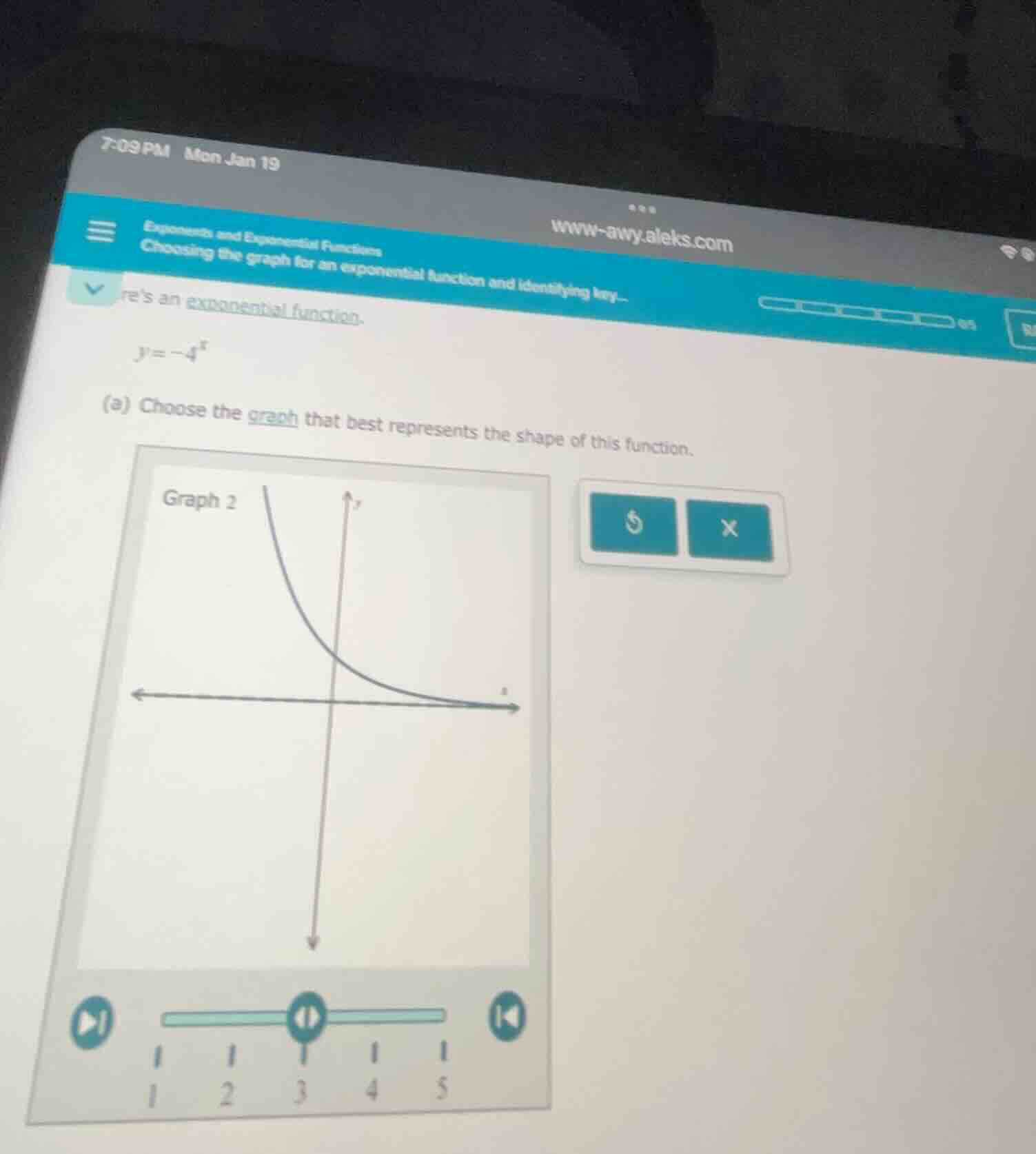
Question
res an exponential function.
y = -4^x
(a) choose the graph that best represents the shape of this function.
Step1: Analyze the parent function
The parent function of \( y = - 4^{x}\) is \( y=4^{x}\). The function \( y = 4^{x}\) is an exponential growth function, which has a horizontal asymptote at \( y = 0\) (the \(x\)-axis), passes through the point \((0,1)\) since \(4^{0}=1\), and increases as \(x\) increases.
Step2: Analyze the transformation
The function \( y=-4^{x}\) is a reflection of the parent function \( y = 4^{x}\) over the \(x\)-axis. When we reflect a function \( y = f(x)\) over the \(x\)-axis, we get \( y=-f(x)\). So for \( y = 4^{x}\), reflecting over the \(x\)-axis gives \( y=-4^{x}\).
Step3: Analyze key points and behavior
- For \(x = 0\), \(y=-4^{0}=- 1\), so the graph passes through the point \((0,-1)\).
- As \(x\to+\infty\), \(4^{x}\to+\infty\), so \(y=-4^{x}\to-\infty\).
- As \(x\to-\infty\), \(4^{x}\to0\) (since for exponential functions \(a^{x}\) with \(a>1\), as \(x\to-\infty\), \(a^{x}\to0\)), so \(y =- 4^{x}\to0\). So the horizontal asymptote is \(y = 0\) (the \(x\)-axis), and the function is decreasing (since as \(x\) increases, \(y\) decreases from \(0\) (approached as \(x\to-\infty\)) to \(-\infty\) as \(x\to+\infty\)) and passes through \((0, - 1)\).
Now, looking at the given graph (Graph 2), we check its behavior:
- The graph has a horizontal asymptote at the \(x\)-axis (\(y = 0\)).
- It passes through a point on the \(y\)-axis. If we assume the graph in the image has a \(y\)-intercept that is negative (since our function has \(y\)-intercept \(- 1\)) and is decreasing (going from near \(y = 0\) on the left to lower values on the right), this matches the behavior of \(y=-4^{x}\). So Graph 2 (the provided graph) is the correct graph for \(y=-4^{x}\).

Snap & solve any problem in the app
Get step-by-step solutions on Sovi AI
Photo-based solutions with guided steps
Explore more problems and detailed explanations
The graph (Graph 2) shown in the image is the correct graph for the function \(y =-4^{x}\) as it matches the behavior of a reflected exponential function (reflection of \(y = 4^{x}\) over the \(x\)-axis) with horizontal asymptote \(y = 0\), \(y\)-intercept \((0,-1)\), decreasing as \(x\) increases, and approaching \(0\) as \(x\to-\infty\) and \(-\infty\) as \(x\to+\infty\).