QUESTION IMAGE
Question
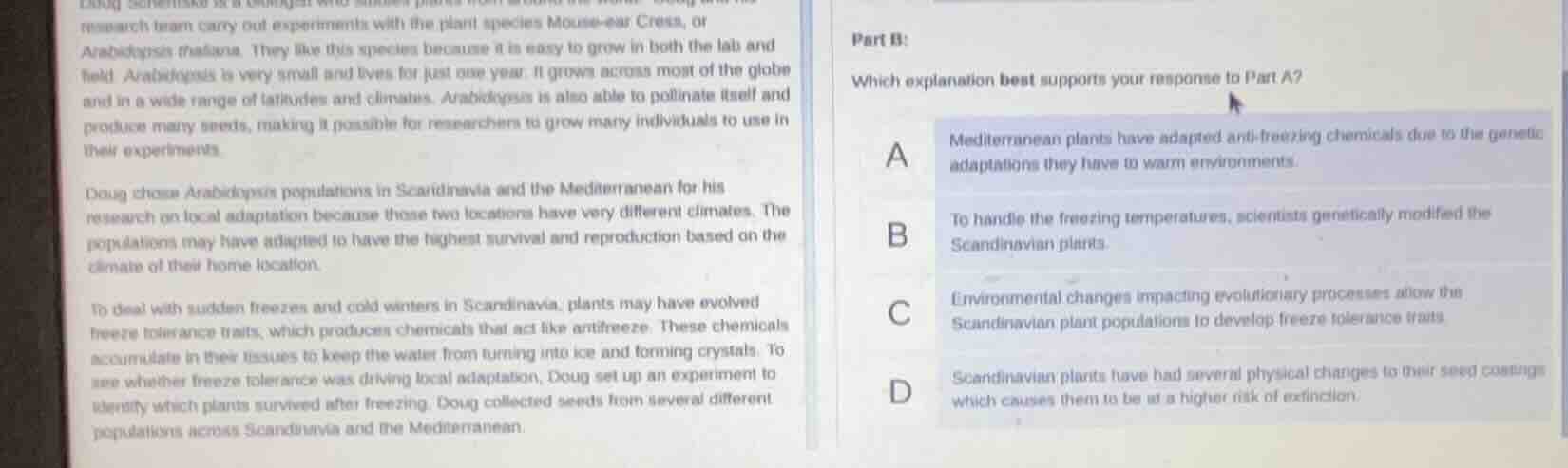
research team carry out experiments with the plant species mouse - ear cress, or arabidopsis thaliana. they like this species because it is easy to grow in both the lab and field. arabidopsis is very small and lives for just one year. it grows across most of the globe and in a wide range of latitudes and climates. arabidopsis is also able to pollinate itself and produce many seeds, making it possible for researchers to grow many individuals to use in their experiments.
doug chose arabidopsis populations in scandinavia and the mediterranean for his research on local adaptation because those two locations have very different climates. the populations may have adapted to have the highest survival and reproduction based on the climate of their home location.
to deal with sudden freezes and cold winters in scandinavia, plants may have evolved freeze tolerance traits, which produces chemicals that act like antifreeze. these chemicals accumulate in their tissues to keep the water from turning into ice and forming crystals. to see whether freeze tolerance was driving local adaptation, doug set up an experiment to identify which plants survived after freezing. doug collected seeds from several different populations across scandinavia and the mediterranean.
part b:
which explanation best supports your response to part a?
a mediterranean plants have adapted anti - freezing chemicals due to the genetic adaptations they have to warm environments.
b to handle the freezing temperatures, scientists genetically modified the scandinavian plants.
c environmental changes impacting evolutionary processes allow the scandinavian plant populations to develop freeze tolerance traits.
d scandinavian plants have had several physical changes to their seed coatings which causes them to be at a higher risk of extinction.
The passage focuses on local adaptation of Arabidopsis populations: Scandinavian populations evolved freeze tolerance traits to survive cold winters, a result of environmental pressures driving evolutionary change. Option A incorrectly links anti-freezing chemicals to warm environments. Option B is wrong because the passage states the trait evolved naturally, not via genetic modification by scientists. Option D is incorrect as it claims seed coat changes increase extinction risk, which is unrelated to the freeze tolerance adaptation described. Option C correctly matches the passage's logic that environmental differences (cold Scandinavian winters) drove the evolution of freeze tolerance traits.

Snap & solve any problem in the app
Get step-by-step solutions on Sovi AI
Photo-based solutions with guided steps
Explore more problems and detailed explanations
C. Environmental changes impacting evolutionary processes allow the Scandinavian plant populations to develop freeze tolerance traits.