QUESTION IMAGE
Question
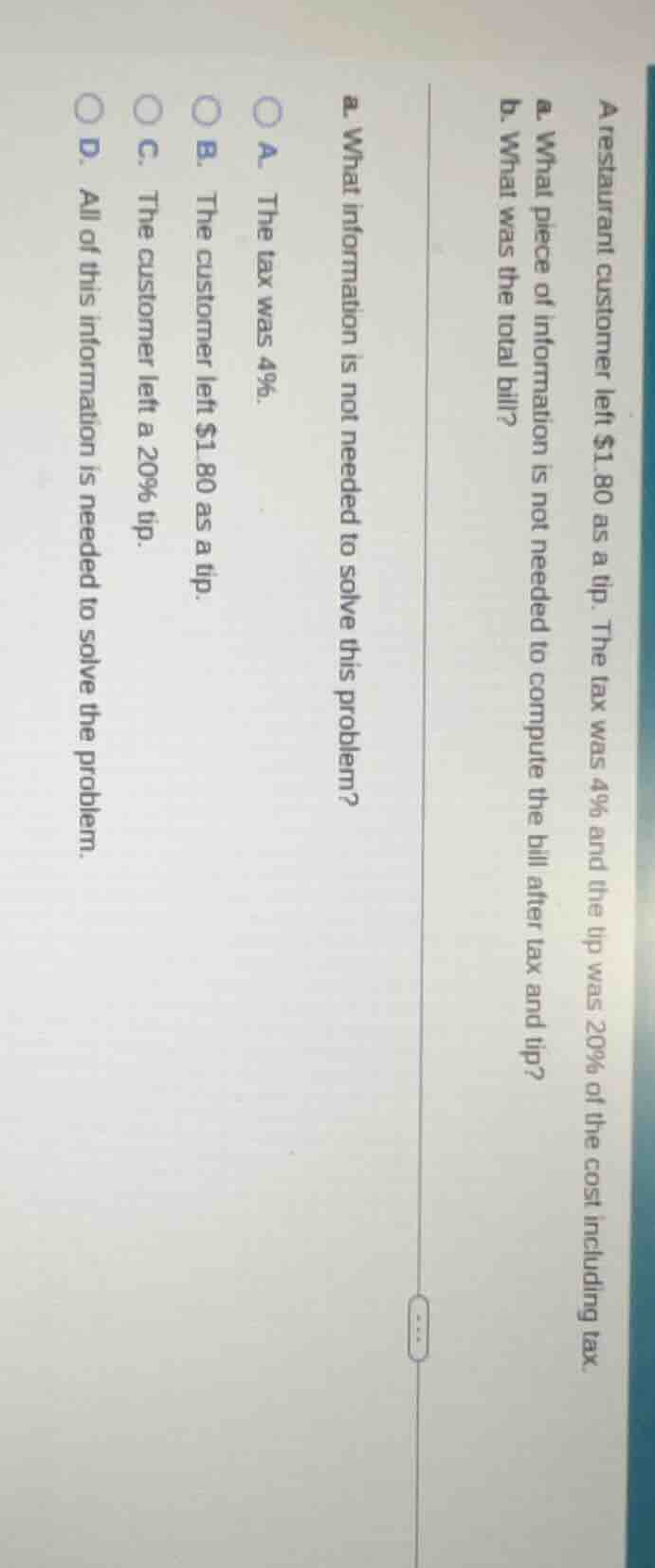
a restaurant customer left $1.80 as a tip. the tax was 4% and the tip was 20% of the cost including tax.
b. what was the total bill?
_________________________________
a. what information is not needed to solve this problem?
a. the tax was 4%.
b. the customer left $1.80 as a tip.
c. the customer left a 20% tip.
d. all of this information is needed to solve the problem.
Part b (First, let's solve part b to understand part a better)
Step1: Let the cost before tax be $x$.
The tax is 4% of $x$, so the cost including tax is $x + 0.04x = 1.04x$.
The tip is 20% of the cost including tax, so the tip amount is $0.20\times(1.04x)$. We know the tip is $1.80, so we set up the equation:
$0.20\times(1.04x) = 1.80$
Step2: Solve for $x$.
First, simplify the left side: $0.208x = 1.80$
Then, $x=\frac{1.80}{0.208}\approx8.65$ (this is the cost before tax)
The cost including tax is $1.04\times8.65\approx9.00$
The total bill (including tax and tip) is the cost including tax plus the tip: $9.00 + 1.80 = 10.80$? Wait, no, actually, the tip is on the cost including tax, so the total bill is cost including tax + tip. But let's re - evaluate.
Wait, the tip is 20% of (cost + tax). Let's do it correctly. Let the original bill (before tax) be $x$. Tax is 4% of $x$, so tax amount is $0.04x$. Cost including tax is $x + 0.04x=1.04x$. Tip is 20% of (cost including tax), so tip amount is $0.2\times(1.04x)$. We know tip is $1.80, so:
$0.2\times1.04x = 1.80$
$1.04x=\frac{1.80}{0.2}=9$
So the cost including tax is $9$. Then the total bill (including tax and tip) is $9 + 1.80 = 10.80$? Wait, no. Wait, the tip is part of the total amount the customer pays. Wait, maybe I misinterpret. The total bill after tax and tip: the tax is on the original bill, the tip is on the bill after tax. So original bill: $x$, tax: $0.04x$, bill after tax: $1.04x$, tip: $0.2\times1.04x$, total bill: $1.04x+0.2\times1.04x = 1.04x(1 + 0.2)=1.04x\times1.2$. But we know that $0.2\times1.04x = 1.80$, so $1.04x = 9$ (as above), then total bill is $9\times1.2 = 10.80$.
Part a
To find the total bill after tax and tip, we used the tip amount ($1.80$), the tip percentage (20%), and we found the original bill and then calculated the total. The tax percentage (4%) was used to find the bill after tax, but wait, no - in our calculation, we used the tip amount and tip percentage to find the bill after tax. Wait, actually, when we set up the equation $0.2\times(1.04x)=1.80$, we used the tax rate (4%) to get the bill after tax as $1.04x$. But let's see: if we think about what's needed to find the total bill (bill + tax + tip). The tip is 20% of (bill + tax), and we know the tip amount is $1.80$. So (bill + tax) = tip / 0.2 = $1.80 / 0.2 = 9$. Then total bill is (bill + tax)+tip = $9 + 1.80 = 10.80$. Wait, in this case, we didn't need to know the tax rate? Wait, no, because (bill + tax) is bill*(1 + tax rate). But if we can find (bill + tax) directly from the tip (since tip is 20% of (bill + tax)), then we don't need the tax rate. Wait, let's re - express:
Let $T$ be the total bill (bill + tax + tip). Let $B$ be the bill before tax, $t$ be tax rate (4%), $p$ be tip percentage (20%), and $tip$ be the tip amount ($1.80$).
We know that $tip=p\times(B + t\times B)=p\times B\times(1 + t)$
And $T=B + t\times B+tip=B\times(1 + t)+p\times B\times(1 + t)=B\times(1 + t)\times(1 + p)$
But we also know that $tip = p\times B\times(1 + t)$, so $B\times(1 + t)=\frac{tip}{p}$
Then $T=\frac{tip}{p}\times(1 + p)$
Wait, in this formula, we don't need the tax rate $t$? Because $B\times(1 + t)=\frac{tip}{p}$, and then $T=\frac{tip}{p}\times(1 + p)$
Let's plug in the numbers: $tip = 1.80$, $p = 0.2$
$T=\frac{1.80}{0.2}\times(1 + 0.2)=9\times1.2 = 10.80$
Ah! So we don't need the tax rate (4%) to calculate the total bill. So the information that is not needed is the tax rate (4%), which is option A.

Snap & solve any problem in the app
Get step-by-step solutions on Sovi AI
Photo-based solutions with guided steps
Explore more problems and detailed explanations
(for part a):
A. The tax was 4%.