QUESTION IMAGE
Question
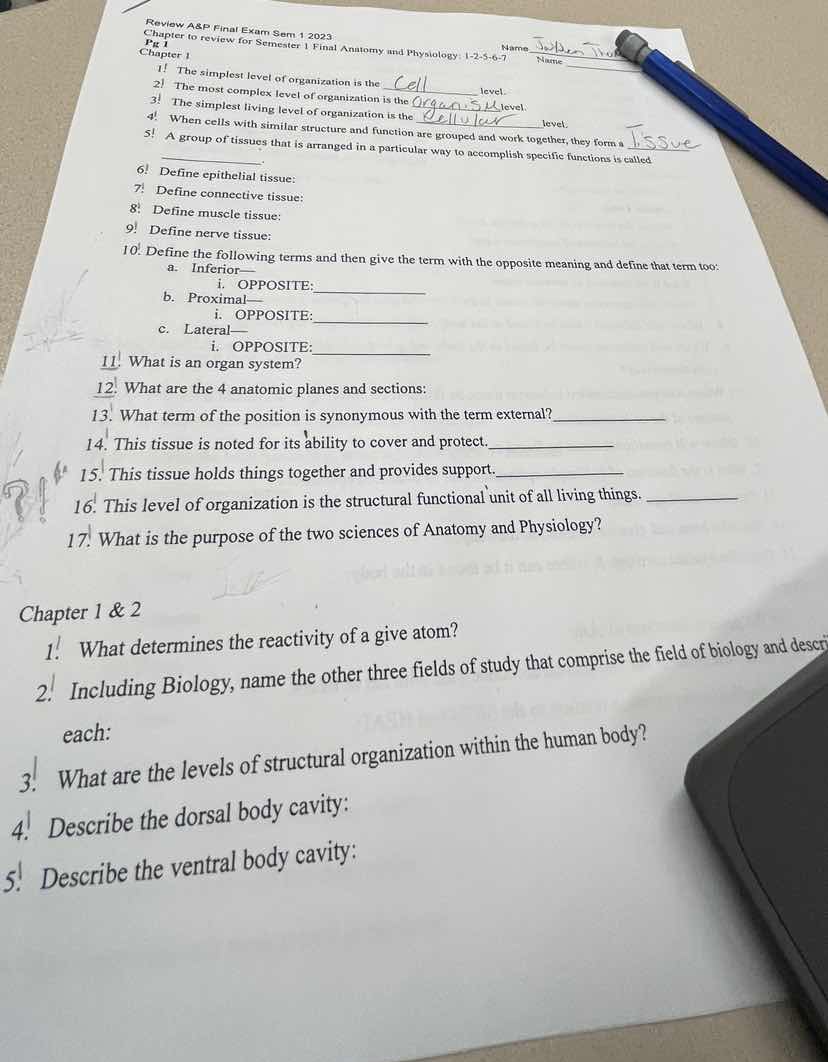
review a&p final exam sem 1 2023
chapter to review for semester 1 final anatomy and physiology 1-2-5-6-7
name
name
chapter 1
1! the simplest level of organization is the ______ level.
2! the most complex level of organization is the ______ level.
3! the simplest living level of organization is the ______ level.
4! when cells with similar structure and function are grouped and work together, they form a ______
5! a group of tissues that is arranged in a particular way to accomplish specific functions is called ______
6! define epithelial tissue:
7! define connective tissue:
8! define muscle tissue:
9! define nerve tissue:
10! define the following terms and then give the term with the opposite meaning and define that term too:
a. inferior—
i. opposite: ______
b. proximal—
i. opposite: ______
c. lateral—
i. opposite: ______
11! what is an organ system?
12! what are the 4 anatomic planes and sections:
- what term of the position is synonymous with the term external? ______
- this tissue is noted for its ability to cover and protect. ______
- this tissue holds things together and provides support. ______
- this level of organization is the structural functional unit of all living things. ______
- what is the purpose of the two sciences of anatomy and physiology?
chapter 1 & 2
1! what determines the reactivity of a give atom?
2! including biology, name the other three fields of study that comprise the field of biology and descri
each:
3! what are the levels of structural organization within the human body?
4! describe the dorsal body cavity:
5! describe the ventral body cavity:
Since this is a set of Anatomy and Physiology review questions, let's answer one of them, for example, question 1 (Chapter 1 & 2: What determines the reactivity of a given atom?):
The reactivity of an atom is determined by the number of valence electrons (electrons in the outermost energy level). Atoms tend to gain, lose, or share electrons to achieve a stable electron configuration (like a full outer shell, e.g., 8 electrons for most, 2 for hydrogen/helium), and the number of valence electrons dictates how easily they can do this.
Epithelial tissue is a type of tissue that covers body surfaces (external or internal linings of organs/cavities), forms glands, and functions in protection, absorption, secretion, and filtration. It has tightly packed cells with little extracellular matrix, and often has a basement membrane.
- Sagittal Plane: Divides the body (or organ) into left and right parts. A midsagittal plane divides into equal left/right; parasagittal into unequal.
- Frontal (Coronal) Plane: Divides the body into anterior (front) and posterior (back) parts.
- Transverse (Horizontal) Plane: Divides the body into superior (upper) and inferior (lower) parts (or proximal/distal for organs).
- Oblique Plane: Divides the body at an angle (not 90° to sagittal/frontal/transverse), used less commonly but useful for specific structures.

Snap & solve any problem in the app
Get step-by-step solutions on Sovi AI
Photo-based solutions with guided steps
Explore more problems and detailed explanations
The number of valence electrons (electrons in the outermost energy level) determines an atom's reactivity. Atoms react to achieve a stable electron configuration (e.g., full outer shell), and valence electrons dictate how easily they gain/lose/share electrons.
For question 6 (Define epithelial tissue):