QUESTION IMAGE
Question
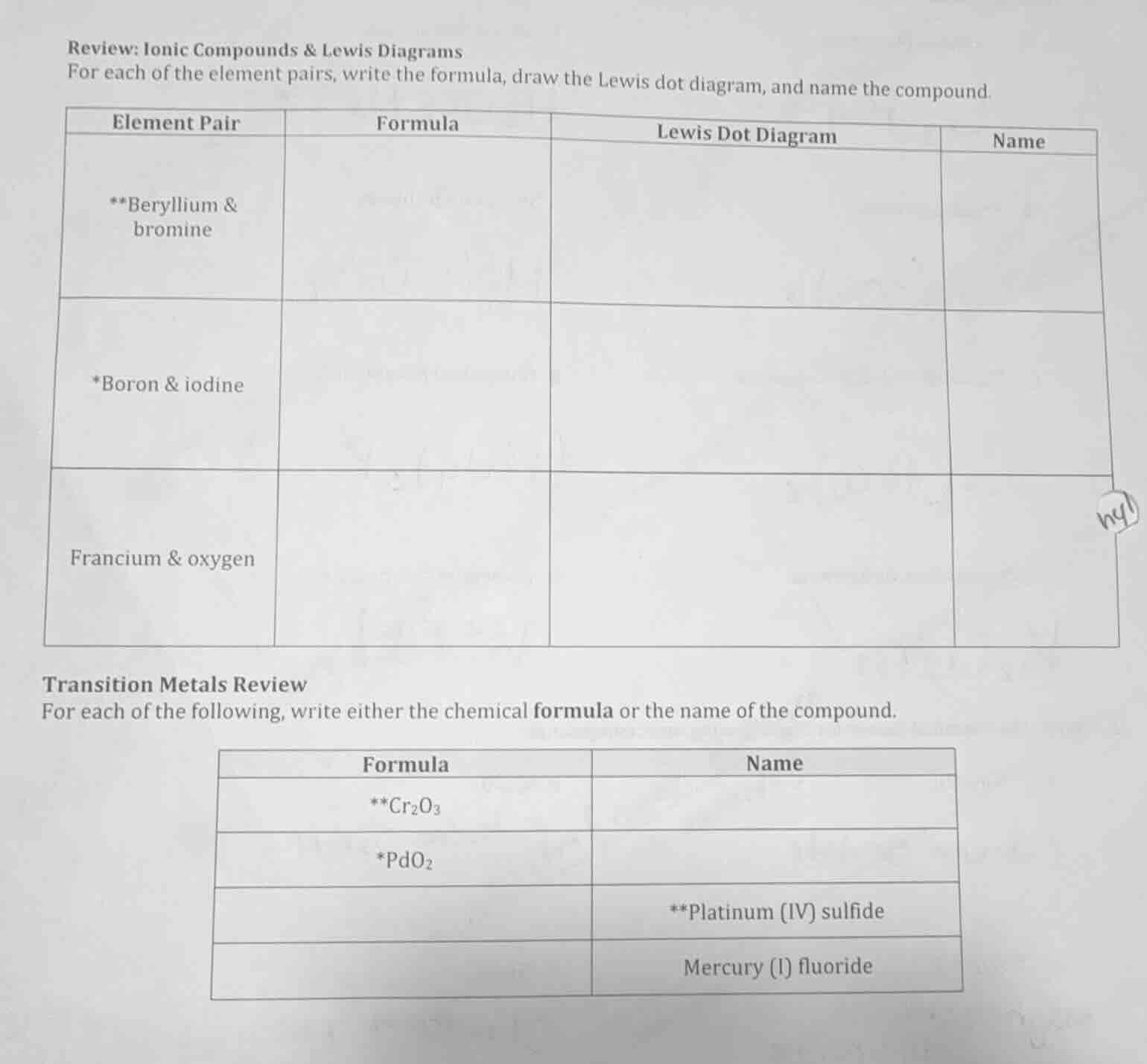
review: ionic compounds & lewis diagrams
for each of the element pairs, write the formula, draw the lewis dot diagram, and name the compound.
| element pair | formula | lewis dot diagram | name |
|---|---|---|---|
| boron & iodine | |||
| francium & oxygen |
transition metals review
for each of the following, write either the chemical formula or the name of the compound.
| formula | name |
|---|---|
| pdo₂ | |
| platinum (iv) sulfide | |
| mercury (i) fluoride |
Part 1: Ionic Compounds & Lewis Diagrams (Element Pairs)
1. Beryllium & Bromine
Step 1: Determine oxidation states
Beryllium (Be) is in Group 2, so it has a +2 oxidation state. Bromine (Br) is in Group 17, so it has a -1 oxidation state.
Step 2: Balance charges for the formula
To balance the charges, we need 2 Br⁻ ions for every 1 Be²⁺ ion. Thus, the formula is $\boldsymbol{BeBr_2}$.
Step 3: Lewis Dot Diagram
- Be: 2 valence electrons (dots: $\cdot \cdot$)
- Br: 7 valence electrons (dots: $\cdot \cdot \cdot \cdot \cdot \cdot \cdot$)
- In $BeBr_2$, Be donates 2 electrons (one to each Br), so each Br gains 1 electron (becomes Br⁻ with 8 valence electrons). The Lewis structure shows Be in the center with two Br atoms, each with 8 electrons (3 lone pairs + 1 bond pair from Be).
Step 4: Name the compound
Beryllium bromide (since Be is a metal, use the metal name + nonmetal name with -ide suffix).
2. Boron & Iodine
Step 1: Determine oxidation states
Boron (B) is in Group 13, so it has a +3 oxidation state. Iodine (I) is in Group 17, so it has a -1 oxidation state.
Step 2: Balance charges for the formula
To balance +3 (B) and -1 (I), we need 3 I⁻ ions. Thus, the formula is $\boldsymbol{BI_3}$.
Step 3: Lewis Dot Diagram
- B: 3 valence electrons (dots: $\cdot \cdot \cdot$)
- I: 7 valence electrons (dots: $\cdot \cdot \cdot \cdot \cdot \cdot \cdot$)
- In $BI_3$, B donates 3 electrons (one to each I), so each I gains 1 electron (becomes I⁻ with 8 valence electrons). The Lewis structure shows B in the center with three I atoms, each with 8 electrons (3 lone pairs + 1 bond pair from B).
Step 4: Name the compound
Boron iodide (B is a metalloid, but for ionic naming, use metal/metalloid name + nonmetal name with -ide suffix).
3. Francium & Oxygen
Step 1: Determine oxidation states
Francium (Fr) is in Group 1, so it has a +1 oxidation state. Oxygen (O) is in Group 16, so it has a -2 oxidation state.
Step 2: Balance charges for the formula
To balance +1 (Fr) and -2 (O), we need 2 Fr⁺ ions for every 1 O²⁻ ion. Thus, the formula is $\boldsymbol{Fr_2O}$.
Step 3: Lewis Dot Diagram
- Fr: 1 valence electron (dot: $\cdot$)
- O: 6 valence electrons (dots: $\cdot \cdot \cdot \cdot \cdot \cdot$)
- In $Fr_2O$, each Fr donates 1 electron (total 2 electrons) to O, so O gains 2 electrons (becomes O²⁻ with 8 valence electrons). The Lewis structure shows O in the center with two Fr atoms, each with 0 valence electrons (donated), and O with 8 electrons (4 lone pairs).
Step 4: Name the compound
Francium oxide (Fr is a metal, so metal name + nonmetal name with -ide suffix).
Part 2: Transition Metals Review
1. $\boldsymbol{Cr_2O_3}$ (Chromium(III) oxide)
Step 1: Determine chromium’s oxidation state
Let Cr’s oxidation state be $x$. Oxygen (O) is -2.
For $Cr_2O_3$: $2x + 3(-2) = 0 \implies 2x - 6 = 0 \implies x = +3$.
Step 2: Name the compound
Chromium(III) oxide (use Roman numerals for the transition metal’s oxidation state, then nonmetal with -ide).
2. $\boldsymbol{PdO_2}$ (Palladium(IV) oxide)
Step 1: Determine palladium’s oxidation state
Let Pd’s oxidation state be $x$. Oxygen (O) is -2.
For $PdO_2$: $x + 2(-2) = 0 \implies x - 4 = 0 \implies x = +4$.
Step 2: Name the compound
Palladium(IV) oxide (Roman numeral for Pd’s +4 state, then nonmetal with -ide).
3. Platinum(IV) sulfide
Step 1: Determine the formula
Platinum (Pt) has a +4 oxidation state. Sulfide (S) has a -2 oxidation state.
Step 2: Balance charges
To balance +4 (Pt) and -2 (S), we…

Snap & solve any problem in the app
Get step-by-step solutions on Sovi AI
Photo-based solutions with guided steps
Explore more problems and detailed explanations
Part 1: Ionic Compounds & Lewis Diagrams (Element Pairs)
1. Beryllium & Bromine
Step 1: Determine oxidation states
Beryllium (Be) is in Group 2, so it has a +2 oxidation state. Bromine (Br) is in Group 17, so it has a -1 oxidation state.
Step 2: Balance charges for the formula
To balance the charges, we need 2 Br⁻ ions for every 1 Be²⁺ ion. Thus, the formula is $\boldsymbol{BeBr_2}$.
Step 3: Lewis Dot Diagram
- Be: 2 valence electrons (dots: $\cdot \cdot$)
- Br: 7 valence electrons (dots: $\cdot \cdot \cdot \cdot \cdot \cdot \cdot$)
- In $BeBr_2$, Be donates 2 electrons (one to each Br), so each Br gains 1 electron (becomes Br⁻ with 8 valence electrons). The Lewis structure shows Be in the center with two Br atoms, each with 8 electrons (3 lone pairs + 1 bond pair from Be).
Step 4: Name the compound
Beryllium bromide (since Be is a metal, use the metal name + nonmetal name with -ide suffix).
2. Boron & Iodine
Step 1: Determine oxidation states
Boron (B) is in Group 13, so it has a +3 oxidation state. Iodine (I) is in Group 17, so it has a -1 oxidation state.
Step 2: Balance charges for the formula
To balance +3 (B) and -1 (I), we need 3 I⁻ ions. Thus, the formula is $\boldsymbol{BI_3}$.
Step 3: Lewis Dot Diagram
- B: 3 valence electrons (dots: $\cdot \cdot \cdot$)
- I: 7 valence electrons (dots: $\cdot \cdot \cdot \cdot \cdot \cdot \cdot$)
- In $BI_3$, B donates 3 electrons (one to each I), so each I gains 1 electron (becomes I⁻ with 8 valence electrons). The Lewis structure shows B in the center with three I atoms, each with 8 electrons (3 lone pairs + 1 bond pair from B).
Step 4: Name the compound
Boron iodide (B is a metalloid, but for ionic naming, use metal/metalloid name + nonmetal name with -ide suffix).
3. Francium & Oxygen
Step 1: Determine oxidation states
Francium (Fr) is in Group 1, so it has a +1 oxidation state. Oxygen (O) is in Group 16, so it has a -2 oxidation state.
Step 2: Balance charges for the formula
To balance +1 (Fr) and -2 (O), we need 2 Fr⁺ ions for every 1 O²⁻ ion. Thus, the formula is $\boldsymbol{Fr_2O}$.
Step 3: Lewis Dot Diagram
- Fr: 1 valence electron (dot: $\cdot$)
- O: 6 valence electrons (dots: $\cdot \cdot \cdot \cdot \cdot \cdot$)
- In $Fr_2O$, each Fr donates 1 electron (total 2 electrons) to O, so O gains 2 electrons (becomes O²⁻ with 8 valence electrons). The Lewis structure shows O in the center with two Fr atoms, each with 0 valence electrons (donated), and O with 8 electrons (4 lone pairs).
Step 4: Name the compound
Francium oxide (Fr is a metal, so metal name + nonmetal name with -ide suffix).
Part 2: Transition Metals Review
1. $\boldsymbol{Cr_2O_3}$ (Chromium(III) oxide)
Step 1: Determine chromium’s oxidation state
Let Cr’s oxidation state be $x$. Oxygen (O) is -2.
For $Cr_2O_3$: $2x + 3(-2) = 0 \implies 2x - 6 = 0 \implies x = +3$.
Step 2: Name the compound
Chromium(III) oxide (use Roman numerals for the transition metal’s oxidation state, then nonmetal with -ide).
2. $\boldsymbol{PdO_2}$ (Palladium(IV) oxide)
Step 1: Determine palladium’s oxidation state
Let Pd’s oxidation state be $x$. Oxygen (O) is -2.
For $PdO_2$: $x + 2(-2) = 0 \implies x - 4 = 0 \implies x = +4$.
Step 2: Name the compound
Palladium(IV) oxide (Roman numeral for Pd’s +4 state, then nonmetal with -ide).
3. Platinum(IV) sulfide
Step 1: Determine the formula
Platinum (Pt) has a +4 oxidation state. Sulfide (S) has a -2 oxidation state.
Step 2: Balance charges
To balance +4 (Pt) and -2 (S), we need 1 Pt⁴⁺ and 2 S²⁻ ions. Thus, the formula is $\boldsymbol{PtS_2}$.
4. Mercury(I) fluoride
Step 1: Determine the formula
Mercury(I) is $Hg_2^{2+}$ (a polyatomic ion with a +2 overall charge, so each Hg is +1). Fluoride (F) has a -1 oxidation state.
Step 2: Balance charges
To balance $Hg_2^{2+}$ (+2) and F⁻ (-1), we need 2 F⁻ ions. Thus, the formula is $\boldsymbol{Hg_2F_2}$ (simplified to $\boldsymbol{Hg_2F_2}$, but often written as $Hg_2F_2$ or $HgF$ if considering average charge, but strictly $Hg_2F_2$ for the dimeric ion).
Final Table (Ionic Compounds & Lewis Diagrams)
| Element Pair | Formula | Lewis Dot Diagram (Brief) | Name |
|---|---|---|---|
| Boron & iodine | $BI_3$ | B: $\cdot \cdot \cdot$; I: $\cdot \cdot \cdot \cdot \cdot \cdot \cdot$ (3 I, each with 8 e⁻) | Boron iodide |
| Francium & oxygen | $Fr_2O$ | Fr: $\cdot$ (2 Fr, no e⁻); O: $\cdot \cdot \cdot \cdot \cdot \cdot \cdot \cdot$ (8 e⁻) | Francium oxide |
Final Table (Transition Metals Review)
| Formula | Name |
|---|---|
| $PdO_2$ | Palladium(IV) oxide |
| $PtS_2$ | Platinum(IV) sulfide |
| $Hg_2F_2$ | Mercury(I) fluoride |
(Note: Lewis dot diagrams are best drawn with proper electron dot notation, but the brief description above outlines the valence electrons and bonding.)