QUESTION IMAGE
Question
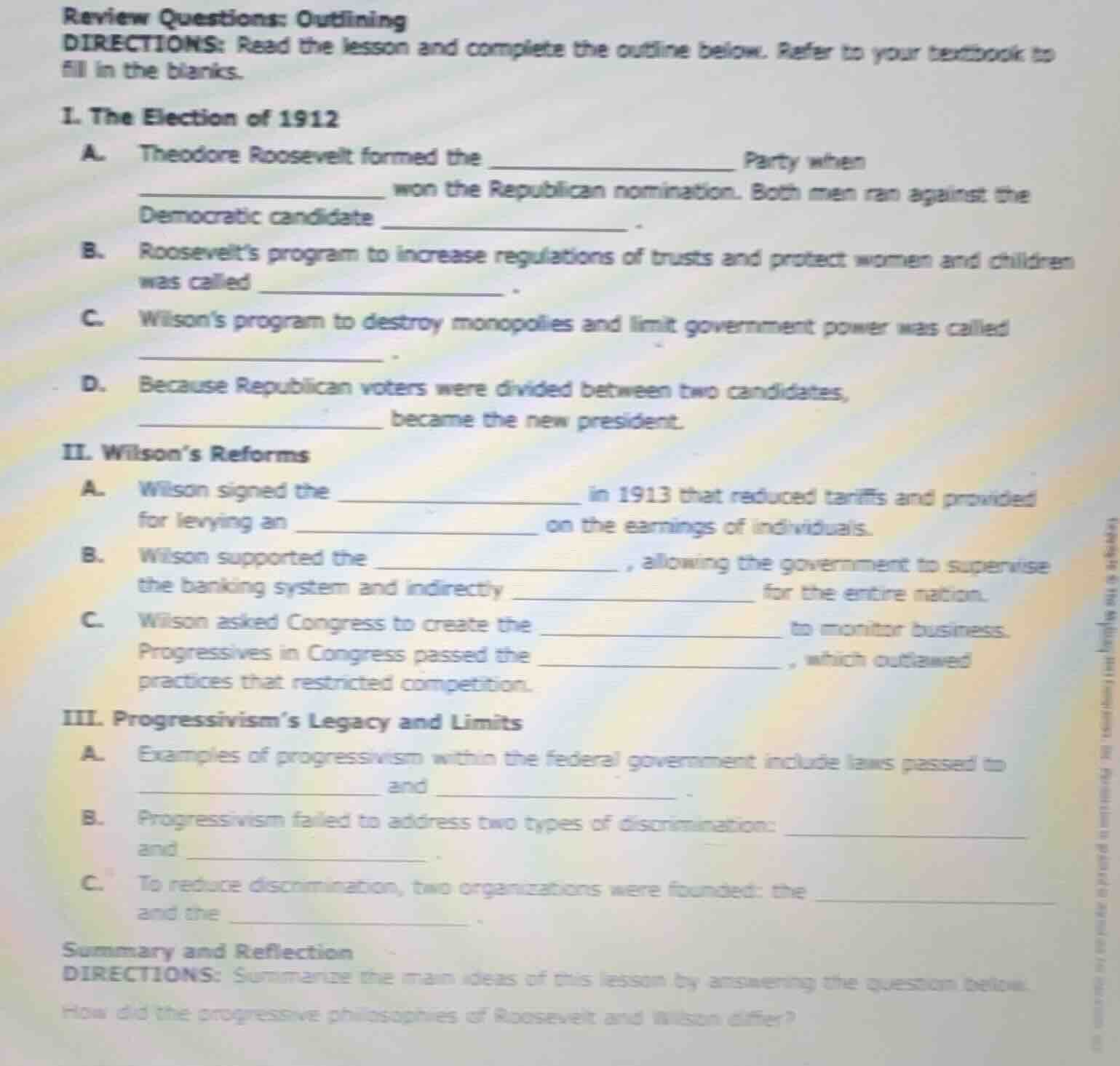
review questions: outlining
directions: read the lesson and complete the outline below. refer to your textbook to fill in the blanks.
i. the election of 1912
a. theodore roosevelt formed the ____________ party when __________ won the republican nomination. both men ran against the democratic candidate ____________ .
b. roosevelt’s program to increase regulations of trusts and protect women and children was called ______________ .
c. wilson’s program to destroy monopolies and limit government power was called ______________ .
d. because republican voters were divided between two candidates, ______________ became the new president.
ii. wilson’s reforms
a. wilson signed the ____________ in 1913 that reduced tariffs and provided for levying an ____________ on the earnings of individuals.
b. wilson supported the ____________ , allowing the government to supervise the banking system and indirectly ____________ for the entire nation.
c. wilson asked congress to create the ____________ to monitor business. progressives in congress passed the ____________ , which outlawed practices that restricted competition.
iii. progressivism’s legacy and limits
a. examples of progressivism within the federal government include laws passed to ____________ and ____________ .
b. progressivism failed to address two types of discrimination: ____________ and ____________ .
c. to reduce discrimination, two organizations were founded: the ____________ and the ____________ .
summary and reflection
directions: summarize the main ideas of this lesson by answering the question below.
how did the progressive philosophies of roosevelt and wilson differ?
All answers are based on key facts of the 1912 U.S. Election and Progressive Era reforms.
- I. The Election of 1912:
- A. Theodore Roosevelt formed the Progressive (Bull Moose) Party after losing the Republican nomination to William Howard Taft; their Democratic opponent was Woodrow Wilson.
- B. Roosevelt's reform platform focused on trust regulation and worker protections, named the New Nationalism.
- C. Wilson's platform aimed at breaking monopolies and limiting government overreach, called the New Freedom.
- D. Split Republican votes let Wilson win the presidency.
- II. Wilson's Reforms:
- A. The Underwood Tariff of 1913 cut tariffs and introduced a federal income tax.
- B. The Federal Reserve Act created a national banking oversight system and established a national currency supply.
- C. The Federal Trade Commission monitored business practices, and the Clayton Antitrust Act outlawed anti-competitive actions.
- III. Progressivism’s Legacy and Limits:
- A. Federal Progressive laws focused on regulating business and protecting consumers/workers.
- B. Progressivism largely ignored racial and gender discrimination (excluding suffrage for most of the era).
- C. The NAACP (for racial equality) and NAWSA (for women's suffrage) were key organizations fighting discrimination.
- Summary and Reflection: Roosevelt's New Nationalism supported a strong federal government to regulate big business and protect citizens, while Wilson's New Freedom favored breaking up monopolies to restore free market competition and limit federal power.

Snap & solve any problem in the app
Get step-by-step solutions on Sovi AI
Photo-based solutions with guided steps
Explore more problems and detailed explanations
I. The Election of 1912
A. Progressive (Bull Moose); William Howard Taft; Woodrow Wilson
B. New Nationalism
C. New Freedom
D. Woodrow Wilson
II. Wilson’s Reforms
A. Underwood Tariff; income tax
B. Federal Reserve Act; manage the money supply
C. Federal Trade Commission; Clayton Antitrust Act
III. Progressivism’s Legacy and Limits
A. regulate big business; protect consumers and workers
B. racial discrimination; gender discrimination
C. National Association for the Advancement of Colored People (NAACP); National American Woman Suffrage Association (NAWSA)
Summary and Reflection
Roosevelt's New Nationalism advocated for a powerful federal government to regulate large corporations, protect workers, and expand social welfare, believing a strong government could balance corporate power. Wilson's New Freedom focused on breaking up monopolies entirely to restore free-market competition, and favored limiting federal power to avoid overreach, prioritizing small businesses and individual economic freedom over centralized regulation.