QUESTION IMAGE
Question
the right sort of risks (part 2)
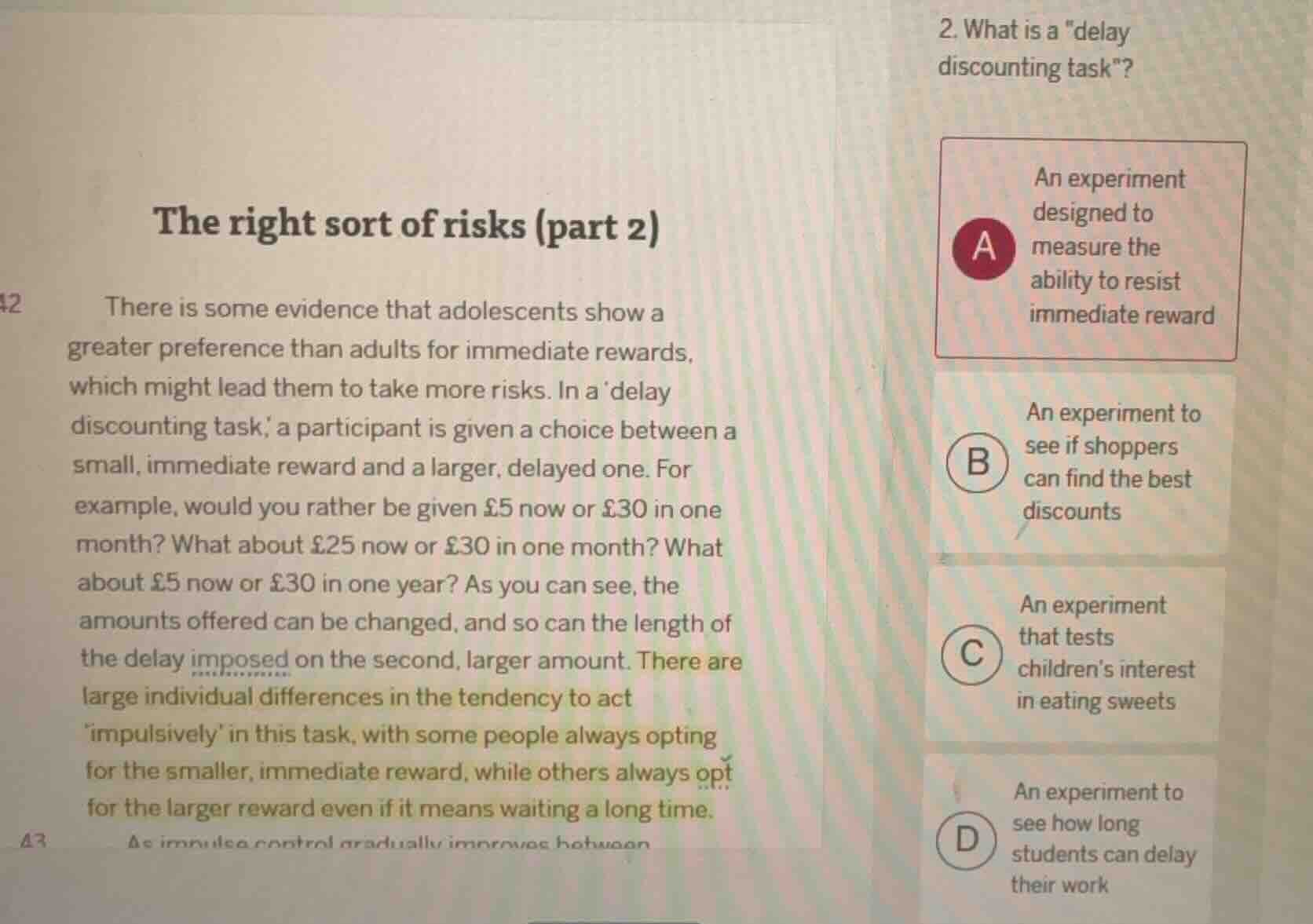
there is some evidence that adolescents show a greater preference than adults for immediate rewards, which might lead them to take more risks. in a delay discounting task, a participant is given a choice between a small, immediate reward and a larger, delayed one. for example, would you rather be given £5 now or £30 in one month? what about £25 now or £30 in one month? what about £5 now or £30 in one year? as you can see, the amounts offered can be changed, and so can the length of the delay imposed on the second, larger amount. there are large individual differences in the tendency to act impulsively in this task, with some people always opting for the smaller, immediate reward, while others always opt for the larger reward even if it means waiting a long time.
- what is a \delay discounting task\?
a an experiment designed to measure the ability to resist immediate reward
b an experiment to see if shoppers can find the best discounts
c an experiment that tests childrens interest in eating sweets
d an experiment to see how long students can delay their work
To determine the answer, we analyze each option:
- Option A: The text describes a "delay discounting task" as a choice between a small immediate reward and a larger delayed one, which measures the ability to resist immediate rewards (since choosing the larger, delayed reward requires resisting the immediate one). This matches the description.
- Option B: The task is not about shopping discounts, so B is incorrect.
- Option C: The task is not about children's interest in sweets, so C is incorrect.
- Option D: The task is about choosing between rewards, not delaying work, so D is incorrect.

Snap & solve any problem in the app
Get step-by-step solutions on Sovi AI
Photo-based solutions with guided steps
Explore more problems and detailed explanations
A. An experiment designed to measure the ability to resist immediate reward