QUESTION IMAGE
Question
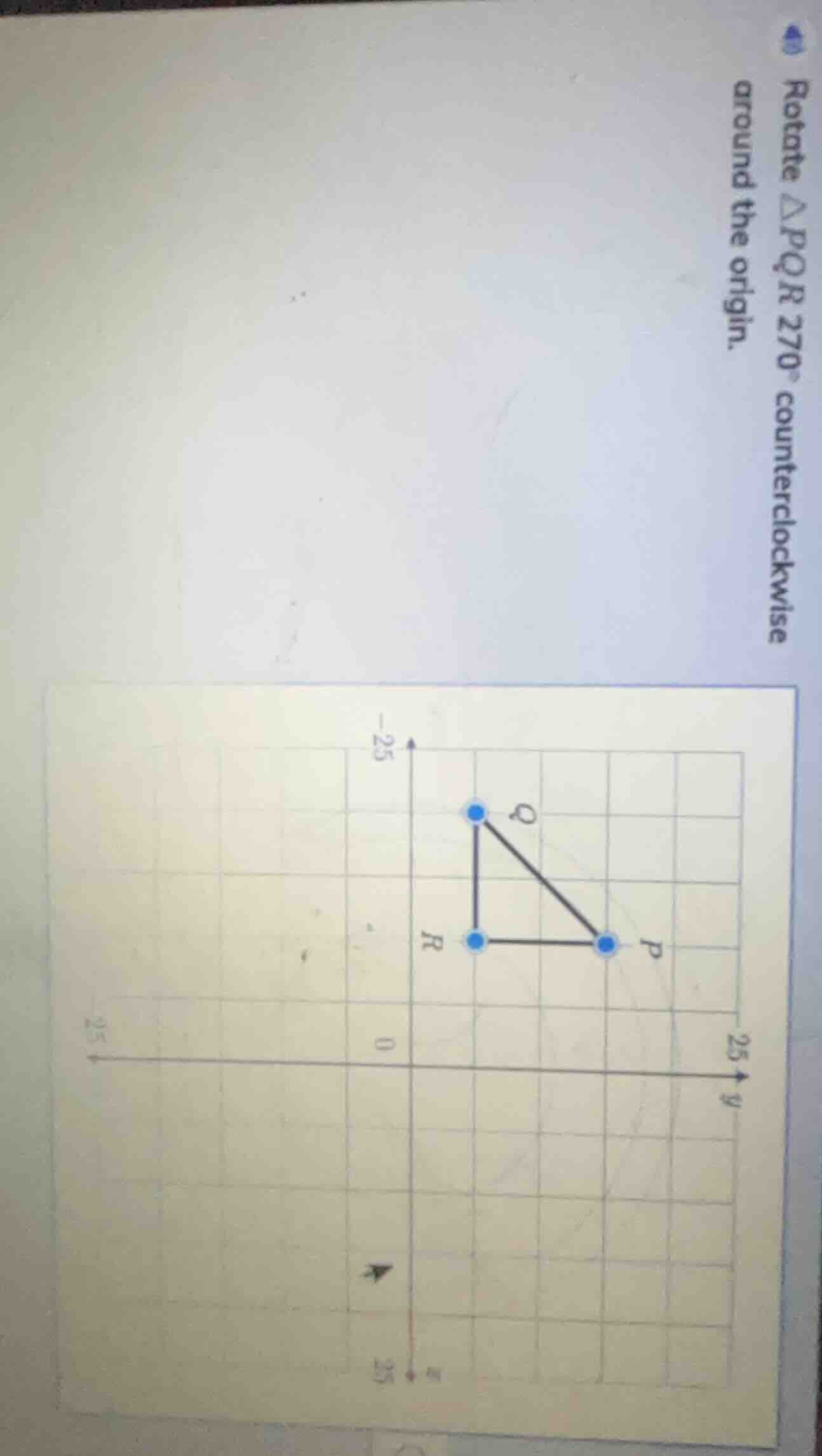
rotate △pqr 270° counterclockwise around the origin.
First, we need to determine the coordinates of the vertices of $\triangle PQR$. Let's assume the grid has a scale where each square is 1 unit. From the graph, let's find the coordinates:
- Let's say point $R$ is at $(1, 1)$ (wait, actually, looking at the axes, the x-axis is labeled with negative numbers on the left, positive on the right? Wait, the graph has the x-axis with -25 on the left, 0 in the middle, and positive on the right? Wait, no, the y-axis is labeled 25 on the top? Wait, maybe the coordinates are: Let's re - examine.
Wait, maybe the coordinate system is a bit unconventional. Let's assume that the origin is at the center. Let's find the coordinates of $P$, $Q$, $R$. Let's suppose:
Let's assume the coordinates:
- Let $R=(1,1)$? No, maybe the coordinates are: Let's look at the positions. Let's suppose the x - axis is horizontal (left - right) and y - axis is vertical (up - down). Let's assume the coordinates:
Wait, maybe the coordinates are:
- $R=(1,1)$, $Q=(1,3)$, $P=(3,1)$ (assuming each grid square is 1 unit).
The rule for rotating a point $(x,y)$ 270° counterclockwise around the origin is $(x,y)\to(y, - x)$.
Step 1: Find the coordinates of the original points
Let's correctly identify the coordinates. Let's assume the grid has the origin at $(0,0)$. Let's look at the positions:
From the graph, let's assume:
- Point $R$: Let's say its coordinates are $(1,1)$ (if the grid is such that each square is 1 unit, and the origin is at the center). Wait, maybe the coordinates are:
- $R=(1,1)$, $Q=(1,3)$, $P=(3,1)$
Step 2: Apply the rotation rule
The rotation rule for 270° counterclockwise about the origin is: If a point has coordinates $(x,y)$, after a 270° counterclockwise rotation, the new coordinates $(x',y')$ are given by $x' = y$ and $y'=-x$.
For point $R=(x_1,y_1)$:
If $R=(1,1)$, then $x_1 = 1$, $y_1 = 1$. After rotation, $x_1'=y_1 = 1$, $y_1'=-x_1=- 1$. So $R'=(1, - 1)$
For point $Q=(x_2,y_2)=(1,3)$:
$x_2'=y_2 = 3$, $y_2'=-x_2=-1$. So $Q'=(3, - 1)$
For point $P=(x_3,y_3)=(3,1)$:
$x_3'=y_3 = 1$, $y_3'=-x_3=-3$. So $P'=(1, - 3)$
Wait, maybe my initial coordinate assumption is wrong. Let's re - consider. Maybe the coordinates are:
Wait, the graph has the x - axis with negative values on the left ( - 25) and positive on the right, and the y - axis with positive values on the top (25) and negative on the bottom. Let's assume the coordinates of the points:
Let's say:
- $R=(1,1)$ (close to the origin), $Q=(1,3)$ (above $R$), $P=(3,1)$ (to the right of $R$)
After rotating 270° counterclockwise, the new coordinates:
For $R=(1,1)$: $(1,1)\to(1, - 1)$
For $Q=(1,3)$: $(1,3)\to(3, - 1)$
For $P=(3,1)$: $(3,1)\to(1, - 3)$
Now, we can plot these new points to get the rotated triangle.

Snap & solve any problem in the app
Get step-by-step solutions on Sovi AI
Photo-based solutions with guided steps
Explore more problems and detailed explanations
The rotated triangle $\triangle P'Q'R'$ has vertices at $P'(1, - 3)$, $Q'(3, - 1)$, $R'(1, - 1)$ (assuming the original coordinates of $P=(3,1)$, $Q=(1,3)$, $R=(1,1)$). If the original coordinates were different, the rotated coordinates would be adjusted according to the rotation rule $(x,y)\to(y, - x)$ for a 270° counterclockwise rotation about the origin.