QUESTION IMAGE
Question
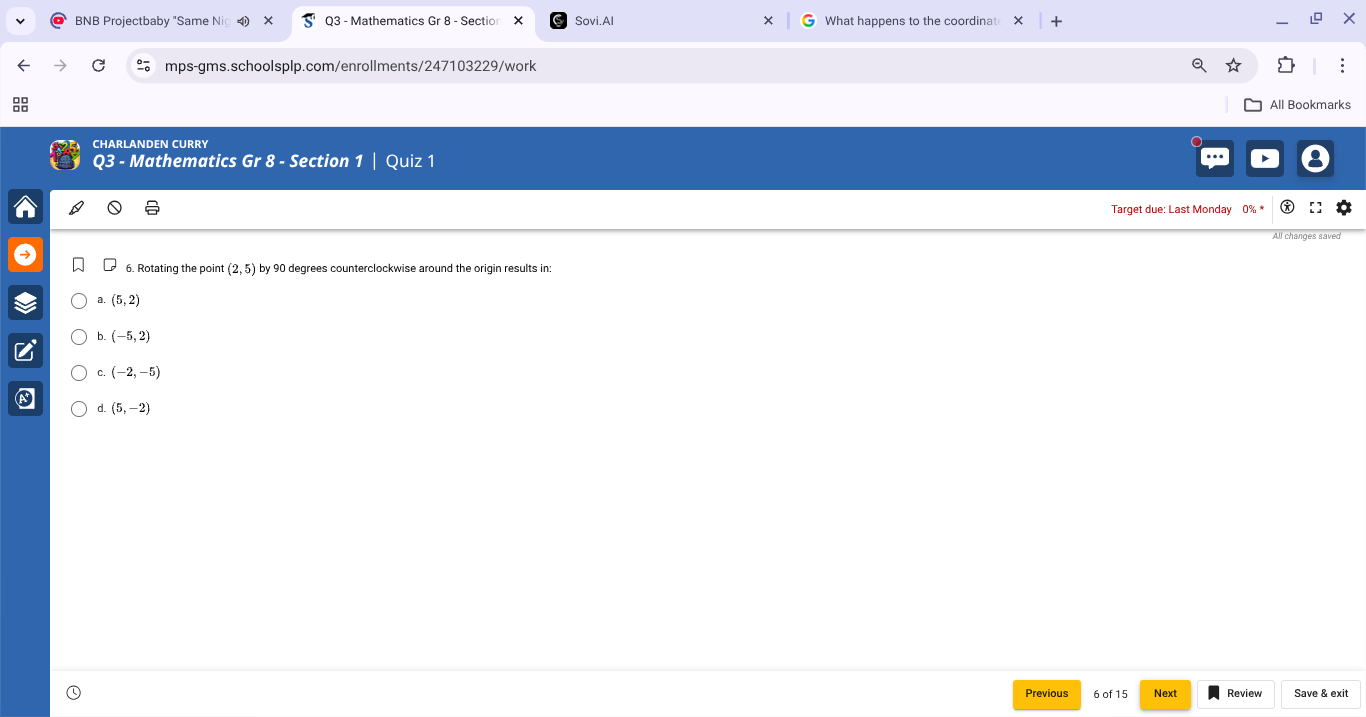
- rotating the point (2, 5) by 90 degrees counterclockwise around the origin results in:
a. (5,2)
b. (-5,2)
c. (-2,-5)
d. (5,-2)
Step1: Recall 90° CCW rotation rule
For a point \((x, y)\), rotating 90° counterclockwise around the origin transforms it to \((-y, x)\).
Step2: Apply the rule to \((2, 5)\)
Here, \(x = 2\) and \(y = 5\). Substituting into the transformation: \(-y=-5\) and \(x = 2\)? Wait, no—wait, the correct rule is \((x, y)\to(-y, x)\)? Wait, no, actually, the standard 90° counterclockwise rotation around the origin is \((x, y)\to(-y, x)\)? Wait, no, let's correct: The correct transformation for 90° counterclockwise about the origin is \((x, y)\to(-y, x)\)? Wait, no, let's take an example. If we have \((1, 0)\), rotating 90° counterclockwise gives \((0, 1)\)? Wait, no, \((1, 0)\) rotated 90° CCW is \((0, 1)\)? Wait, no, the standard formula is: for a point \((x, y)\), rotating 90° counterclockwise around the origin results in \((-y, x)\)? Wait, no, let's use the rotation matrix. The rotation matrix for 90° counterclockwise is \(
\). So multiplying \(
=
\). So for \((x, y)=(2, 5)\), applying the matrix: \(
=
\)? Wait, no, that would be \((-5, 2)\). Wait, let's check with a simple point. Take \((1, 2)\). Rotating 90° CCW: the rotation matrix gives \(
=
\), so the point becomes \((-2, 1)\). Wait, so the rule is \((x, y)\to(-y, x)\). So for \((2, 5)\), \(x = 2\), \(y = 5\). Then \(-y=-5\), \(x = 2\)? Wait, no, the matrix multiplication is \(
=
\). So \((x, y)=(2, 5)\) becomes \((-5, 2)\). Let's verify with another method. Imagine the point \((2, 5)\) in the first quadrant. Rotating 90° counterclockwise around the origin: the x - coordinate (2) will become the negative of the y - coordinate ( - 5) and the y - coordinate (5) will become the x - coordinate (2)? Wait, no, the rotation matrix gives \((-y, x)\). So \((2, 5)\) becomes \((-5, 2)\), which is option b.

Snap & solve any problem in the app
Get step-by-step solutions on Sovi AI
Photo-based solutions with guided steps
Explore more problems and detailed explanations
b. \((-5, 2)\)