QUESTION IMAGE
Question
round your answer to the nearest hundredth.
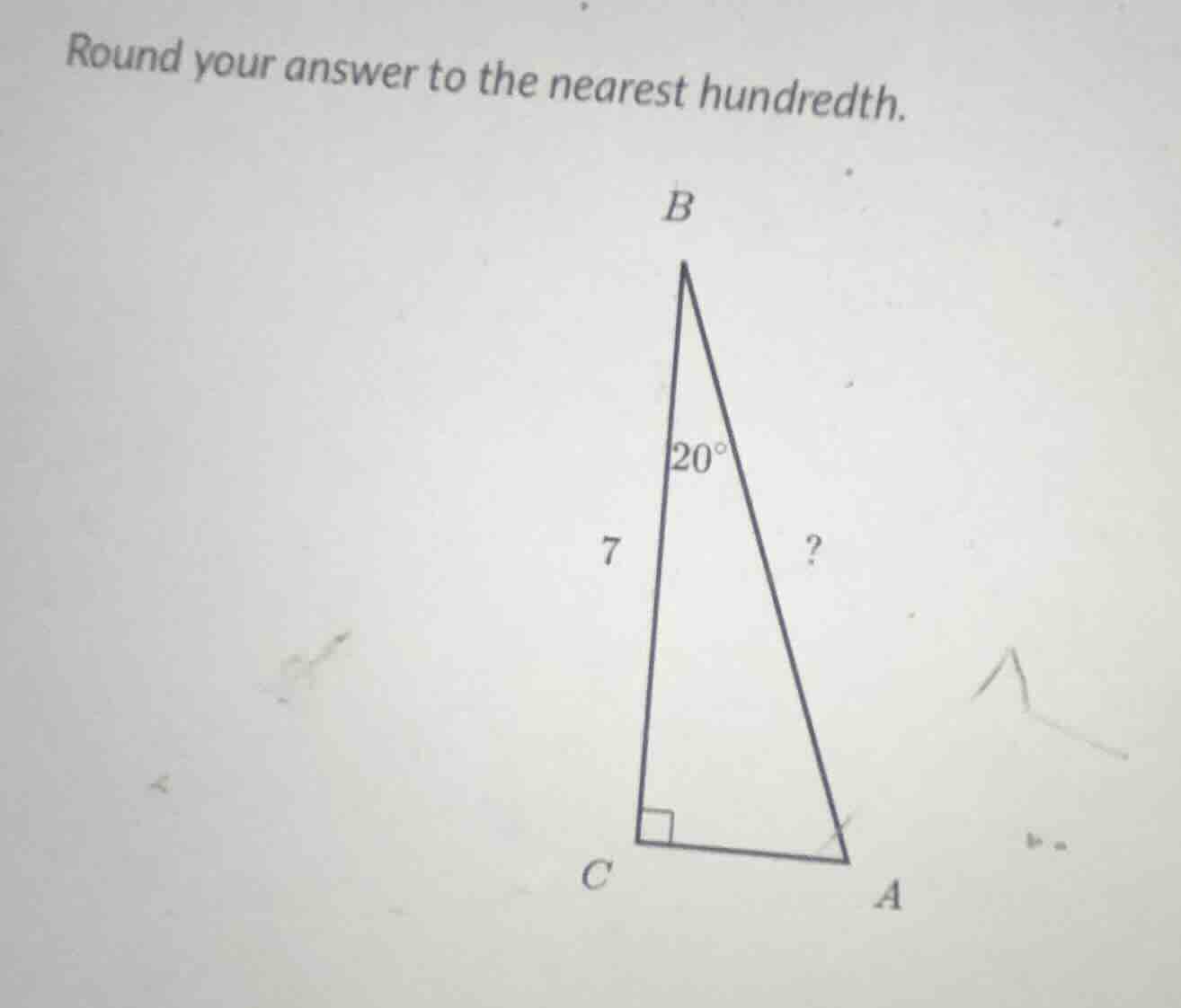
(there is a right triangle bca with right angle at c. the length of bc is 7, angle at b is 20 degrees, and the length of ba is unknown, marked as ?)
Step1: Identify triangle type
Right triangle at C, angle B=20°, BC=7
Step2: Choose trigonometric ratio
tan(20°) = AC/BC
Step3: Calculate AC
AC = BC × tan(20°) = 7 × tan(20°)
Step4: Compute value
tan(20°) ≈ 0.3640, so AC ≈ 7×0.3640≈2.548
Wait correction: Wait, angle at B is 20°, adjacent side to B is BC=7, opposite side is AC. Yes tan(theta)=opposite/adjacent, so AC=7tan(20°). tan(20)≈0.3640, so 70.3640=2.548≈2.55? Wait no, let's check calculator: tan(20°)≈0.3640, 70.3640=2.548≈2.55. Wait maybe I miscalculated earlier. Correct: AC=7tan(20°)≈70.3640=2.548≈2.55. Oh right, 0.36407: 0.37=2.1, 0.0647=0.448, total 2.548≈2.55.
Wait another check: If angle B is 20°, BC=7 (adjacent), AC=opposite. So yes tan(B)=AC/BC => AC=BCtan(B). So yes 7tan(20)≈2.55.
Final Answer: 2.55
Step1: Confirm triangle properties
Right triangle at C, ∠B=20°, BC=7
Step2: Apply tangent function
tan(20°) = AC/BC
Step3: Solve for AC
AC = 7 × tan(20°)
Step4: Calculate value
tan(20°)≈0.3640, AC≈7×0.3640≈2.55

Snap & solve any problem in the app
Get step-by-step solutions on Sovi AI
Photo-based solutions with guided steps
Explore more problems and detailed explanations
2.42