QUESTION IMAGE
Question
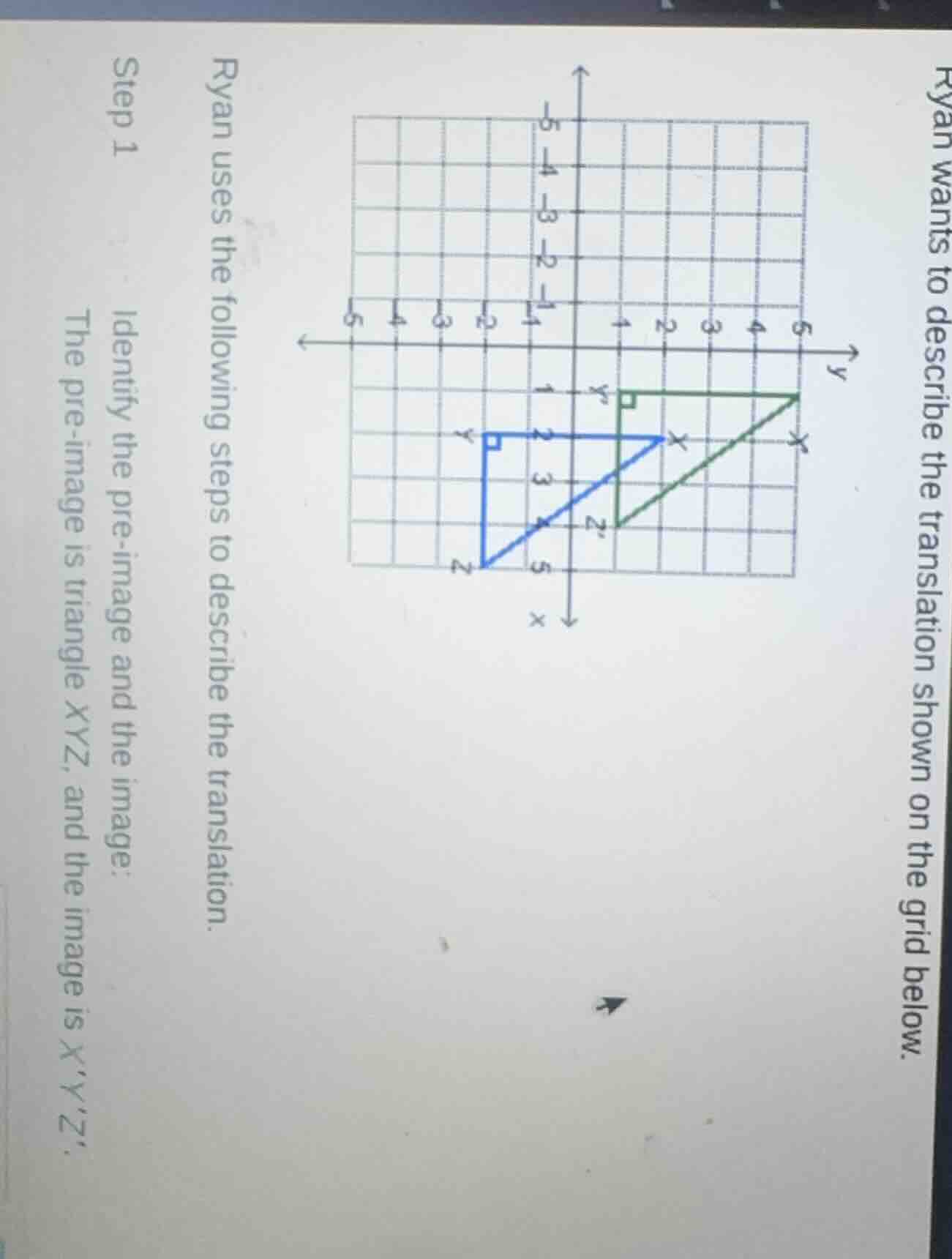
ryan wants to describe the translation shown on the grid below.
ryan uses the following steps to describe the translation.
step 1
identify the pre - image and the image:
the pre - image is triangle xyz, and the image is xyz.
To determine the translation, we first identify the coordinates of corresponding vertices of the pre - image (triangle \(XYZ\)) and the image (triangle \(X'Y'Z'\)).
Step 1: Find coordinates of vertices
Let's assume the coordinates of the vertices:
- For pre - image \(XYZ\): Let's say \(X=(x_1,y_1)\), \(Y=(y_1,y_2)\), \(Z=(z_1,z_2)\)
- For image \(X'Y'Z'\): Let's say \(X'=(x_1 + a,y_1 + b)\), \(Y'=(y_1 + a,y_2 + b)\), \(Z'=(z_1 + a,z_2 + b)\) (since translation is a rigid transformation where all points are shifted by the same amount \((a,b)\) in the \(x\) and \(y\) directions)
Looking at the grid:
- Let's find the coordinates of \(Y\) and \(Y'\). From the grid, if \(Y\) has coordinates \((- 1,2)\) and \(Y'\) has coordinates \((1,1)\) (we can also check other points like \(X\) and \(X'\) or \(Z\) and \(Z'\))
- Let's take point \(Y(-1,2)\) and \(Y'(1,1)\)
Step 2: Calculate the horizontal (x - direction) shift
The horizontal shift \(a\) is given by \(x_{new}-x_{old}\). For point \(Y\): \(a = 1-(-1)=2\)
Step 3: Calculate the vertical (y - direction) shift
The vertical shift \(b\) is given by \(y_{new}-y_{old}\). For point \(Y\): \(b=1 - 2=- 1\)
So the translation vector is \((2,-1)\), which means the pre - image (triangle \(XYZ\)) is translated 2 units to the right and 1 unit down to get the image (triangle \(X'Y'Z'\))
If the question was to find the translation (for example, how many units right/left and up/down):

Snap & solve any problem in the app
Get step-by-step solutions on Sovi AI
Photo-based solutions with guided steps
Explore more problems and detailed explanations
The translation is 2 units to the right and 1 unit down (or in vector form \((2,-1)\))