QUESTION IMAGE
Question
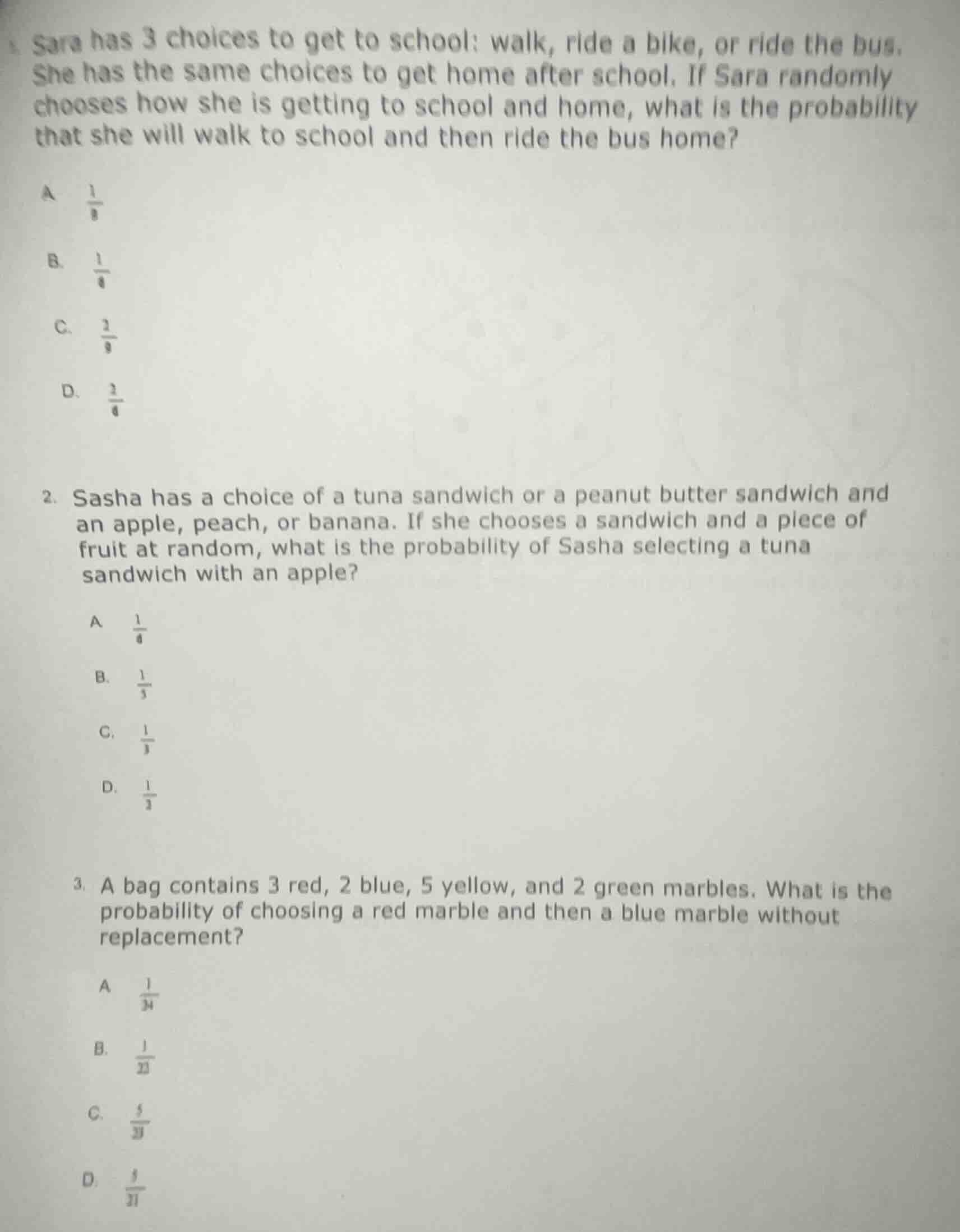
- sara has 3 choices to get to school: walk, ride a bike, or ride the bus. she has the same choices to get home after school. if sara randomly chooses how she is getting to school and home, what is the probability that she will walk to school and then ride the bus home?
a (\frac{1}{8})
b. (\frac{1}{9})
c. (\frac{2}{9})
d. (\frac{2}{6})
- sasha has a choice of a tuna sandwich or a peanut butter sandwich and an apple, peach, or banana. if she chooses a sandwich and a piece of fruit at random, what is the probability of sasha selecting a tuna sandwich with an apple?
a (\frac{1}{4})
b. (\frac{1}{5})
c. (\frac{1}{6})
d. (\frac{1}{3})
- a bag contains 3 red, 2 blue, 5 yellow, and 2 green marbles. what is the probability of choosing a red marble and then a blue marble without replacement?
a (\frac{1}{24})
b. (\frac{1}{22})
c. (\frac{5}{23})
d. (\frac{5}{21})
Question 1
Step1: Determine the number of choices for each trip
Sara has 3 choices (walk, bike, bus) to get to school and 3 choices to get home.
Step2: Calculate the probability of walking to school
The probability of walking to school is $\frac{1}{3}$ since there are 3 equally - likely choices.
Step3: Calculate the probability of riding the bus home
The probability of riding the bus home is $\frac{1}{3}$ since there are 3 equally - likely choices.
Step4: Calculate the combined probability
Since the two events (going to school and going home) are independent, we multiply the probabilities of each event. So the probability of walking to school and then riding the bus home is $\frac{1}{3}\times\frac{1}{3}=\frac{1}{9}$.
Step1: Determine the number of sandwich choices and fruit choices
There are 2 sandwich choices (tuna, peanut butter) and 3 fruit choices (apple, peach, banana).
Step2: Calculate the probability of choosing a tuna sandwich
The probability of choosing a tuna sandwich is $\frac{1}{2}$ (since there are 2 sandwich options).
Step3: Calculate the probability of choosing an apple
The probability of choosing an apple is $\frac{1}{3}$ (since there are 3 fruit options).
Step4: Calculate the combined probability
Since the choices of sandwich and fruit are independent, we multiply the probabilities. So the probability of choosing a tuna sandwich and an apple is $\frac{1}{2}\times\frac{1}{3}=\frac{1}{6}$. Wait, let's re - evaluate. The total number of possible combinations is the number of sandwich choices times the number of fruit choices. The number of sandwich choices $n_{s}=2$, the number of fruit choices $n_{f}=3$, so the total number of combinations $N = 2\times3=6$. The number of favorable combinations (tuna sandwich and apple) is 1. So the probability is $\frac{1}{6}$. But looking at the options, if we consider the probability of tuna sandwich is $\frac{1}{2}$ and apple is $\frac{1}{3}$, and since the events are independent, $P=\frac{1}{2}\times\frac{1}{3}=\frac{1}{6}$. But the options given: A. $\frac{1}{4}$, B. $\frac{1}{5}$, C. $\frac{1}{6}$, D. $\frac{1}{3}$. So the correct option is C.
Step1: Calculate the total number of marbles initially
The total number of marbles initially is $3 + 2+5 + 2=12$ marbles.
Step2: Calculate the probability of choosing a red marble first
The probability of choosing a red marble first is $\frac{3}{12}=\frac{1}{4}$ (since there are 3 red marbles out of 12 total marbles).
Step3: Calculate the probability of choosing a blue marble after choosing a red marble (without replacement)
After removing one red marble, the total number of marbles left is $12 - 1 = 11$ marbles, and the number of blue marbles is still 2. So the probability of choosing a blue marble next is $\frac{2}{11}$.
Step4: Calculate the combined probability
Since the two events are dependent (without replacement), we multiply the probabilities of each event. So the probability of choosing a red marble and then a blue marble without replacement is $\frac{3}{12}\times\frac{2}{11}=\frac{6}{132}=\frac{1}{22}$.

Snap & solve any problem in the app
Get step-by-step solutions on Sovi AI
Photo-based solutions with guided steps
Explore more problems and detailed explanations
B. $\frac{1}{9}$