QUESTION IMAGE
Question
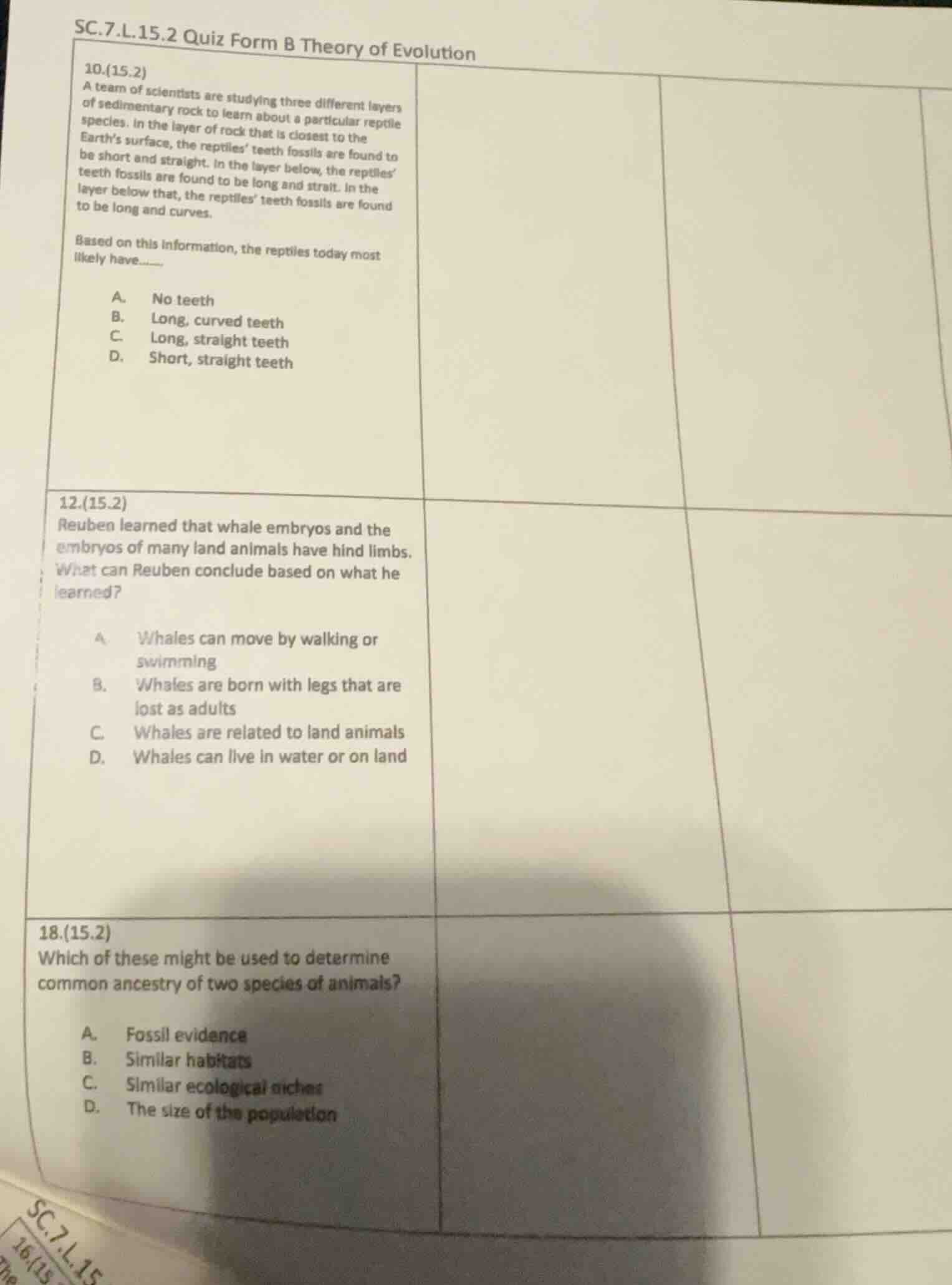
sc.7.l.15.2 quiz form b theory of evolution
10.(15.2)
a team of scientists are studying three different layers of sedimentary rock to learn about a particular reptile species. in the layer of rock that is closest to the earths surface, the reptiles teeth fossils are found to be short and straight. in the layer below, the reptiles teeth fossils are found to be long and strait. in the layer below that, the reptiles teeth fossils are found to be long and curves.
based on this information, the reptiles today most likely have......
a. no teeth
b. long, curved teeth
c. long, straight teeth
d. short, straight teeth
12.(15.2)
reuben learned that whale embryos and the embryos of many land animals have hind limbs. what can reuben conclude based on what he learned?
a. whales can move by walking or swimming
b. whales are born with legs that are lost as adults
c. whales are related to land animals
d. whales can live in water or on land
18.(15.2)
which of these might be used to determine common ancestry of two species of animals?
a. fossil evidence
b. similar habitats
c. similar ecological niches
d. the size of the population
- For question 10: Sedimentary rock layers closest to the surface contain the most recent fossils, matching modern organisms. The top layer has short, straight teeth fossils.
- For question 12: Shared embryonic structures (hind limbs in whale and land animal embryos) indicate a common evolutionary ancestor, meaning the species are related.
- For question 18: Fossil evidence shows physical traits of ancient organisms, which can reveal shared ancestry between species. Similar habitats/niches and population size do not indicate common ancestry.

Snap & solve any problem in the app
Get step-by-step solutions on Sovi AI
Photo-based solutions with guided steps
Explore more problems and detailed explanations
- D. Short, straight teeth
- C. Whales are related to land animals
- A. Fossil evidence