QUESTION IMAGE
Question
scanning electron microscope
compound light microscope
transmission electron microscope
stereoscope (dissecting microscope)
a microscope that has lower magnifying power but can provide 3 - dimensional viewing of objects.
designed for studying cells and tiny slices of microorganisms like viruses.
a microscope which magnifies from magnification ranging from 20x to approximately 30,000x and provides a 3 - dimensional view of the specimen.
a scope built of two systems of lenses for greater magnification (an objective and an ocular: eye piece). the most useful magnification of a compound microscope is about 1000x.
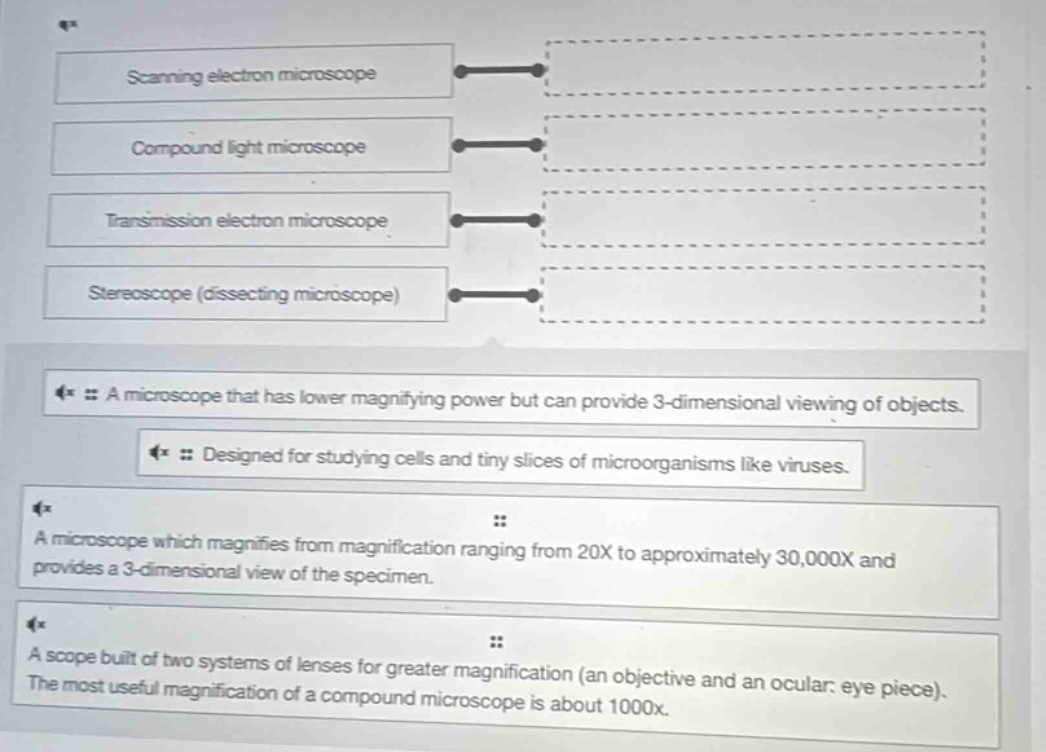
To solve this, we match each microscope to its description:
1. Scanning electron microscope
Description: "A microscope which magnifies from magnification ranging from 20X to approximately 30,000X and provides a 3 - dimensional view of the specimen."
Reason: Scanning electron microscopes (SEM) have a magnification range around 20X - 30,000X and produce 3D images of the specimen’s surface.
2. Compound light microscope
Description: "A scope built of two systems of lenses for greater magnification (an objective and an ocular: eye piece). The most useful magnification of a compound microscope is about 1000x."
Reason: Compound light microscopes use two lens systems (objective and ocular) and typically have a maximum useful magnification of around 1000x for observing cells and small specimens.
3. Transmission electron microscope
Description: "Designed for studying cells and tiny slices of microorganisms like viruses."
Reason: Transmission electron microscopes (TEM) are used to study thin slices of cells, viruses, and other tiny structures at very high magnifications.
4. Stereoscope (dissecting microscope)
Description: "A microscope that has lower magnifying power but can provide 3 - dimensional viewing of objects."
Reason: Stereoscopes (dissecting microscopes) have lower magnification compared to other microscopes but provide a 3D view of the object, which is useful for dissecting or viewing larger specimens in 3D.
Final Matches:
- Scanning electron microscope → "A microscope which magnifies from magnification ranging from 20X to approximately 30,000X and provides a 3 - dimensional view of the specimen."
- Compound light microscope → "A scope built of two systems of lenses for greater magnification (an objective and an ocular: eye piece). The most useful magnification of a compound microscope is about 1000x."
- Transmission electron microscope → "Designed for studying cells and tiny slices of microorganisms like viruses."
- Stereoscope (dissecting microscope) → "A microscope that has lower magnifying power but can provide 3 - dimensional viewing of objects."

Snap & solve any problem in the app
Get step-by-step solutions on Sovi AI
Photo-based solutions with guided steps
Explore more problems and detailed explanations
To solve this, we match each microscope to its description:
1. Scanning electron microscope
Description: "A microscope which magnifies from magnification ranging from 20X to approximately 30,000X and provides a 3 - dimensional view of the specimen."
Reason: Scanning electron microscopes (SEM) have a magnification range around 20X - 30,000X and produce 3D images of the specimen’s surface.
2. Compound light microscope
Description: "A scope built of two systems of lenses for greater magnification (an objective and an ocular: eye piece). The most useful magnification of a compound microscope is about 1000x."
Reason: Compound light microscopes use two lens systems (objective and ocular) and typically have a maximum useful magnification of around 1000x for observing cells and small specimens.
3. Transmission electron microscope
Description: "Designed for studying cells and tiny slices of microorganisms like viruses."
Reason: Transmission electron microscopes (TEM) are used to study thin slices of cells, viruses, and other tiny structures at very high magnifications.
4. Stereoscope (dissecting microscope)
Description: "A microscope that has lower magnifying power but can provide 3 - dimensional viewing of objects."
Reason: Stereoscopes (dissecting microscopes) have lower magnification compared to other microscopes but provide a 3D view of the object, which is useful for dissecting or viewing larger specimens in 3D.
Final Matches:
- Scanning electron microscope → "A microscope which magnifies from magnification ranging from 20X to approximately 30,000X and provides a 3 - dimensional view of the specimen."
- Compound light microscope → "A scope built of two systems of lenses for greater magnification (an objective and an ocular: eye piece). The most useful magnification of a compound microscope is about 1000x."
- Transmission electron microscope → "Designed for studying cells and tiny slices of microorganisms like viruses."
- Stereoscope (dissecting microscope) → "A microscope that has lower magnifying power but can provide 3 - dimensional viewing of objects."