QUESTION IMAGE
Question
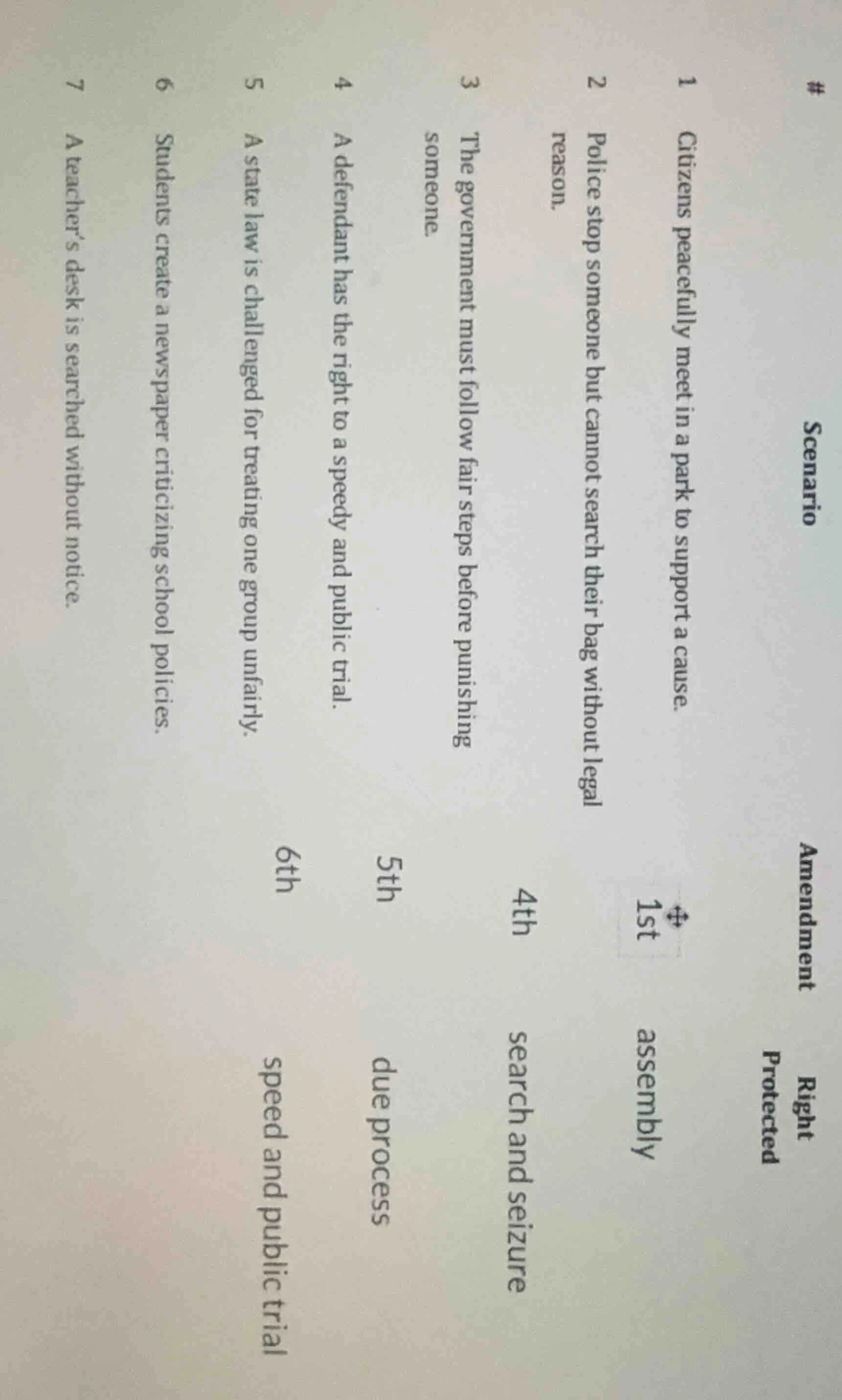
scenario amendment right protected 1 citizens peacefully meet in a park to support a cause. 1st assembly 2 police stop someone but cannot search their bag without legal reason. 4th search and seizure 3 the government must follow fair steps before punishing someone. 5th due process 4 a defendant has the right to a speedy and public trial. 6th speed and public trial 5 a state law is challenged for treating one group unfairly. 6 students create a newspaper criticizing school policies. 7 a teacher’s desk is searched without notice.
Brief Explanations
This problem involves matching scenarios to the corresponding US Constitutional Amendments and the rights they protect. Let's analyze each:
- Scenario 1: Citizens peacefully meet in a park to support a cause
- The 1st Amendment protects the right to peaceful assembly. So match to "1st" Amendment and "assembly" right.
- Scenario 2: Police stop someone but cannot search their bag without legal reason
- The 4th Amendment regulates search and seizure (requiring probable cause). Match to "4th" Amendment and "search and seizure" right.
- Scenario 3: The government must follow fair steps before punishing someone
- The 5th Amendment includes due process (fair legal procedures before deprivation of liberty/property). Match to "5th" Amendment and "due process" right.
- Scenario 4: A defendant has the right to a speedy and public trial
- The 6th Amendment guarantees a speedy and public trial. Match to "6th" Amendment and "speed and public trial" right.
- Scenario 5: A state law is challenged for treating one group unfairly
- The 14th Amendment (implied, though not labeled here) addresses equal protection, but if using the given labels, the 5th/14th due process includes equal protection. However, the 6th is about trial, 5th about due process. Wait, the 5th Amendment’s due process (and 14th) applies to equal protection. But the given "5th" is labeled with "due process". So match Scenario 5 to "5th" Amendment and "due process" (since equal protection is part of due process clause).
- Scenario 6: Students create a newspaper criticizing school policies
- The 1st Amendment protects freedom of speech/press. Match to "1st" Amendment and (implied) speech/press, but the given "1st" is labeled "assembly" – wait, maybe a typo, but the 1st Amendment includes speech, press, assembly, religion. So Scenario 6 (student newspaper) is 1st Amendment (press).
- Scenario 7: A teacher’s desk is searched without notice
- The 4th Amendment requires search warrants (or reasonable suspicion in schools, but generally, search and seizure). Match to "4th" Amendment and "search and seizure".

Snap & solve any problem in the app
Get step-by-step solutions on Sovi AI
Photo-based solutions with guided steps
Explore more problems and detailed explanations
- Scenario 1: 1st Amendment, Right: assembly
- Scenario 2: 4th Amendment, Right: search and seizure
- Scenario 3: 5th Amendment, Right: due process
- Scenario 4: 6th Amendment, Right: speed and public trial
- Scenario 5: 5th Amendment, Right: due process (equal protection under due process clause)
- Scenario 6: 1st Amendment, Right: (press, part of 1st Amendment rights)
- Scenario 7: 4th Amendment, Right: search and seizure
(Note: If strictly matching the given labels:
- Scenario 1: 1st, assembly
- Scenario 2: 4th, search and seizure
- Scenario 3: 5th, due process
- Scenario 4: 6th, speed and public trial
- Scenario 5: 5th, due process (equal protection)
- Scenario 6: 1st, (speech/press, under 1st)
- Scenario 7: 4th, search and seizure)