QUESTION IMAGE
Question
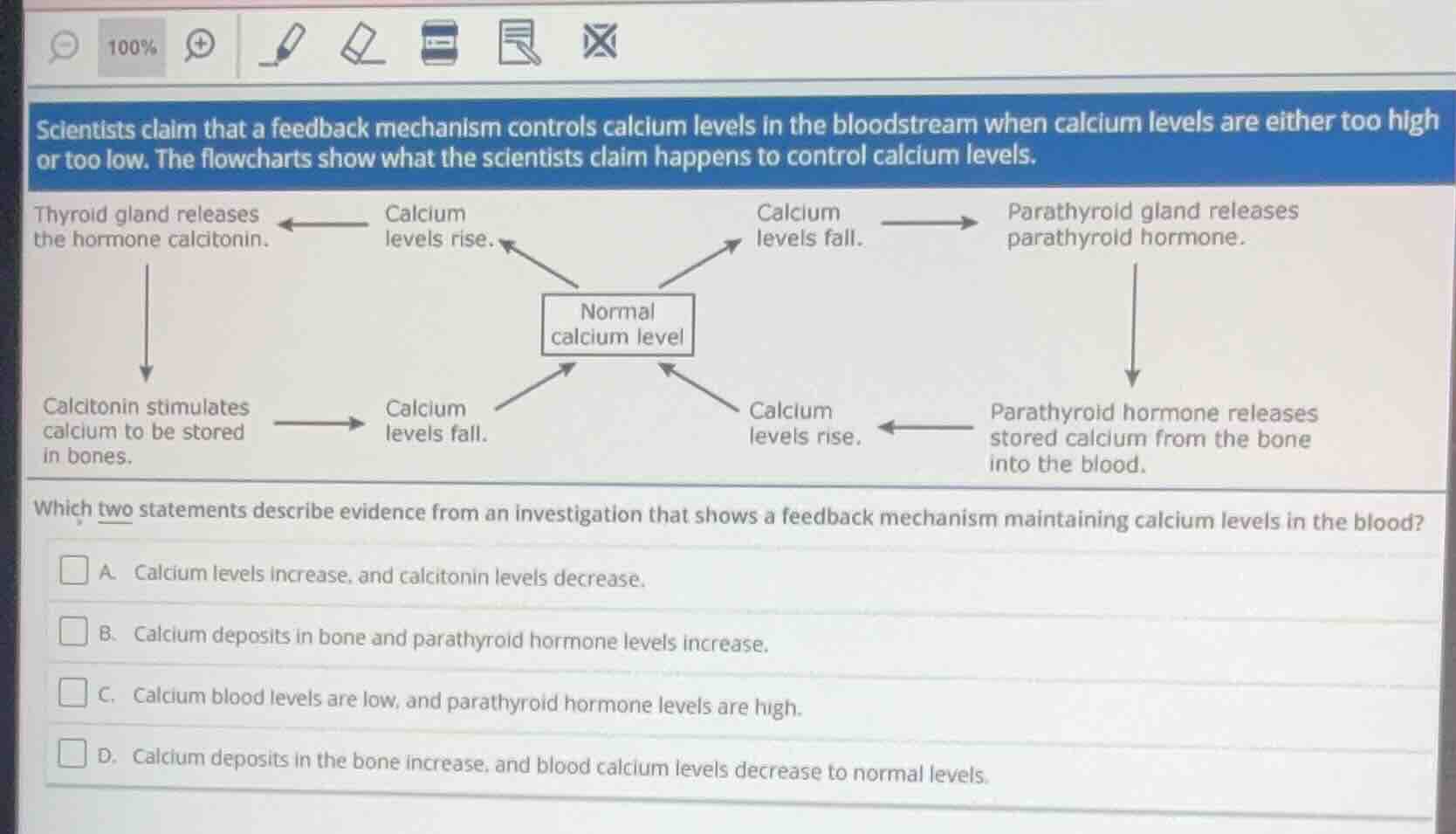
scientists claim that a feedback mechanism controls calcium levels in the bloodstream when calcium levels are either too high or too low. the flowcharts show what the scientists claim happens to control calcium levels.
thyroid gland releases the hormone calcitonin. ← calcium levels rise. calcium levels fall. → parathyroid gland releases parathyroid hormone.
↓ ↓
calcitonin stimulates calcium to be stored in bones. → calcium levels fall. calcium levels rise. ← parathyroid hormone releases stored calcium from the bone into the blood.
which two statements describe evidence from an investigation that shows a feedback mechanism maintaining calcium levels in the blood?
a. calcium levels increase, and calcitonin levels decrease.
b. calcium deposits in bone and parathyroid hormone levels increase.
c. calcium blood levels are low, and parathyroid hormone levels are high.
d. calcium deposits in the bone increase, and blood calcium levels decrease to normal levels.
- For option C: When blood calcium is low, the feedback mechanism triggers the parathyroid gland to release more parathyroid hormone, which matches the flow chart's pathway for low calcium levels.
- For option D: When calcitonin stimulates calcium storage in bones, blood calcium decreases back to normal, which is the corrective feedback loop for high calcium levels shown in the diagram.
- Option A is incorrect: High calcium should increase calcitonin, not decrease it.
- Option B is incorrect: Parathyroid hormone increases calcium release from bones, not calcium deposition in bones.

Snap & solve any problem in the app
Get step-by-step solutions on Sovi AI
Photo-based solutions with guided steps
Explore more problems and detailed explanations
C. Calcium blood levels are low, and parathyroid hormone levels are high.
D. Calcium deposits in the bone increase, and blood calcium levels decrease to normal levels.