QUESTION IMAGE
Question
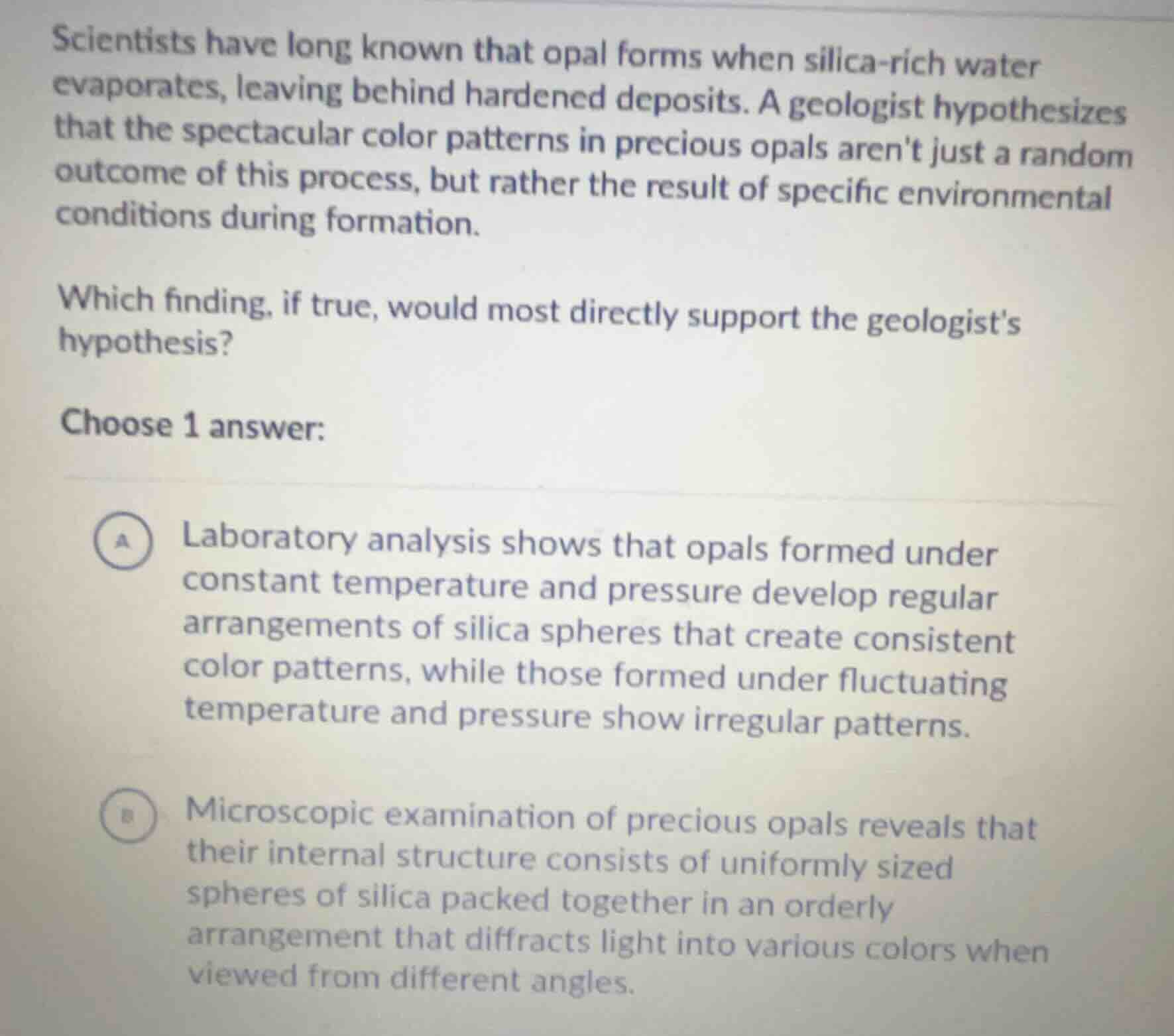
scientists have long known that opal forms when silica - rich water evaporates, leaving behind hardened deposits. a geologist hypothesizes that the spectacular color patterns in precious opals arent just a random outcome of this process, but rather the result of specific environmental conditions during formation. which finding, if true, would most directly support the geologists hypothesis? choose 1 answer: a laboratory analysis shows that opals formed under constant temperature and pressure develop regular arrangements of silica spheres that create consistent color patterns, while those formed under fluctuating temperature and pressure show irregular patterns. b microscopic examination of precious opals reveals that their internal structure consists of uniformly sized spheres of silica packed together in an orderly arrangement that diffracts light into various colors when viewed from different angles.
The geologist's hypothesis states that opal color patterns result from specific environmental conditions during formation, not random processes. Option A directly links specific environmental factors (constant vs. fluctuating temperature/pressure) to distinct, non-random color patterns, which supports the claim that environmental conditions shape the patterns. Option B only describes the internal structure that creates color but does not connect it to specific formation conditions.

Snap & solve any problem in the app
Get step-by-step solutions on Sovi AI
Photo-based solutions with guided steps
Explore more problems and detailed explanations
A. Laboratory analysis shows that opals formed under constant temperature and pressure develop regular arrangements of silica spheres that create consistent color patterns, while those formed under fluctuating temperature and pressure show irregular patterns.