QUESTION IMAGE
Question
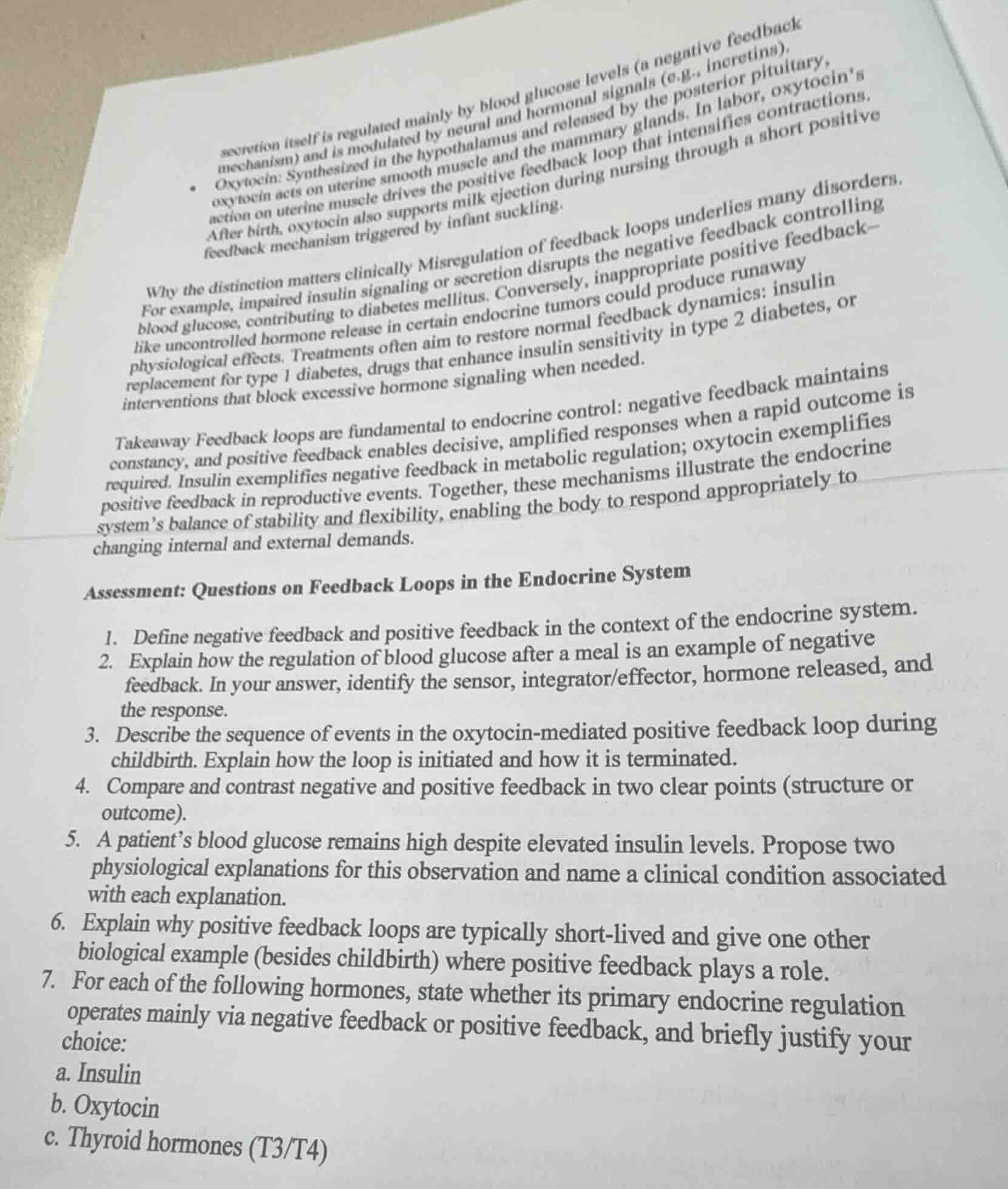
secretion itself is regulated mainly by blood glucose levels (a negative feedback mechanism) and is modulated by neural and hormonal signals (e.g., incretins).
- oxytocin: synthesized in the hypothalamus and released by the posterior pituitary, oxytocin acts on uterine smooth muscle and the mammary glands. in labor, oxytocin’s action on uterine muscle drives the positive feedback loop that intensifies contractions. after birth, oxytocin also supports milk ejection during nursing through a short positive feedback mechanism triggered by infant suckling.
why the distinction matters clinically misregulation of feedback loops underlies many disorders. for example, impaired insulin signaling or secretion disrupts the negative feedback controlling blood glucose, contributing to diabetes mellitus. conversely, inappropriate positive feedback—like uncontrolled hormone release in certain endocrine tumors could produce runaway physiological effects. treatments often aim to restore normal feedback dynamics: insulin replacement for type 1 diabetes, drugs that enhance insulin sensitivity in type 2 diabetes, or interventions that block excessive hormone signaling when needed.
takeaway feedback loops are fundamental to endocrine control: negative feedback maintains constancy, and positive feedback enables decisive, amplified responses when a rapid outcome is required. insulin exemplifies negative feedback in metabolic regulation; oxytocin exemplifies positive feedback in reproductive events. together, these mechanisms illustrate the endocrine system’s balance of stability and flexibility, enabling the body to respond appropriately to changing internal and external demands.
assessment: questions on feedback loops in the endocrine system
- define negative feedback and positive feedback in the context of the endocrine system.
- explain how the regulation of blood glucose after a meal is an example of negative feedback. in your answer, identify the sensor, integrator/effector, hormone released, and the response.
- describe the sequence of events in the oxytocin - mediated positive feedback loop during childbirth. explain how the loop is initiated and how it is terminated.
- compare and contrast negative and positive feedback in two clear points (structure or outcome).
- a patient’s blood glucose remains high despite elevated insulin levels. propose two physiological explanations for this observation and name a clinical condition associated with each explanation.
- explain why positive feedback loops are typically short - lived and give one other biological example (besides childbirth) where positive feedback plays a role.
- for each of the following hormones, state whether its primary endocrine regulation operates mainly via negative feedback or positive feedback, and briefly justify your choice:
a. insulin
b. oxytocin
c. thyroid hormones (t3/t4)
- Definitions:
- Negative feedback: An endocrine mechanism where a hormone's effect reduces its own secretion, stabilizing physiological levels.
- Positive feedback: An endocrine mechanism where a hormone's effect amplifies its own secretion, driving a rapid, targeted physiological change.
- Blood glucose negative feedback:
- Sensor: Pancreatic beta cells detect elevated blood glucose post-meal.
- Integrator/effector: Pancreatic beta cells act as both, releasing insulin.
- Hormone: Insulin
- Response: Insulin triggers cells (liver, muscle, adipose) to take up glucose, lowering blood glucose levels. As glucose drops, insulin secretion is inhibited, completing the loop.
- Oxytocin positive feedback in childbirth:
- Initiation: Fetal head presses on the cervix, stimulating neural signals to the hypothalamus. The hypothalamus signals the posterior pituitary to release oxytocin.
- Sequence: Oxytocin binds to uterine muscle receptors, causing stronger contractions. These contractions increase cervical pressure, triggering more oxytocin release, amplifying the response.
- Termination: The loop ends once the fetus is delivered, removing cervical pressure and stopping the signal for oxytocin release.
- Compare/contrast feedback loops:
- Outcome: Negative feedback maintains stable, constant physiological conditions (e.g., blood glucose); positive feedback produces rapid, extreme changes to complete a specific process (e.g., childbirth).
- Self-regulation: Negative feedback reverses the initial trigger to reduce hormone secretion; positive feedback reinforces the initial trigger to increase hormone secretion.
- Elevated insulin, high blood glucose:
- 1. Cells have reduced sensitivity to insulin (insulin resistance). Associated condition: Type 2 Diabetes Mellitus.
- 2. Insulin is structurally abnormal or cannot properly bind to cell receptors, so it cannot signal glucose uptake. Associated condition: Mutation-related insulin receptor dysfunction (e.g., Leprechaunism).
- Short-lived positive feedback:
- Positive feedback amplifies a response exponentially, which would disrupt homeostasis if sustained; it only ends when the target process (e.g., childbirth) is completed. Another example: Blood clotting, where clotting factors trigger more clotting factors until a clot forms to stop bleeding.
- Hormone feedback classification:
- a. Insulin: Negative feedback. Elevated blood glucose triggers insulin release, which lowers glucose, reducing further insulin secretion.
- b. Oxytocin: Positive feedback. Oxytocin-induced uterine contractions trigger more oxytocin release during childbirth.
- c. Thyroid hormones (T3/T4): Negative feedback. High T3/T4 levels inhibit the hypothalamus (TRH) and pituitary (TSH), reducing thyroid hormone secretion.

Snap & solve any problem in the app
Get step-by-step solutions on Sovi AI
Photo-based solutions with guided steps
Explore more problems and detailed explanations
1.
- Negative feedback: An endocrine mechanism where a hormone's effect reduces its own secretion to stabilize physiological levels.
- Positive feedback: An endocrine mechanism where a hormone's effect amplifies its own secretion to drive a rapid physiological change.
2.
- Sensor: Pancreatic beta cells (detect high post-meal blood glucose)
- Integrator/effector: Pancreatic beta cells
- Hormone released: Insulin
- Response: Insulin stimulates liver, muscle, and adipose cells to absorb glucose, lowering blood glucose. As glucose levels fall, insulin secretion is inhibited, completing the negative feedback loop.
3.
- Initiation: Fetal head pressure on the cervix sends neural signals to the hypothalamus, which triggers the posterior pituitary to secrete oxytocin.
- Sequence: Oxytocin stimulates stronger uterine contractions, which increase cervical pressure, leading to more oxytocin release, amplifying the response.
- Termination: The loop stops after fetal delivery, which removes cervical pressure and the signal for oxytocin secretion.
4.
- 1. Outcome: Negative feedback maintains homeostasis/constant levels; positive feedback drives rapid, process-completing changes.
- 2. Regulation direction: Negative feedback reverses the initial trigger; positive feedback reinforces the initial trigger.
5.
- 1. Insulin resistance (cells do not respond to insulin). Associated condition: Type 2 Diabetes Mellitus.
- 2. Dysfunctional insulin receptors (insulin cannot bind to cells to signal glucose uptake). Associated condition: Leprechaunism (insulin receptor mutation disorder).
6.
- Positive feedback is short-lived because its exponential amplification would disrupt homeostasis if sustained; it only ends when the target physiological process is finished. Another example: Blood clotting, where activated clotting factors trigger more clotting factors until a clot forms to halt bleeding.
7.
- a. Insulin: Negative feedback. High blood glucose triggers insulin release, which lowers glucose, reducing further insulin secretion.
- b. Oxytocin: Positive feedback. Oxytocin-induced uterine contractions trigger more oxytocin release during childbirth.
- c. Thyroid hormones (T3/T4): Negative feedback. High T3/T4 levels inhibit hypothalamic TRH and pituitary TSH secretion, reducing thyroid hormone production.