QUESTION IMAGE
Question
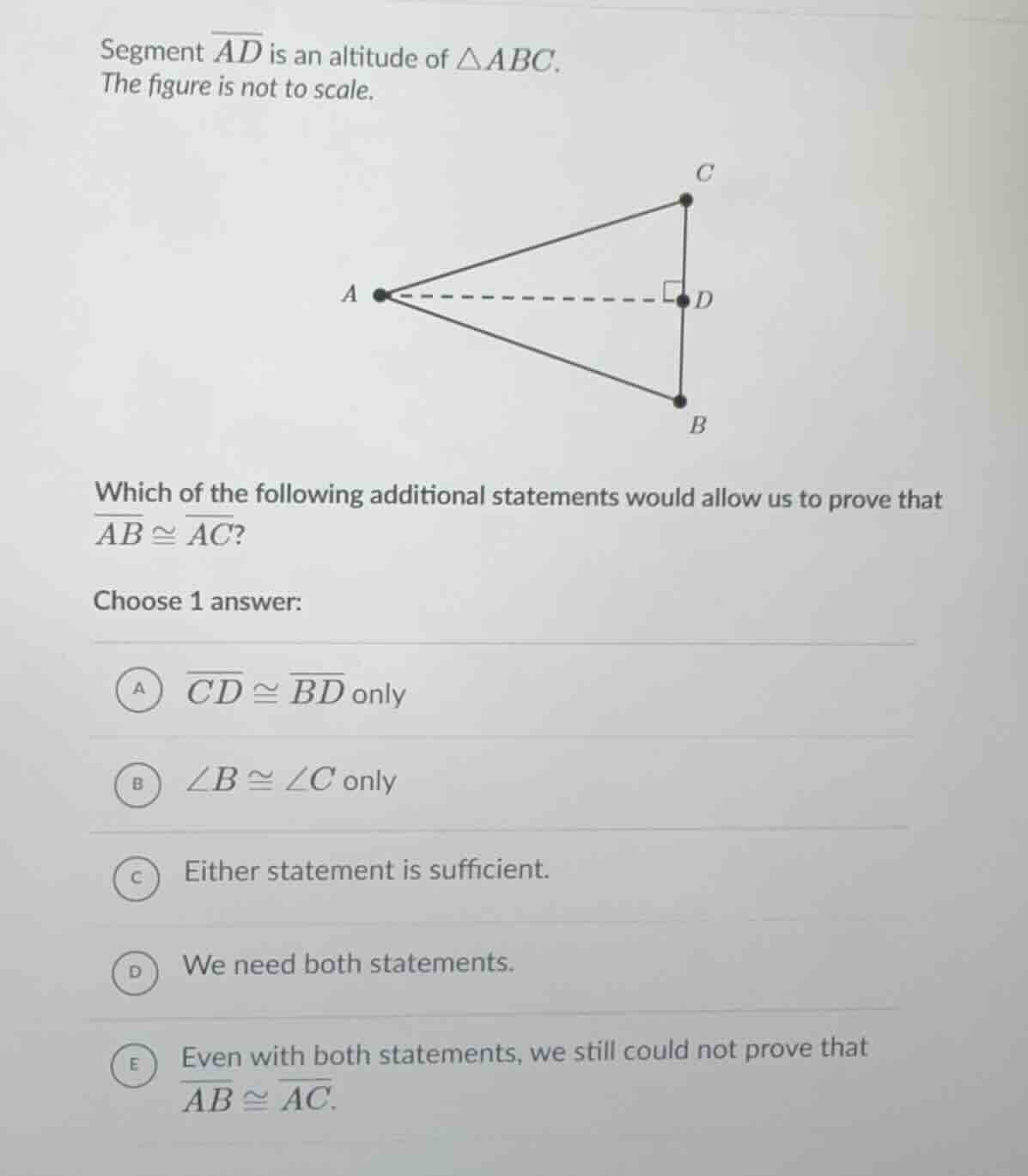
segment \\(\overline{ad}\\) is an altitude of \\(\triangle abc\\).
the figure is not to scale.
which of the following additional statements would allow us to prove that \\(\overline{ab} \cong \overline{ac}\\)?
choose 1 answer:
\\(\boldsymbol{\text{a}}\\) \\(\overline{cd} \cong \overline{bd}\\) only
\\(\boldsymbol{\text{b}}\\) \\(\angle b \cong \angle c\\) only
\\(\boldsymbol{\text{c}}\\) either statement is sufficient.
\\(\boldsymbol{\text{d}}\\) we need both statements.
\\(\boldsymbol{\text{e}}\\) even with both statements, we still could not prove that \\(\overline{ab} \cong \overline{ac}\\).
Step1: Analyze given altitude property
Since $\overline{AD}$ is an altitude, $\angle ADC = \angle ADB = 90^\circ$, and $\overline{AD} \cong \overline{AD}$ (reflexive property).
Step2: Test $\overline{CD} \cong \overline{BD}$
If $\overline{CD} \cong \overline{BD}$, we use SAS congruence:
$\triangle ADC \cong \triangle ADB$ (SAS: $\overline{AD} \cong \overline{AD}$, $\angle ADC \cong \angle ADB$, $\overline{CD} \cong \overline{BD}$).
Corresponding sides $\overline{AB} \cong \overline{AC}$.
Step3: Test $\angle B \cong \angle C$
If $\angle B \cong \angle C$, we use AAS congruence:
$\triangle ADC \cong \triangle ADB$ (AAS: $\angle C \cong \angle B$, $\angle ADC \cong \angle ADB$, $\overline{AD} \cong \overline{AD}$).
Corresponding sides $\overline{AB} \cong \overline{AC}$.
Step4: Evaluate sufficiency
Both statements alone prove $\overline{AB} \cong \overline{AC}$.

Snap & solve any problem in the app
Get step-by-step solutions on Sovi AI
Photo-based solutions with guided steps
Explore more problems and detailed explanations
C. Either statement is sufficient.