QUESTION IMAGE
Question
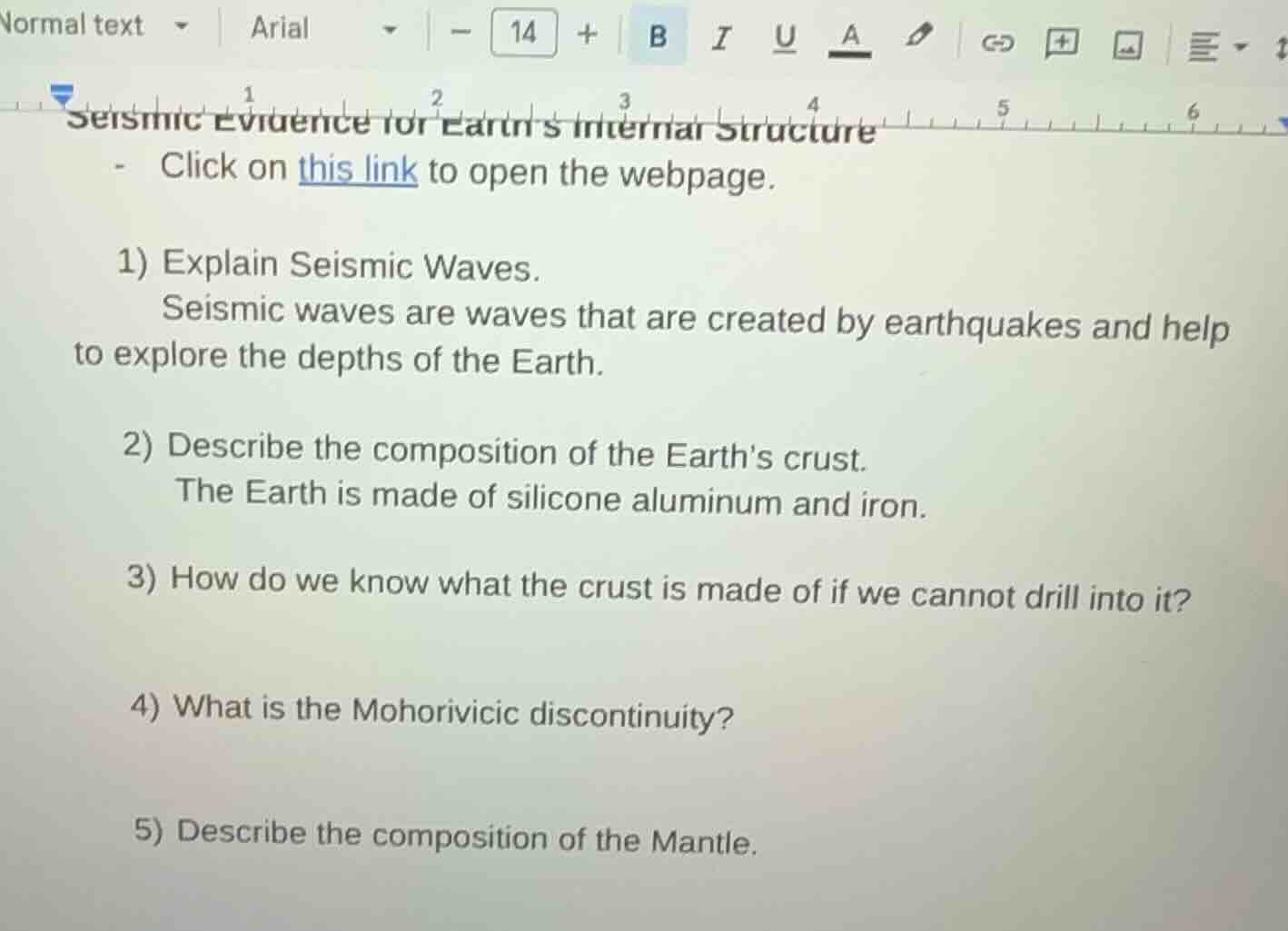
seismic evidence for earths internal structure- click on this link to open the webpage.1) explain seismic waves.seismic waves are waves that are created by earthquakes and help to explore the depths of the earth.2) describe the composition of the earths crust.the earth is made of silicone aluminum and iron.3) how do we know what the crust is made of if we cannot drill into it?4) what is the mohorivicic discontinuity?5) describe the composition of the mantle.
Brief Explanations
- Seismic waves are elastic energy waves generated by geological events like earthquakes, volcanic eruptions, or man-made blasts. They propagate through Earth's layers, and their behavior reveals details about Earth's internal structure.
- Earth's crust has two types: continental crust (thicker, ~30-50 km, mostly felsic rocks like granite, rich in silicon, aluminum, oxygen, and potassium) and oceanic crust (thinner, ~5-10 km, mafic rocks like basalt, rich in silicon, oxygen, iron, and magnesium).
- Scientists analyze seismic waves: their speed and refraction change when passing through materials of different densities/compositions. They also study exposed crustal rocks from mountain formations, drill samples from shallow crust, and analyze meteorites (proxy for early Earth composition).
- The Mohorovičić discontinuity (Moho) is a sharp boundary between Earth's crust and mantle, where seismic wave speeds increase abruptly due to a change in rock composition and density.
- The mantle is mostly solid, ultramafic rock. The upper mantle includes rocks like peridotite, rich in silicon, oxygen, iron, and magnesium. The lower mantle has more dense, iron-rich silicate minerals under high pressure.

Snap & solve any problem in the app
Get step-by-step solutions on Sovi AI
Photo-based solutions with guided steps
Explore more problems and detailed explanations
- Seismic waves are elastic energy waves produced by earthquakes, volcanic activity, or human-made disturbances. They travel through Earth's layers, and their properties are used to map and understand Earth's internal structure.
- Earth's crust has two segments:
- Continental crust: Thick (30-50 km), composed of felsic rocks (e.g., granite) rich in silicon, aluminum, oxygen, and potassium.
- Oceanic crust: Thin (5-10 km), composed of mafic rocks (e.g., basalt) rich in silicon, oxygen, iron, and magnesium.
- Scientists use three key methods:
- Analyzing seismic wave refraction/speed changes through different crustal materials.
- Studying exposed crustal rocks from uplifted mountain regions.
- Examining shallow drill samples and using meteorites as a proxy for early Earth's crust composition.
- The Mohorovičić discontinuity (Moho) is a distinct boundary between Earth's crust and mantle, marked by a sudden increase in seismic wave velocity due to differences in rock density and composition.
- The mantle is a mostly solid layer made of ultramafic silicate rocks. The upper mantle is dominated by peridotite (rich in silicon, oxygen, iron, and magnesium), while the lower mantle consists of denser, iron-rich silicate minerals formed under extreme pressure.