QUESTION IMAGE
Question
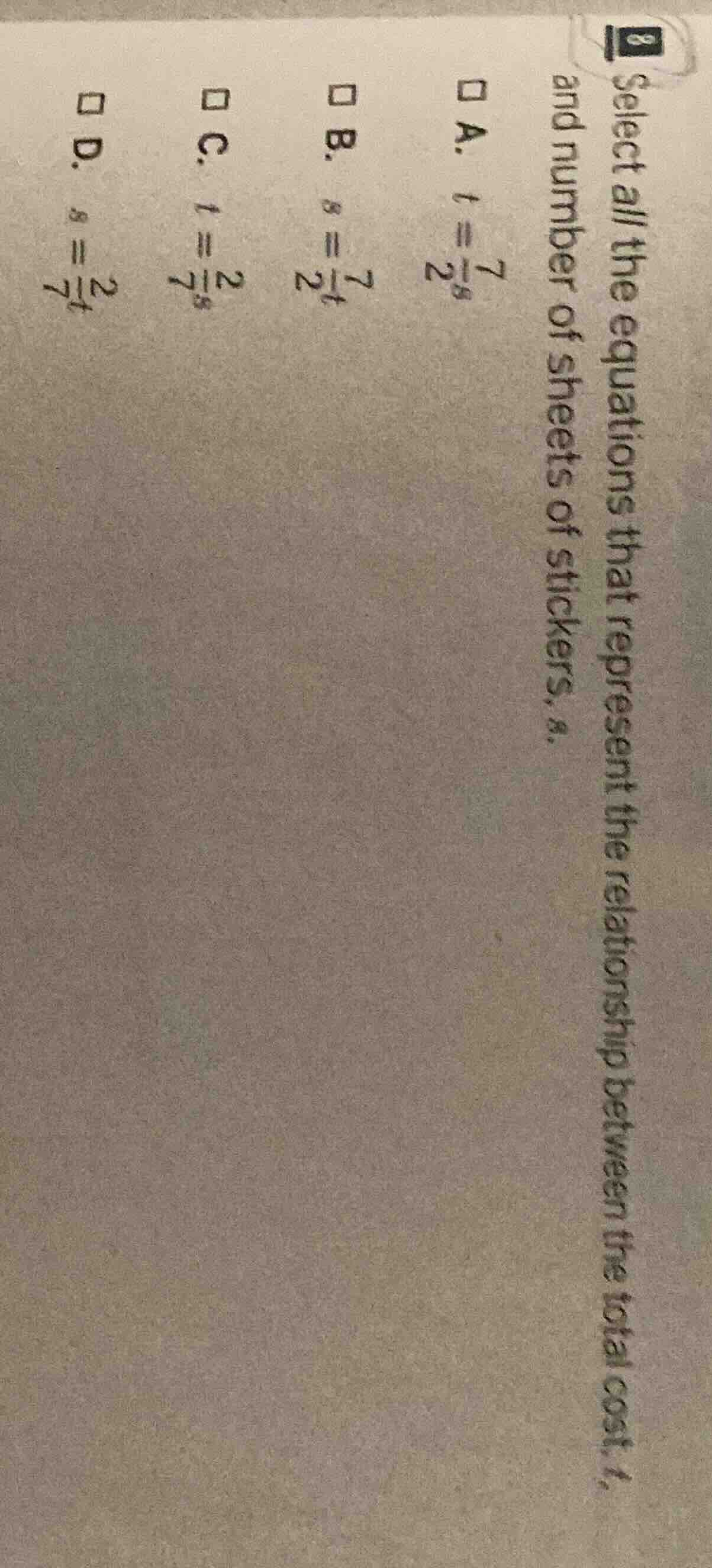
select all the equations that represent the relationship between the total cost, t, and number of sheets of stickers, s.
a. ( t = \frac{7}{2}s )
b. ( s = \frac{7}{2}t )
c. ( t = \frac{2}{7}s )
d. ( s = \frac{2}{7}t )
Assume the relationship is a proportional one, say the cost per sheet of stickers is a constant. Let's assume that the cost per sheet \( s \) is such that \( t = k\times s \), where \( k \) is the cost per sheet. Let's check each option:
Step 1: Analyze Option A (\( t=\frac{7}{2}s \))
If we consider the cost per sheet as \( \frac{7}{2} \), then total cost \( t \) is the number of sheets \( s \) times cost per sheet. So this is a valid proportional relationship.
Step 2: Analyze Option B (\( s = \frac{7}{2}t \))
Rearranging, \( t=\frac{2}{7}s \), which would mean cost per sheet is \( \frac{2}{7} \), but this is a different relationship than A. But let's check the logic. If \( s=\frac{7}{2}t \), then \( t=\frac{2}{7}s \), which is not the same as A. Wait, maybe I made a mistake. Wait, maybe the problem is about total cost \( t \) and number of sheets \( s \), so if each sheet costs \( \frac{7}{2} \), then \( t=\frac{7}{2}s \) (A is correct). If we solve \( t=\frac{7}{2}s \) for \( s \), we get \( s=\frac{2}{7}t \), but option B is \( s = \frac{7}{2}t \), which is different. Wait, maybe the original problem has a different context. Wait, maybe the cost per sheet is \( \frac{2}{7} \)? No, let's re - evaluate.
Wait, maybe the correct relationship is \( t = k\times s \), so if we have \( t=\frac{7}{2}s \) (A), then solving for \( s \) gives \( s=\frac{2}{7}t \), but option C is \( t=\frac{2}{7}s \), which would be a different cost per sheet. Wait, maybe the problem is that we need to find which equations represent the relationship between \( t \) (total cost) and \( s \) (number of sheets). Let's assume that the cost per sheet is a constant. Let's check each equation:
- For option A: \( t=\frac{7}{2}s \): Total cost is number of sheets times cost per sheet (\( \frac{7}{2} \) per sheet). Valid.
- For option C: \( t=\frac{2}{7}s \): Total cost is number of sheets times cost per sheet (\( \frac{2}{7} \) per sheet). But if we solve \( t=\frac{7}{2}s \) for \( s \), we get \( s = \frac{2}{7}t \), which is not option B or D. Wait, option D is \( s=\frac{2}{7}t \), which is the rearrangement of \( t=\frac{7}{2}s \) (since \( t=\frac{7}{2}s\Rightarrow s=\frac{2}{7}t \)). Oh! I made a mistake earlier. Let's re - do:
From \( t=\frac{7}{2}s \), divide both sides by \( \frac{7}{2} \), we get \( s=\frac{2}{7}t \), which is option D. Wait, so:
- Option A: \( t=\frac{7}{2}s \) (total cost = cost per sheet \( \times \) number of sheets, cost per sheet \( \frac{7}{2} \))
- Option D: \( s=\frac{2}{7}t \) (number of sheets = total cost \( \div \) cost per sheet, cost per sheet \( \frac{7}{2} \), since \( s=\frac{t}{\frac{7}{2}}=\frac{2}{7}t \))
Wait, let's check the equations again:
- Option A: \( t=\frac{7}{2}s \)
- Option D: \( s=\frac{2}{7}t \)
These two are equivalent because if we start with \( t=\frac{7}{2}s \), multiply both sides by \( \frac{2}{7} \), we get \( \frac{2}{7}t = s \), which is \( s=\frac{2}{7}t \) (Option D).
Now check Option B: \( s=\frac{7}{2}t \) would imply \( t=\frac{2}{7}s \), which is a different cost per sheet ( \( \frac{2}{7} \) per sheet), and Option C: \( t=\frac{2}{7}s \) is also a different cost per sheet.
So the correct equations are A and D? Wait, no, wait the problem says "select all the equations that represent the relationship between the total cost, \( t \), and number of sheets of stickers, \( s \)".
Wait, maybe the cost per sheet is \( \frac{7}{2} \), so \( t=\frac{7}{2}s \) (A is correct). And if we solve for \( s \), \( s=\frac{2}{7}t \) (D is correct). Let's verify:
If \( t=\frac{7}{2}s \), then…

Snap & solve any problem in the app
Get step-by-step solutions on Sovi AI
Photo-based solutions with guided steps
Explore more problems and detailed explanations
A. \( t=\frac{7}{2}s \), D. \( s=\frac{2}{7}t \)