QUESTION IMAGE
Question
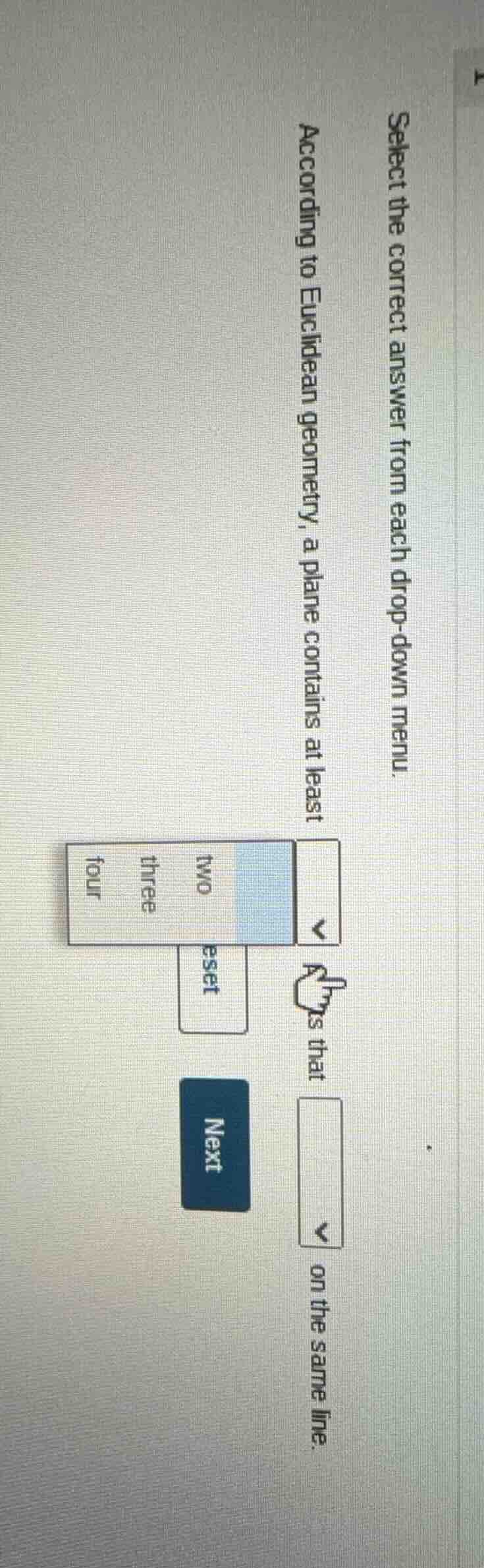
select the correct answer from each drop - down menu. according to euclidean geometry, a plane contains at least drop - down menu with options two, three, four points that drop - down part not fully visible on the same line.
Step1: Recall Euclidean geometry plane axiom
In Euclidean geometry, a fundamental axiom about planes states that a plane contains at least three non - collinear points, but when considering the number of points (without the non - collinear condition for the minimum count in terms of existence), the axiom also tells us that a plane contains at least three points (and these three points are not all on the same line, but the minimum number of points to define a plane is three). Wait, no, correction: The axiom is that a plane contains at least three non - collinear points. But looking at the drop - down options (two, three, four), the correct answer based on Euclidean geometry axioms is three. Wait, no, another way: The axiom "A plane contains at least three non - collinear points" but if we consider the question's context, maybe the question is about the minimum number of points (regardless of collinearity? No, collinearity matters). Wait, no, let's re - check. The standard Euclidean geometry axiom: "Through any three non - collinear points, there is exactly one plane" and also "A plane contains at least three non - collinear points". But if the drop - down has two, three, four, the correct answer is three. Wait, maybe I made a mistake. Wait, no, the first part of the question: "According to Euclidean geometry, a plane contains at least" and the options are two, three, four. The correct axiom is that a plane contains at least three non - collinear points. So the answer is three.
Step2: Confirm with axioms
The Euclidean geometry axiom regarding the number of points in a plane: A plane contains at least three non - collinear points. So among the options two, three, four, the correct one is three.

Snap & solve any problem in the app
Get step-by-step solutions on Sovi AI
Photo-based solutions with guided steps
Explore more problems and detailed explanations
three